What a Pump n Dump actually is
Different game than supplement-brand ripping (covered in the next sub-page). Different goal. Different time horizon. Different risk profile.
A pump and dump is a product you launch for cash flow, not LTV. You ship it, it scales fast (5 ROAS, 7 ROAS on launch day), you ride it hard for 4-8 weeks, and then it dies. You knew it was going to die going in. That was the whole plan.
The death usually comes from one or more of:
- DMCA / copyright takedown — especially on books and trending viral products
- Ad account ban — Meta catches up to the policy violation or trademark issue
- The trend dies organically — viral product saturates, attention moves on
- Quality complaints flood your support inbox at higher volume than you can handle and you decide to cut your losses
The play: launch → pump → cash out before the dump → move to the next one OR use the cash to fund a real brand build.
Who this is for: operators who need cash flow now. First 5 figures. Funding the next thing. High risk tolerance. Willing to deal with ad account whack-a-mole.
Who this isn't for: anyone trying to build a real brand. PnD is the opposite play from supplement-brand ripping — the foundations don't transfer, the LTV doesn't exist, the MRR never compounds.
Both are valid. Just don't confuse the two.
The honest pros and cons
Pros:
- Cash fast — $20-30k in a month and a half is realistic on a single product
- Lower upfront investment than a real brand (small ad budget, no inventory commitment beyond MOQ)
- High variance reward — can hit a 5-10x ROAS product on a single test
- Lets you fund a real brand without external capital
Cons:
- DMCAs are a near-certainty on books and trademarked content
- Ad accounts will get banned — plan for this (cross-reference Module 4 → Different Ad Account Strategies)
- Zero LTV — these are one-and-done products, no email flows that pay back, no customer reactivation
- The mental loop trap — product testing, product testing, product testing forever, nothing compounds
- You will deal with quality complaints from customers, and you have to be okay with that
- Threatening emails from agencies / brands you ripped
The Brandon-rule on the loop trap: "The guy who decides to lock in on one brand for one year and stack LTV and MRR with a good product will lap you when he ends up doing seven-eight figures a month and his MRR stacks up to half a million, which is 70% gross margin."
PnD is the means. The end is the brand. Use it. Don't live in it.
The categories that work
Three primary categories for PnD. Each has its own dynamic.
1. Books, magazines, audio — the #1 PnD category
2. Phones and electronics — gadgets, gimmicks, content-creator widgets
3. Collectibles — trending physical objects with viral hook potential
You can go outside these. Be creative. But these are where the highest-frequency wins are.
Why books are the #1 PnD product
Books rip stupid hard. Here's why:
- Perceived value is high. A $4 paperback (your cost) sells for $35-45 with the right positioning, no problem.
- Easy to source. Most agents can produce a similar book on similar paper. MOQ usually 1,000-2,000 units.
- Niche pain points scale aggressively. Survival books, nursing study guides, religious texts, parenting manuals, conspiracy-adjacent content — narrow audiences with high emotional engagement.
- Visual content rips easy. A creator holding a book, flipping through pages, reading a passage — that's the format. You don't need to recreate a complex video.
What to avoid in books:
- Top-tier known authors. Robert Greene, James Clear, Mark Manson — DMCA in 24-48 hours.
- Disney / major IP. Instant takedown.
- High protein cookbooks / generic mainstream nonfiction. Saturated, not enough hook.
- Anything where the actual content matters to the buyer in a way you can't replicate (you're shipping a similar physical book — if buyers expect specific content and don't get it, refunds flood in).
What works in books:
- Survival / off-grid manuals. Banger but will get banned fast.
- Religious texts with unusual angles. Niche Bible editions, alternative translations, conspiracy-adjacent religious content.
- Niche parenting / education. "Raise children street smart," "how to survive when there's no doctor," specialty kids books.
- Professional study guides. "Quick facts for nursing school," exam prep niche.
- Pseudoscience / alternative theory. Ancient civilizations, mainstream history alternatives, conspiracy content.
The ebook upsell hack — 100% margin:
Every physical book PnD should have an ebook offer attached.
Workflow:
- Send your supplier a request: scan the book and send you a PDF
- Or: send the physical copy to a VA, have them OCR / clean it into PDF format
- Add an offer tier on the product page: "$X for the physical book + ebook bundle, $Y for the ebook only"
- Ebook-only orders = 100% gross margin (no shipping, no inventory cost, no fulfillment time)
This boosts AOV and creates a margin floor that keeps the campaign profitable even when paid traffic costs spike.
Quality note on books with MOQ: specify A1 paper minimum when you order. Lower-grade paper will trigger complaint volume on the quality of the physical product, and you don't have time to deal with that at PnD scale.
Kalodata filters for PnD
Different filter set than the supplement-brand workflow. Same tool, different lens.
| Filter | Value | Why |
|---|---|---|
| Category | Books / Phones & Electronics / Collectibles (depending on category you're hunting) | Stay in the PnD-friendly categories |
| Time period | Last 30 days | Short window — you want what's trending NOW, not 90 days ago |
| Minimum revenue | $30,000 | Below this, not enough validation; above this, you have proof |
| Revenue source | Video / Affiliate | TikTok organic, not live |
| Creator number | 100+ for general PnD, 3-4 minimum for books | Books only need 3-4 rippable creatives to rip — you don't need 100 |
The book filter adjustment is critical. A book with just 3-4 viral creative angles can carry a 6-figure month. You don't need depth of creative library on books the way you do on supplements. Lower the creator floor accordingly and you'll surface books that aren't yet over-ripped.
What "viral" looks like (the metrics)
For PnD, you're not looking for "good" video metrics. You're looking for unbelievable video metrics. The bar is different.
What you want to see in the top creatives for a PnD product:
- 700k-1.5M+ views on individual videos
- 15k+ shares (shares = engagement quality, not just attention)
- High view-to-engagement ratios even if conversion rate is mid
- Weird, gimmicky, pattern-interrupt moments in the videos — not polished UGC, but content that hooks viewers because it's strange
The PnD videos don't convert at high rates. They convert at enough of a rate that, when paired with viral reach, the math works.
Example pattern: a smart-glasses video gets 1.5M views and 30 sales. That's a 0.002% conversion rate from views — terrible by normal standards. But 30 sales at $50 AOV = $1,500 from one organic video, and the same creative scaled on Meta with the right targeting prints. Volume of attention compensates for conversion mediocrity.
BrandSearch for viral PnD hunting
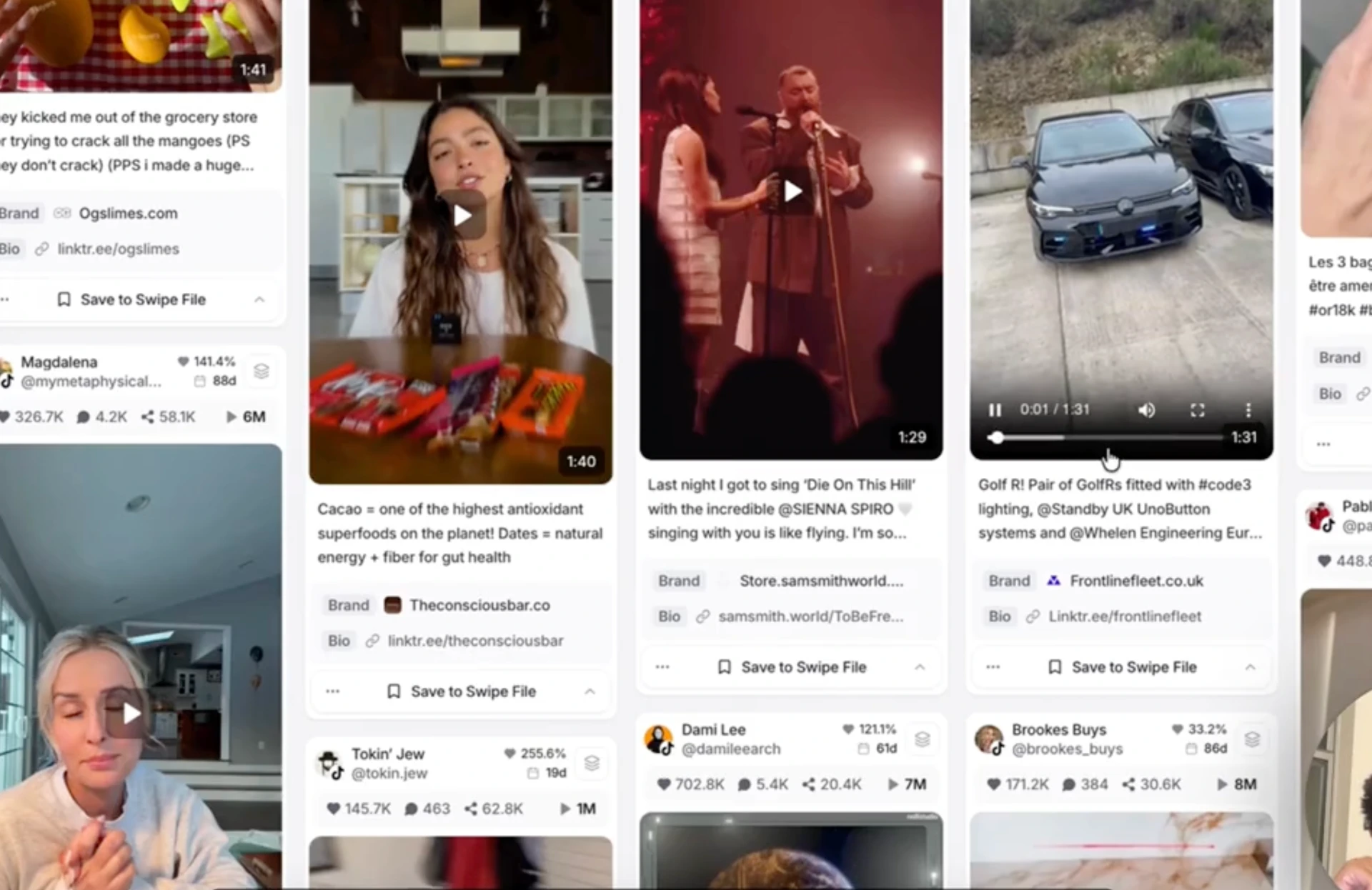
Kalodata is one entry point. BrandSearch is the better entry point for non-TikTok viral product hunting — especially for content-creator widgets and gadgets that go viral on Instagram/Reels.
Filter setup I use:
- Views: 10M+ minimum
- Shares: 15k+ minimum (the engagement signal)
- Use the BrandSearch presets: "Viral TikToks," "Spark Ad Winners," "Viral Jewelry"
- Play around with other presets — there's a lot of leverage in the preset library
What you find: small brands doing $1k-2k/day organic that just started running Meta ads. You catch them in the window where the product is validated but not yet saturated. That's the entry point.
Get 20% off BrandSearch with code DIALED — affiliate link, full disclosure, I use it every day.
The burner account doom-scroll method
Underrated PnD research source. Set up a burner TikTok and Instagram account, follow nothing, just scroll.
The algorithm will start surfacing trending products to you within 30 minutes of scrolling. You'll find PnD candidates that aren't on Kalodata yet because:
- Kalodata has data lag (always)
- BrandSearch has data lag (slightly less)
- The TikTok / Instagram FYP is real-time
The pattern to look for in doom-scroll mode:
- Same product appearing 3-4 times in a single scroll session = trending fast
- Multiple creators making different angles for the same product = creator network is forming around it
- Unusual / pattern-interrupt visual that makes you stop = the hook is doing its job
- Comments are full of "where do I get this" = product-search intent without a clear winner brand
When you find a candidate via doom-scrolling, cross-reference on Kalodata + BrandSearch to validate the revenue. If the data says the product is making real money, source it immediately.
Brandon-rule: doom-scrolling in burner mode IS work for the PnD operator. Time-box it (20-30 min sessions, 2-3 times per day) so it doesn't become procrastination.
Source verification BEFORE launch (the margin trap)
This is where most PnD operators get cooked. The product trends, they get excited, they launch ads at $35 AOV — and then the supplier comes back with a $20 unit cost + shipping. Margin is dead.
For PnD specifically (more than for supplements), source before you launch:
- Take a screenshot of the product on Kalodata / BrandSearch / TikTok
- WhatsApp it to your agent (gatekept supplier list in masterclass)
- Ask for unit cost, MOQ requirements, estimated shipping cost
- Wait for the quote
- Then decide if the math works at your target AOV
If the supplier quotes $20 and you can't sell at $40+ without crushing CTR, the product is a no-go regardless of how viral it is. Don't launch.
This is more important for books and gadgets than for supplements because:
- Books vary wildly in production cost based on page count, paper grade, binding, MOQ size
- Gadgets vary wildly based on materials and complexity
- Shipping cost on heavy items (backpacks, hardware) eats margin you didn't budget for
A $39 PnD with a $20 COGS + $8 shipping + $15 CPA = $-4 contribution margin. You will lose money on every order. Source first, math first, then launch.
Aggressive testing discipline — cut fast, scale fast
PnD requires a more aggressive testing rhythm than brand-building.
The discipline:
- Launch with a small budget ($50-100/day per ad set) to validate the product can convert on Meta
- 24-48 hour cut window — if it's not showing 2+ ROAS within 48 hours, kill it and move to the next product
- Scale fast on winners — if you see 5+ ROAS holding for 3-4 days, ramp aggressively (cross-reference Module 4 → Different Ad Account Strategies for which strategy to use during PnD scaling)
- Don't iterate creatives much — PnD is "the creative works or it doesn't." Spend your effort on volume of product tests, not creative iteration on a losing product
The math on this is brutal but clean. For every 10 PnD products you test, 1-2 will pump. The other 8-9 are sunk cost. The 1-2 winners need to make enough to fund the next 10 tests + take profit.
Operators who treat PnD like brand-building (long testing windows, multiple creative iterations on the same product) get stuck. The discipline is volume.
Worked example — what a banger PnD looks like
To make this concrete, two product types I've seen rip recently.
Smart glasses (gadget category)
The setup: cheap smart glasses, ~$50 list price, positioned as a "$50 alternative to $500 Meta Ray-Bans."
The viral video format: someone wearing them, secretly recording, "I'm recording you and you didn't even know it" — pattern interrupt, curiosity gap, slight transgression hook.
The metrics on the top creator videos:
- 700k+ views per video
- 900k, 1.4M, 1.5M views on the bangers
- Engagement: shares pushing 20k+ on the best ones
- Conversion: not amazing, but the volume makes up for it
The PnD play: source from your gadget supplier ($15-20 unit cost likely), launch at $50-60 AOV, ride the viral wave for 4-6 weeks until either the trend dies, Meta gets stricter on the "spy camera" angle, or DMCAs come in. Cash out, move to the next.
Niche-religious / alternative-history book
The setup: an alternative-text Bible (e.g., "The Complete Ethiopian Bible in English") positioned as the "real" version of scripture that mainstream Bibles are missing.
The viral video format: creator opens the book on camera, points to a specific passage, contrasts it with the King James version, hints at "what they don't want you to know."
The metrics:
- Multiple creators making the same comparison-format video
- Strong shares (this content gets sent in religious group chats)
- Comments full of "where do I get this"
The PnD play: source from a book printer (MOQ likely 1,000-2,000 units at A1 paper), launch at $40-60 with an ebook upsell at $20, ride the religious-curiosity wave. Add the ebook for 100% margin floor. This book did over $350k in 90 days at peak before getting DMCA'd.
Pattern across both: strong viral hook, narrow emotional/identity-driven niche, multiple creators producing similar content (so you have material to rip), supplier-verifiable margin at target AOV.
The PnD-to-Brand transition (Brandon-rule)
The trap is staying in PnD mode forever. The win is using it as the funding mechanism for the real play.
My recommended path:
- Test PnD products with $500-2k of initial capital
- Hit one winner, scale it to $20-30k revenue over 6-8 weeks
- Bank the profit (typically $5-10k clear after ad spend, COGS, fees)
- Take that capital and fund a real brand build — supplement-brand ripping (next sub-page), custom brand (Module 7), or other long-term play
- The PnD becomes the bridge, not the destination