The sub-market most operators don't see
This sub-page is sauce I've been gatekeeping inside the 1-on-1 for a minute. The guys I've worked with got their money off it. I got mine off it. Time to release it.
There is a 40-50 million person sub-market of Spanish speakers inside the US that almost nobody is running supplement ads to.
Think about that for a second. A market the size of a major country, inside the US market. Existing on the same Meta platform you're already running on. Buying the same products. With almost zero advertiser competition.
The CPC differential is brutal:
| Targeting | Average CPC |
|---|---|
| US English | $2+ (rising every quarter) |
| US Spanish-language inclusion | $0.40-$0.70 |
That's a 3-5x cost-per-click reduction for an audience that buys the same supplements. The math at scale is silly.
This is one of the cheapest, lowest-competition ways to ride a validated product to 4-5 figure days while you build something more permanent. It's not the long-term play. It's the fastest cash flow play that doesn't require finding new winners.
My results with this method
Real numbers from when I ran this at peak:
- Scaled to $20k/day in spend at the peak
- Did $15-18k revenue days consistently for a stretch
- One day we were doing $12k in revenue by 8am before card processing issues hit (more on that below)
- A handful of students inside the 1-on-1 ran the same playbook and pulled 5-6 figure months with real MRR off it
The risk you take: at scale, payment processors get nervous about the velocity. Card processing issues, payout holds, descaling — same operational risks I cover in Module 2 → Customer Support SOP. Have your ops, your chargeback prevention, and your processor setup tight before you push past $5k/day.
Why this works (the economic reality)
Three forces stack:
- The Spanish-speaking US market is huge. 45-60M people you can market to. Bigger than most countries.
- Almost no advertiser competition targeting them specifically. Most DTC operators run Meta ads with broad English targeting and let Spanish-speaking users self-select. They don't run Spanish-specific creatives in Spanish-specific funnels.
- The products are already validated. You're not creating demand. You're routing an existing successful English product to an audience that's already buying the same product (or wants to but doesn't have it presented in their language).
Result: cheap clicks, validated demand, no creative competition in the auction. The auction itself has fewer bidders, so CPC drops.
The core method — step by step
Different application of Kalodata than supplement-brand ripping (covered later in this module). Same tool. New lens.
Step 1 — Find a strong English-market supplement product
Run your normal Kalodata filters for supplements:
- Category: Health
- Last 30-90 days
- Minimum revenue: $30k+
- Affiliate source
- 100+ creators
This time you're not looking for "the next product to rip." You're looking for products that are already winning in English with a meaningful creator library.
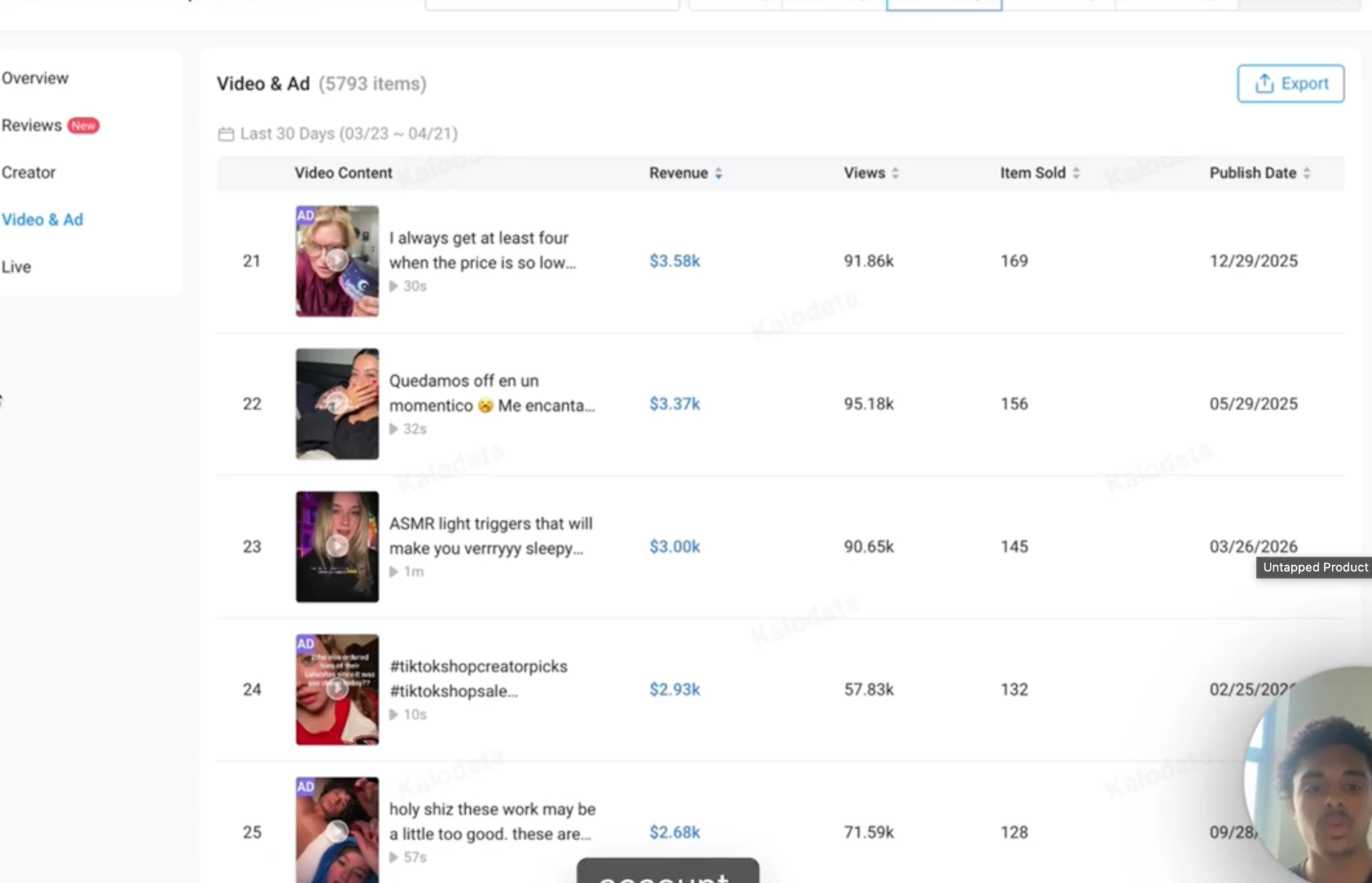
Step 2 — Identify the Spanish creators in the existing creative library
Click into the product on Kalodata. Open the "Video Creatives" section. Scroll through the top videos.
You're looking for creatives that are in Spanish. Sometimes they're on page 1. Sometimes you have to scroll to page 2 or page 3. Sometimes the very first few are English and starting around the 7th or 8th video you'll start seeing Spanish creators talking about the same product.
This is the signal: Spanish creators are already making content for this English product. That tells you:
- The product has Spanish-market demand built into it
- Spanish creators have already done the awareness-building / creative work for you
- You have ripped Spanish-language creatives ready to launch with
If a product has no Spanish creators making content for it, skip it for this method. You'd be building the Spanish funnel from scratch, which is more work than this method is supposed to be.
Step 3 — Rip the Spanish creatives
Same approach as English ripping (cross-reference Module 3 → Videos and the Supplement Brand sub-page). Download the Spanish creator videos. These are your starting ads.
The brilliance is you don't need to translate anything yourself. The translation work has already been done by the Spanish creators. You're just routing their existing content to a targeted Spanish audience that hasn't seen it yet at scale.
Step 4 — Build a Spanish-language landing page (next section)
Step 5 — Run the ad set with Spanish-language inclusion only (next section)
That's the whole method. Find product → find Spanish creators in the product's existing library → rip their videos → ship to a Spanish funnel.
The image translation strategy (the subtle critical detail)
When you build the funnel, you'll need to translate the landing page assets to Spanish. The detail most operators miss: hero images Spanish, product label English.
Why:
- Hero images Spanish — these are the marketing graphics (benefit callouts, headline imagery, lifestyle shots with text overlays). They need to be Spanish so the avatar reads them in their first language and engages.
- Product label English — the actual product they receive in the mail has English packaging (because you're ripping a US-market English-supply-chain product). If the customer expects Spanish-labeled product based on your funnel and receives English packaging, you get chargebacks and "I got the wrong product" complaints.
The mismatch between Spanish marketing and English physical product is the trap. Translate the marketing, leave the product as-is.
Image translation workflow
- Single image: screenshot the hero image, drop into Google Studio (Nano Banana 2 model), prompt the translation, output Spanish version
- Batch translation: translate the hero image set in a session, swap them into the Shopify funnel
Shopify setup for Spanish
Step by step. About 10 minutes of setup work.
1. Add Spanish as a language
- Shopify Admin → Settings → Languages
- Click "Add language"
- Select Spanish (NOT "Sudanese Spanish" or other variants — just standard Spanish)
- Confirm
2. Auto-translate via Shopify Translate and Adapt
- Open the Shopify Translate & Adapt app (built into Shopify)
- Click "Auto Translate"
- Wait for the email confirmation that translation is complete
3. Publish the Spanish version
- Once translation finishes, go back into Translate & Adapt
- Click "Publish" on the Spanish language
- Assign to your domain (or to a sub-domain like es.yoursite.com if you want to keep English version separate)
- If you're running 100% Spanish on this store, make Spanish the main language
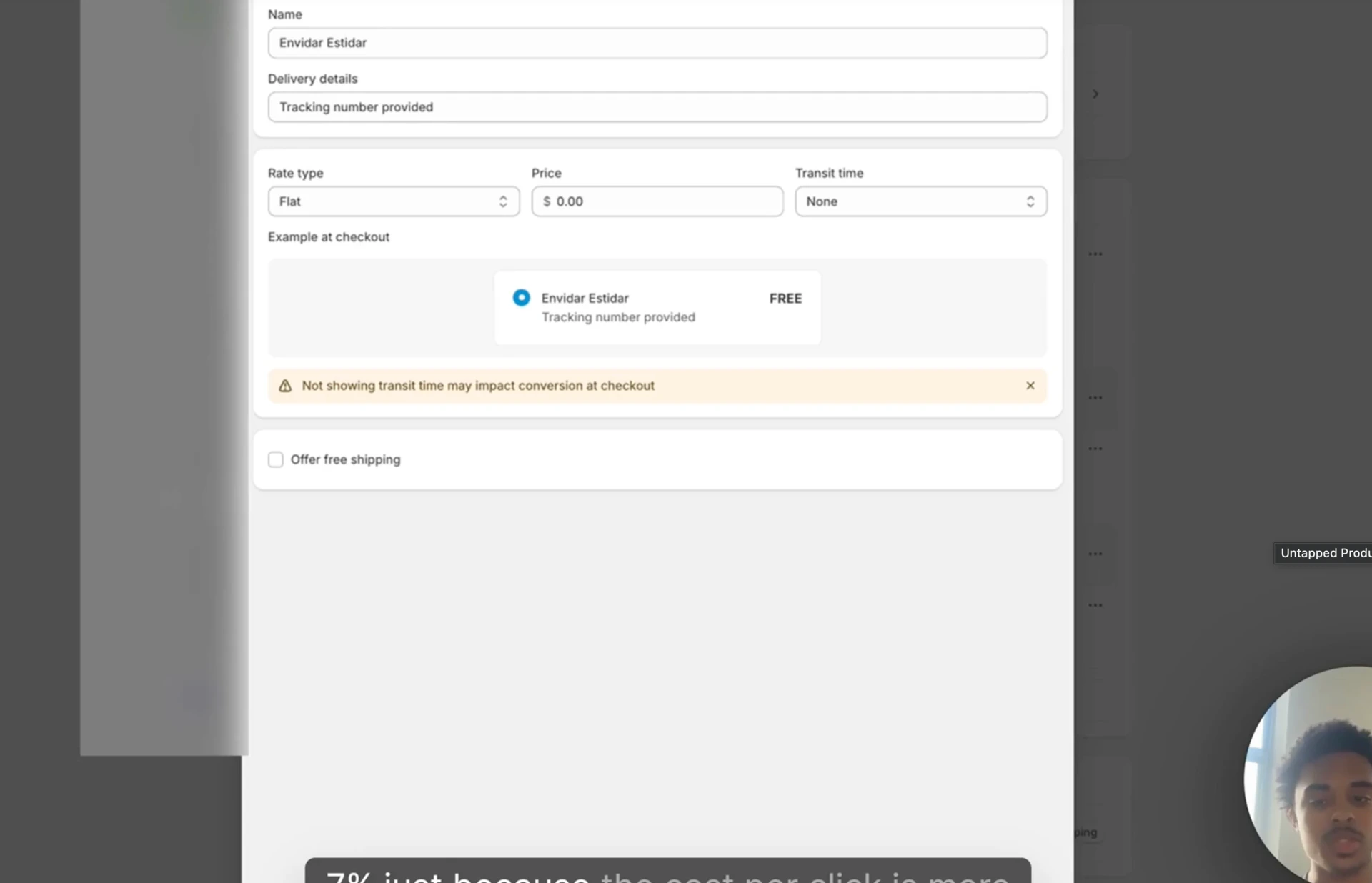
4. Fix shipping language
- Shopify Admin → Settings → Shipping and Delivery → General Profile
- Change "Standard Shipping" to the Spanish equivalent (Envío Estándar or similar — verify with Google Translate or a native speaker before going live)
- This sounds minor but it's a trust signal at checkout — auto-translation sometimes leaves shipping labels in English which creates a credibility break
5. (Recommended) Free shipping at launch
- A meaningful percentage of Spanish-language buyers will drop off at checkout
- Free shipping reduces the friction enough to keep cost-per-purchase manageable
- You can test paid shipping later once the funnel is validated, but launch with free
The ad account setup (one change)
This is the easiest part. Set up your ad campaign exactly as you would for any other supplement product. One change at the ad set level:
- Audience section → click "Show more controls"
- Find "Languages"
- Select Spanish (all variants)
That's it. Done. Run the ad with the ripped Spanish creatives, the Spanish-translated landing page, and the language-inclusion targeting.
You technically don't need this language filter — Meta's algorithm will eventually find Spanish speakers because your creative is Spanish. But the filter speeds up optimization significantly and gets your CPA down 2-3 days faster. Worth the 30 seconds it takes to set.
What "normal" looks like (expected metrics)
Spanish-market metrics differ from US-English. Don't panic when you see these:
| Metric | US English | US Spanish |
|---|---|---|
| CPC | $1.50-$3.00+ | $0.40-$0.70 |
| CTR | 1-2% | 1.5-3% (higher due to less ad competition) |
| Add to Cart cost | $4-$8 | $1-$3 |
| Initiate Checkout cost | $8-$15 | $3-$6 |
| Cost per Purchase | $25-$50 | $15-$25 (but with ~4x spike vs checkout cost) |
| Conversion rate | 3-5% | 1-3% |
The 4x spike from checkout-cost to purchase-cost is normal. Don't read it as a broken funnel. Spanish-market buyers add to cart, initiate checkout, and then drop off at a higher rate than English. The cheap front-end CPC makes the math still work.
If you see this pattern, your funnel is healthy. Hold scale and keep optimizing creative.
If you see a 10x+ spike from checkout to purchase, something's actually broken (payment processor declining, shipping cost surprise, translation error in checkout flow). Audit the funnel.
The expansion play — beyond Spanish
This same method applies to every non-English sub-market.
On Meta:
| Sub-market | Approach |
|---|---|
| Spanish (US) | Find Spanish creators on US Kalodata, run Spanish-language inclusion in US targeting |
| UK English | UK Kalodata, target UK only, slightly different ad copy register |
| Germany | UK or EU Kalodata, run German-language inclusion in DE/AT/CH |
| France | EU Kalodata, French-language inclusion in FR/BE/CA |
| Italy | EU Kalodata, Italian-language inclusion in IT |
| Spain (Castilian) | Spain Kalodata directly — native Spanish products, run in Spain only |
Each one is a sub-market with the same arbitrage: lower CPC, less competition, validated products. You can stack multiple sub-markets on the same product to multiply revenue.
I've personally only scaled the US Spanish play hard. The UK + EU plays exist; I haven't run them at the scale where I can speak to nuances. The framework is the same. The execution details vary by country (payment processors, fulfillment partners, tax requirements). Verify before you launch.
TAM ceiling reality (Brandon-rule on when to transition)
This is the most important honest take on this method.
The Spanish-market TAM is meaningful but capped. 45-60M Spanish speakers vs ~300M English-market on Meta. You'll hit a saturation point.
What that looks like in practice:
- First 30-60 days: scaling clean, low CPC, easy to hit $4-5k days on a single product
- 60-90 days: CPC starts creeping up as the algorithm exhausts the easy-to-convert pool
- 90-120 days: scale plateaus or starts dropping — you've tapped the addressable market for that specific product within Spanish
Two ways to extend:
- Constantly launch more Spanish products in the same niche on the same store. This is what I did to keep volume up. New products, new Spanish creatives, same Spanish landing page architecture, same Spanish-language inclusion targeting. The store becomes a Spanish-language portfolio brand.
- Translate the winning angles back into English and scale into the bigger English market. The Spanish ads taught you which angles work — apply those to English creatives and run in the 300M-person US English market. This is the bridge from cash-flow play to brand-build play.
The trap is trying to scale a single Spanish product past its TAM. Either launch more products or graduate to English. Don't sit on a single Spanish product trying to squeeze the last 20% of TAM out of it.
Why this method is so good for cash flow
The reason this works as a cash flow play specifically:
- You're not testing — you're routing. The product is already validated in English. You're just sending it to a new sub-market.
- Low upfront capital. Small ad budget gets you to data fast because CPC is low.
- No new creative production needed. Spanish creators already made the content. You're ripping their existing winners.
- Lower-stakes scaling. $5-10k/day at $0.50 CPC means your ad budget can be modest while revenue is real.
This is the cleanest path I know from "no winning product" to "$5-figure month profit" with minimal capital. Use it. Don't live in it.
What's gatekept inside the masterclass
The principles are here. The full video + step-by-step walkthrough lives in the masterclass:
- The full 12-minute video walkthrough of this method — me on Kalodata identifying the Spanish creators inside an English product, ripping the creatives, walking through the full ad account setup live
- The Shopify Spanish setup walked through on screen — language assignment, Translate & Adapt flow, domain assignment, the shipping translation values, common gotchas
- The ad account configuration shown in full — exactly where to click on the audience controls, what to leave default, the placement strategy that worked at scale
Want the full video walkthrough, the live Shopify Spanish setup, and the ad account configuration? All inside the RunItUp Masterclass → Join here
Join now to lock in your rate, prices are increasing quickly.