What a Catalyst ad actually is
I gave them the name "Catalyst." There's no industry-standard term for them. I called them Catalysts because a catalyst is a shift in the normal — something that disrupts what you already believe and forces you to look closer.
The format you've already seen a thousand times scrolling Facebook or Instagram: the breaking-news-style image ad with a strong headline, a sub-headline, and a CTA. No product in the image. No "buy this." Just a piece of news, a discovery, a shock that demands more information.
That's a Catalyst.
This sub-page is the full strategic breakdown — the structural rules, the perspective iteration multiplier, the design variation discipline, the relationship between Catalysts and advertorials, and the Native → Catalyst migration path that built my brand.
Cross-reference Module 3 → Catalyst sub-page for the Claude automation / production layer (the JSON image prompts, the headline generation prompts, the visual style guides). This sub-page is the strategy and craft. Module 3 was "how to make them at scale with AI." Module 7 is "how to make them land."
The 3 required elements (and the 1 forbidden element)
Every Catalyst must have:
- Headline — the hook, the shock, the curiosity gap, the news-style claim
- Sub-headline — the deepening, the implication, the proof element
- CTA — "Read More," "Click for Details," "Find Out Why" — a clear next-action
What every Catalyst must NOT have:
❌ Product callout in the image. No bottles, no packaging, no "Buy XYZ Now." The moment you sell the product in the Catalyst image, you've broken the format. The Catalyst is news, not advertising. People click news. They scroll past advertising.
If your Catalyst includes a product image with pricing in the corner, you've made a regular product ad. Not a Catalyst.
The top-right benchmark (the rule I die on)
This is the single best quality check for Catalysts and I tell Claude this over and over when I'm generating them.
On Facebook desktop, when you scroll your feed, out of the corner of your eye you can see other ads in the top-right of the screen — just the image and headline, no body copy.
The benchmark:
If someone can see ONLY the image and the headline of my Catalyst — out of the corner of their eye, not even directly looking at it — and want to click on it, then I've made a good Catalyst.
That's it. That's the bar. Image + headline alone must be strong enough to pull the eye and drive the click. If you need the body copy or sub-headline to "sell" the click, the image and headline aren't doing their job.
I write this exact paragraph into my Claude prompts when generating Catalysts. It's the single highest-leverage quality criterion I use across all ad formats.
The 4 core principles
Catalysts that hit share four characteristics:
1. A shift in normally-held beliefs
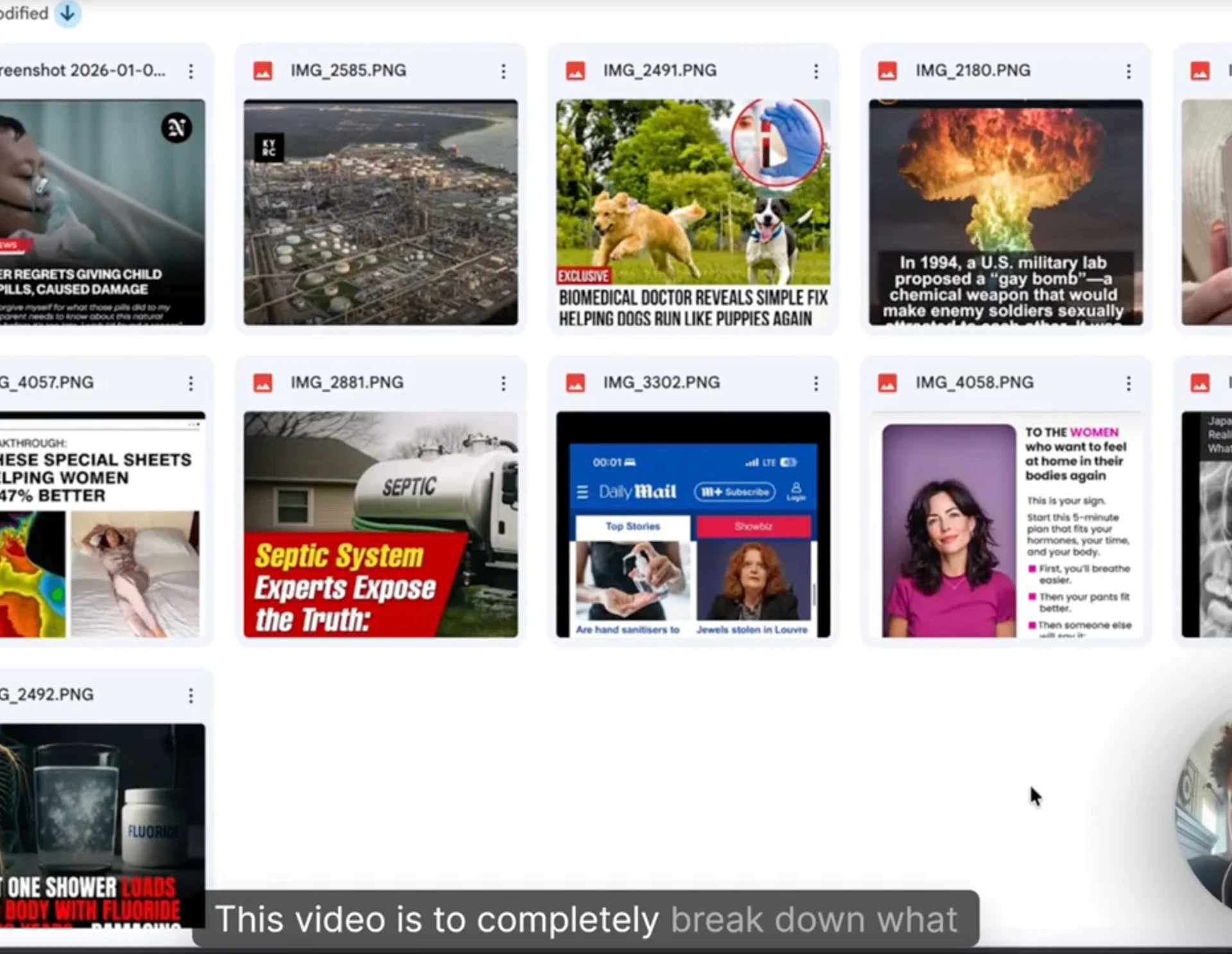
The Catalyst must introduce something the avatar doesn't already know — a reframe, a discovery, a revelation. "1994 US military lab tried to develop a chemical that would make enemy soldiers attracted to each other" — that's a shift. The reader's worldview adjusts in real time, which is why they click.
2. A new discovery framing
Even when the underlying claim isn't novel, the framing must feel like a fresh discovery. "Newly uncovered research shows..." "What scientists are now saying about..." "The truth about X they don't want you to know..." — frame it as something just surfacing, not something already settled.
3. Specific to one avatar
The Catalyst must speak to a specific person's specific pain. "Mother regrets giving child ADHD pills, caused damage" speaks to one avatar — guilty mothers questioning prescription decisions. It's not for everyone. It's for her. A generic Catalyst that tries to speak to "all parents" or "anyone interested in health" lands with no one.
Cross-reference Module 5 → Customer Research and Module 7 → Native Ads Breakdown for the Persona definition framework. Same persona discipline applies here — you're building the Catalyst for one specific reader.
4. Authority signals (carefully)
Authority elements amplify Catalyst performance:
- "Breaking news" framing — people assign authority to news format
- Editorial layouts — visual cues that this is reporting, not advertising
- Authority institutions referenced — Harvard, Columbia, John Hopkins, Cambridge
Compliance caveat: be careful with authority claims. Too aggressive (fake institutional endorsements, fabricated study citations) and your ad gets rejected and your account flagged. Stay credible. Use real-sounding framing without making specific claims you can't defend.
Worked examples — what bangers look like in the wild
To make this concrete, examples I've collected in my swipe file and what makes each one work.
Example 1 — The 1994 "gay bomb" curiosity
The headline: "1994 US military lab proposed a chemical weapon that would make enemy soldiers attracted to each other. It was real. It was submitted. It was funded."
Why it works:
- Major shift in normal beliefs (most people don't know this exists)
- Specific year + institution (1994 US military lab) = authority + specificity
- Curiosity gap that demands resolution
- Stops the scroll cold
What's missing: no clear sub-headline or CTA in the version I saw. If they'd added "Here's how it was discovered and what it reveals" with a "Read the full investigation →" CTA, the click rate would be substantially higher.
Example 2 — Mother regrets ADHD pills
The headline: "Mother regrets giving child ADHD pills — caused permanent damage" with a "Breaking News" icon overlay.
Why it works:
- Specific avatar (mothers giving children ADHD pills, e.g. Adderall)
- Emotional stakes immediate (regret + permanent damage to a child)
- News format with strong authority icon
- Headline + image alone passes the top-right benchmark
Avatar specificity matters here. This Catalyst will get scrolled past by men, by women without children, by parents whose children don't have ADHD. That's fine. The 5-10% of the feed that matches the avatar will stop cold, click, and convert. Catalyst CTR optimization isn't about reach — it's about avatar resonance density.
Example 3 — The fluoride shower head
The headline: "One shower loads your body with fluoride for 20 years, damaging your hair and your health" with a product image.
What's wrong: they put the product in the image. "Protect yourself with Promise Filter Shower Head Now." Suddenly it's a product ad, not a Catalyst.
The fix: strip the product. Strip the brand. Lead with the shocking claim only. Send the click to an advertorial that introduces the product after the reader has been pulled in by the curiosity. The advertorial does the product-introduction work. The Catalyst's only job is the click.
Perspective Iteration — the multiplier on every winning Catalyst
This is the most important section in this sub-page.
Once a Catalyst hits — even if it's just hitting baseline KPIs that signal potential — you can multiply it by changing the perspective.
Same messaging, same core framework, same product. Different speaker. Different frame.
The mechanic
| Perspective | Page running it | Hook framing |
|---|---|---|
| Third party witness | Brand page or news-style whitelist | "Mother regrets giving child ADHD pills, caused damage" |
| First person confession | Personal whitelist page (mother's name) | "I destroyed my child with pills. I'll never forgive myself." |
| Doctor authority | Doctor whitelist page (Dr. X) | "Doctor warns: ADHD pills are causing permanent damage in children" |
| Researcher / institution | Editorial whitelist page | "Cambridge study finds long-term cognitive damage in children prescribed Adderall" |
| Insider revelation | Whistleblower-style whitelist | "Former pharma rep exposes what they don't tell parents about ADHD medication" |
Same core message. Five different perspectives. Five different ads. Each one routes through a different psychological doorway and pulls in a different sub-segment of the same avatar.
Why this works
Different audience segments trust different frames:
- Skeptical / authority-leaning audiences → trust the doctor or researcher frame
- Peer-affinity audiences → trust the first-person mother confession ("she's like me")
- News-consuming audiences → trust the editorial / third-party witness frame
- Conspiracy-adjacent audiences → trust the insider revelation frame
One winning Catalyst becomes five Catalysts by running the same core message across these perspectives. All five compound your ad account's reach. You're not finding five new concepts — you're extracting the maximum yield from one validated concept.
Cross-reference to whitelist pages
This entire approach requires the whitelist Facebook page architecture covered in Module 7 → Sales Campaigns in Meta / How To Launch. You need multiple page types ready to deploy each perspective. Brand page, personal page (named after a fictional but plausible person), doctor page, editorial page. Build the infrastructure, then iterate perspectives at will.
This isn't just a Catalyst technique — it applies to video ads too. Got a winning UGC video? Reshoot the same script as a doctor. Same script as a peer testimonial. Same script as an investigator-style piece. Shift the frame, multiply the winner.
Major design variations (not tiny headline tweaks)
Common mistake: you have a winning Catalyst, so you make 10 versions with tiny headline tweaks. "Mother regrets giving child ADHD pills" → "Mom regrets giving child ADHD medication" → "A mother regrets giving her child ADHD pills" etc.
This doesn't work the way operators think it does.
Why it doesn't work
Meta reads ads by pixels. That's literally how the algorithm processes your image — it scans the pixels and identifies patterns. If your design is 95% identical between variations, Meta's algorithm sees them as the same ad. It groups them, gives them similar performance reads, and doesn't expand reach across new sub-audiences.
If your design is 30% different — different layout, different color palette, different image structure, different visual hierarchy — Meta's algorithm reads them as completely different ads. Each one gets its own learning, its own audience exploration, its own performance trajectory.
What real variation looks like
Two designs, same core messaging, structurally different:
Variation A:
- Layout: news article with image + headline on top, product callout in corner
- Color: muted news editorial palette (whites, grays, navy)
- Visual: realistic photo with overlay text
Variation B:
- Layout: side-by-side before/after with bold center text
- Color: high-contrast (red + black, bold yellows)
- Visual: stylized graphic with arrows and emphasis lines
Both communicate the same core message. Meta reads them as completely different ads. Both get their own learning. Both can become winners independently.
The variation discipline
When you find a winning Catalyst:
- Lock the messaging — that's the validated piece
- Generate 3-5 completely different designs that all communicate the same message
- Test them in parallel with the same audience and bid strategy
- Each design that hits becomes its own winner to iterate further
You can layer headline variation on top of design variation, but design variation is the primary lever. Headline-only tweaks are a secondary refinement once you've found which design structures work.
Catalyst vs Advertorial — the job split
The single most important conceptual point in this sub-page:
Catalysts get the cheap click. Advertorials do the conversion.
These are two separate jobs. The Catalyst is not designed to convert. It's designed to pull a specific avatar out of the feed cheaply. That's the only job.
The thought experiment
Imagine I throw an image of two unrelated controversial public figures in front of you with the headline "X exposed in Y investigation — here's what investigators found."
You'd click. Almost everyone would. It's a perfect Catalyst — strong shift in normal beliefs, news framing, curiosity gap, completely click-driving.
Now imagine I'm trying to sell you earbuds at the end of that funnel.
You're not buying earbuds. You clicked because the headline was irresistible curiosity bait. Your mental state when clicking is not "I'm interested in earbuds." It's "I want the gossip." The advertorial trying to convert this click into an earbuds purchase has to do an absurd amount of psychological work, and probably can't.
That's an extreme example of the mismatch. But the principle applies at lower extremes too. The Catalyst must pull the avatar who's actually relevant to the product. Not just any clicker. The right clicker.
The Catalyst's actual job
- Pull the specific avatar (the guilty mother, the joint pain grandmother, the post-LASIK dry eye sufferer) out of the feed
- Get them to click cheaply
- Deliver them to the advertorial in a curious, open mental state
The advertorial's actual job
- Receive the curious clicker
- Build the case for the mechanism
- Introduce the product as the validated solution
- Close the sale
Cross-reference Module 3 → Advertorials and Module 7 → Advertorials Breakdown (next sub-page) for the conversion-layer mechanics.
The Native → Catalyst migration path (how I built my brand)
This is the actual flow my custom brand took, and the pattern I recommend to any operator building a custom brand from scratch.
Stage 1 — Native ads test the copy
Launch with native ads (in-feed, long-form copy in primary text, no off-feed bridge). Cross-reference Module 7 → Native Ads Breakdown for the full framework.
Why natives first:
- Cheap to test (no bridge page to build)
- High concept density (15+ ad concepts in a weekend)
- Validates the actual messaging across the awareness arc
- Identifies which Persona × Angle × Awareness combinations convert
Stage 2 — Promote winning natives to advertorials
Once a native produces winning metrics, promote it to a full advertorial:
- Main image of the winning native → hero image of the advertorial
- Top-spending headline from the native → headline of the advertorial (lightly tweaked if needed)
- Native primary text copy → body copy of the advertorial, kept largely intact
- Insert images where they reinforce the message and break up the long copy
- The advertorial now lives on its own bridge page (separate URL, your own site)
You've now validated copy that converts on a bridge page. The advertorial works because the underlying native copy worked. You haven't tested new copy — you've translated proven copy into a higher-converting format.
Stage 3 — Create Catalysts that drive cheap clicks to the advertorial
This is where Catalysts come in.
With your advertorial validated, make 5-10 Catalyst image ads pointing to that advertorial. Each Catalyst is a different perspective on the same core hook from the advertorial. Same Persona, same awareness stage, same core mechanism — different image, different headline angle, different perspective.
Why this works:
- The advertorial is doing the conversion work (already validated)
- The Catalysts are just driving cheap clicks (different job, simpler format)
- You can multiply traffic to a validated advertorial 5-10x without building new bridge pages
- Each Catalyst test costs $30-100, and you only need 1 in 5-10 to hit for the math to work
The full progression chart
| Stage | What it does | What you produce |
|---|---|---|
| 1 — Native testing | Validate the messaging at high volume in-feed | 15+ native ads, 3-5 winning combinations |
| 2 — Advertorial promotion | Convert winning copy to off-feed bridge page | 1 advertorial per winning native concept |
| 3 — Catalyst scaling | Drive cheap clicks to the validated advertorial | 5-10 Catalyst variations per advertorial |
| 4 — Compound | Multiple advertorials, each with multiple Catalysts feeding them | Scaled custom brand ad system |
This is the migration path my brand walked. Most custom brand operators try to skip Stage 1 and launch straight into Catalysts. That fails because they haven't validated the messaging yet — they're guessing at what hooks will convert, instead of letting the native testing tell them. Test cheap first. Promote what works. Scale with Catalysts.
Where to find Catalyst inspiration
The sources I actually use:
1. Magazines (the goats)
Walgreens magazine rack. CVS. Any grocery store checkout aisle. Tabloid magazines. Health & wellness magazines. Women's magazines. Take photos of every cover and every interior page.
These editorial layouts have been A/B tested across millions of impressions over decades. Every cover is a Catalyst. Tom Selleck shocking weight loss story. Royal family revelations. Celebrity divorce exposés. They've solved for "what stops the scroll" — apply the format directly.
2. Daily Mail
UK tabloid format. Best place to study editorial-style strong headlines that imply news authority without being too aggressive. The Daily Mail headline writers have an unmatched ability to deliver shocking framing inside Meta-compliant boundaries.
3. InfoWars
For maximum aggressive headline ideas. Don't run InfoWars-tier copy verbatim — it'll get rejected. But the headline construction is instructive. Study how they layer urgency, authority, and political angle into a single line.
4. Rumble.com
Especially for VSL Catalysts. Rumble allows much more aggressive copy than Meta does, so the operators there push harder. Study them, then dial back 30-40% for Meta compliance.
5. YouTube thumbnails (the underrated source)
This was put on me by one of the 1-on-1 guys. A YouTube thumbnail is doing the exact same job as a Catalyst — strong image, packaging all the content underneath into one click-driving visual.
Study the high-CTR YouTube thumbnails in adjacent niches. Replicate the visual format for a Catalyst. It's the same job at the same psychological layer.
Brandon-rule on thumbnails: my own YouTube thumbnails are deliberately boring because I don't want everyone clicking — I want only the high-intent operator who wants real depth. For Catalysts you want the opposite. You want EVERYONE clicking who matches your avatar. Maximum dopaminergic visual, strong color schemes, high-contrast designs, eye-grabbing imagery.
6. Facebook Ad Library
Type advertorial into the Facebook Ad Library search. You won't see the smart operators (they don't put "advertorial" in their URLs), but you'll see a steady stream of mid-tier Catalysts to study.
Better: use BrandSearch (cross-reference Module 7 → Product Research for Custom Brands) and filter by Catalyst-style ad formats. Sort by impressions to find what's actually scaling.
Catalyst limitations (the honest take)
Catalysts are excellent for what they do. They're not a complete brand strategy.
What Catalysts do well:
- Drive cheap clicks at scale
- Hit specific avatars who match the hook
- Validate messaging quickly at low cost
- Multiply the reach of a validated advertorial
What Catalysts don't do well:
- Build brand affinity / LTV
- Reach prospects who aren't in a curious / news-consuming mental state
- Scale into top-of-funnel cold-cold audiences who don't yet know they have the problem
- Generate repeat purchases (the click is curiosity-driven, not brand-driven)
Brandon-rule on Catalysts:
Catalysts are easy winners every time, but they hit middle-funnel and bottom-funnel hard and tap out at the upper-funnel ceiling. They're a tool in the stack, not the whole stack.
If your brand depends entirely on Catalysts, you'll hit a revenue ceiling within 60-90 days where the high-curiosity audience in your niche is saturated. You need natives, UGC, AI UGC, and Catalysts running in parallel to compound across awareness stages.
Cross-reference Module 3 → Native and Module 3 → Videos for the upper-funnel formats that Catalysts can't reach on their own.
Cross-references
This sub-page lives inside a deep system of related material:
- Module 3 → Catalyst is the Claude automation / production layer (the JSON image prompts, the headline generation prompts, the visual asset generation workflow)
- Module 3 → Advertorials is the conversion-layer companion piece — where Catalyst clicks land
- Module 7 → Native Ads Breakdown is the testing layer that validates the copy before you promote to Catalyst
- Module 7 → Advertorials Breakdown (next sub-page) is the strategic deep-dive on the advertorial that pairs with every Catalyst
- Module 7 → Sales Campaigns in Meta / How To Launch is where the whitelist Facebook page architecture lives — necessary for perspective iteration
- Module 5 → Customer Research is the qualitative foundation that defines who your Catalyst is speaking to
- Module 5 → The Brief & Concept Tracking System is the framework foundation for the Persona × Angle × Awareness structure
The natural production sequence:
- Customer research (Module 5) → define Persona, Angle, Awareness
- Native ad testing (Module 7 → Native) → validate which Persona × Angle × Awareness combos convert
- Advertorial promotion (Module 7 → Advertorials Breakdown) → translate winning natives into bridge pages
- Catalyst scaling (this sub-page) → drive cheap clicks at scale into the validated advertorial
- Perspective iteration (this sub-page) → multiply each winning Catalyst by 4-5x via frame shifting
What's gatekept inside the masterclass
The principles are here. The artifacts and live walkthrough live in the masterclass:
- The full 20-minute video walkthrough with my live Catalyst swipe file and concept breakdowns
- My personal Catalyst swipe file — the perspective iteration examples, the GOATs, the winning designs I've collected and built off of
- The Native → Catalyst migration walked through live on my actual brand — me showing the exact native that became the advertorial that became the Catalysts
- The Catalyst image generation prompt + style guides (also referenced in Module 3 → Catalyst) tailored for the news/editorial/breaking-news aesthetic
- The perspective iteration framework demonstrated with 4-5 worked examples on the same core message
Want the full 20-minute video walkthrough, the Catalyst swipe file, the Native → Catalyst migration shown live, and the perspective iteration framework? All inside the RunItUp Masterclass → Join here
Join now to lock in your rate, prices are increasing quickly.