Why advertorials are the engine
If you want to scale cold traffic to a custom brand without spending years building a video creative library, advertorials are the best vehicle that exists. Period.
Affiliates and direct response operators do stupid numbers running purely images + advertorials with no video at all. My custom brand is built entirely on this stack. It's not too difficult to get right anymore — AI has lowered the production cost. The bottleneck is now skill and intent, not production capacity.
This sub-page is the strategic breakdown — how I think about advertorials, the Eugene Schwartz framework that powers them, the awareness stage strategy, the headline structure that does 80% of the work, the world-building principle, and the fiction-reading discipline that's actually upgraded my copy more than any direct response book.
Cross-reference Module 3 → Advertorials for the Claude automation / production layer. This sub-page is the strategy and craft.
Start with Eugene Schwartz
If you don't know Eugene Schwartz, you're missing the foundation. Founder of Breakthrough Advertising, original direct response copywriter, the writer everyone copies from whether they know it or not.
His swipe file is freely available — search "Eugene Schwartz swipe file" and you'll find sales letters direct from Schwartz with full copy, images, structure. Study them. Not to copy them, but to understand the architecture of what direct response actually is.
Direct response is research first, copy second. You don't create copy. You form copy. You pull together different pieces of research, story, mechanism, and avatar voice into a long-form essay that has a pitch built into it.
When you watch my 2-hour advertorial video (gatekept in the masterclass), you'll see me doing this live. I'm not inventing anything from scratch. I'm pulling from research, from competitor advertorials, from fiction references, from my customer research, from Reddit threads — and assembling them into one full-length story for one specific avatar.
That's all advertorials are. Long-form assembled copy that builds a world your avatar wants to live in for 5-10 minutes, and quietly closes them at the end.
(Side note: while we're crediting the OGs, Edward Bernays — founder of public relations / propaganda — is the other side reference worth knowing. Schwartz invented modern direct response. Bernays invented modern persuasion. Both shape every ad you write.)
The awareness stage decision (where to play)
Cross-reference Module 5 → Customer Research, Module 7 → Native Ads Breakdown, and Module 7 → Catalyst Ads Breakdown for the full Eugene Schwartz awareness framework. Refresher applied specifically to advertorials:
| Stage | Difficulty | Advertorial sweet spot? |
|---|---|---|
| Unaware | Hardest. Have to identify the problem for the reader, then solutions, then your product. Difficult with AI. | Biggest scale ceiling if you can crack it. |
| Problem aware | Medium. They know the problem; you walk them through solutions. Bigger TAM than solution aware in most markets. | ✅ My most common play |
| Solution aware | Easiest. They already know solutions exist; you compare and contrast, position your product as superior. | ✅ My recommendation for first advertorial |
| Product aware | Easy. They already know the product. | Limited to retargeting / bottom funnel. Won't scale cold. |
| Most aware | Easiest of all. Bottom funnel only. | Use for bottom-funnel statics, not advertorials. |
For a new advertorial operator: start at solution aware. For scaling a validated advertorial: move toward problem aware (bigger audience, longer copy needed). For breaking through revenue ceilings: crack unaware (highest ceiling, hardest execution).
Why solution aware is the easiest entry:
The reader already knows they have the problem. They've already tried solutions that didn't work. You don't have to convince them anything is wrong with them. You just walk through why their previous solutions failed and why your product is structurally different.
The compare/contrast format writes itself. You list the failed solutions, name why each one failed for the avatar (cost, side effect, doesn't address root cause, etc.), then introduce your product as the solution that solves what the others missed. Easy structure, low writing skill required, reliable conversions.
Why unaware is the biggest scale ceiling:
In an unaware advertorial, you're educating the reader about a problem they didn't know they had. The TAM is everyone — not just the people who've already identified themselves as having the problem. If you crack the conversion math here, you're playing in a 10x larger market than solution-aware operators.
Most operators reading this should NOT start with unaware advertorials. Get good with solution-aware first, then problem-aware, then graduate.
The headline does 80% of the work
This is the most important structural insight in advertorials.
Headline + sub-headline + hero image = 80% of conversions. Body copy is the closing argument, but it only matters if the top of the page hooks them long enough to start reading.
If your headline is weak, no one reads down to the body. No matter how brilliant the body is. The headline is the gate. Spend 50% of your advertorial creation time on the headline alone.
The Schwartz arthritis worked example
Headline:
"Doctor reports a new miracle diet cures arthritis."
Sub-headline:
"In most cases, ends pain, heat and swelling in joints in three to ten days. Restores normal bone structure in three to six months."
Why this headline structure works:
- "Doctor reports" = authority framing
- "new miracle diet" = curiosity + novelty (Schwartz framing — something new just emerged)
- "cures arthritis" = specific outcome stated outright, the word that makes the right reader stop scrolling
Why this sub-headline works:
- Specific timelines (3-10 days, 3-6 months) = adds credibility through specificity
- Specific mechanisms (pain, heat, swelling, bone structure) = adds depth
- Connects the broad curiosity of the headline to the framing of what the body delivers
The reader who skim-reads will catch the big words: arthritis, miracle, doctor, ends pain, restores bone. That alone is enough to make them keep reading. Most people are skim readers. Write for skim readers first, deep readers second.
The sub-headline = thesis statement
If you wrote essays in school, this will land instantly.
A thesis statement summarizes the rest of the essay in one or two sentences. It hints at paragraph 2, paragraph 3, paragraph 4 — then connects to the conclusion.
Your advertorial sub-headline does the same job. It teases what's coming in the body without giving the conclusion away. Leaves an open loop. Frames the reader for what they're about to read.
The structure:
| Element | Function |
|---|---|
| Headline | Stops the scroll. Broad curiosity hook. Authority + outcome + novelty. |
| Sub-headline | Frames the body. Specificity + open loop + thesis-style summary. |
| Hero image | Reinforces credibility. News-style, scientific-style, or peer-testimonial style depending on advertorial framing. |
| Body | The full story arc that converts. |
Get the top right and the body does its job. Get the top wrong and the body doesn't matter.
The "insert yourself in the middle" positioning principle
This is one of the most important conceptual reframes for direct response copy.
Your avatar is at Point A: suffering from a problem. Their dream outcome is Point B: living without that problem. Your job is not to sell. Your job is to position yourself in the middle of A and B.
You're not pushing them. You're not selling them. You're showing up between where they are and where they want to be, naturally bridging the gap with your product.
The concrete example
Avatar problem: I'm tired but I want to work.
Dream outcome: high energy + focused work without sacrificing other things I value.
Bad advertorial: "Buy this caffeine supplement! It will give you energy!" — you're pushing the product at them, not bridging anything.
Good advertorial: walk through their day. Show you understand what tired-but-trying-to-work actually feels like. Talk about the failures of other energy solutions (coffee → bathroom problems, energy drinks → crash, prescription stimulants → side effects). Then introduce your product as the bridge between where they are and where they want to be — energy without the trade-offs.
You haven't sold anything. You've positioned yourself in the middle of their actual life. That's why they buy.
Why "no hard close" works
Watch my advertorial videos and you'll notice: I almost never use hard pitches or aggressive closes. There's no "BUY NOW BEFORE THE TIMER RUNS OUT" energy.
The principle: let people make decisions for themselves, but lead them down the path. People resist being pushed. They follow when they're shown the way.
The hard close has its place in funnel architecture (offer pages, upsell flows, abandoned cart sequences). The advertorial isn't the place. The advertorial builds trust, mechanism understanding, and identification. The product page does the closing.
System 1 vs System 2 thinking
This framework is the most important psychology layer underneath advertorial copy. (Credit to my friend Noah for helping me articulate this.)
| System | What it does | When it activates |
|---|---|---|
| System 1 | Fast, emotional, intuitive | First decision-making — "do I want this?" |
| System 2 | Slow, logical, analytical | Justification — "should I want this?" |
People buy from System 1 (emotion). They justify the purchase from System 2 (logic).
The implication for advertorials:
- First half of the advertorial = System 1. Emotional resonance. Pain identification. Dream outcome visualization. Storytelling. Identity reflection. You're getting them to want the outcome before they know how it works.
- Second half of the advertorial = System 2. Mechanism explanation. Clinical studies. Specific ingredient dosages. Comparison to alternatives. You're giving them the logical justification to keep wanting what they already emotionally decided they want.
Get the order wrong and you lose them. Lead with mechanism and specifications and the reader bounces because there's no emotional pull. Lead with pure emotion and never deliver logic and the skeptical readers bounce because they can't justify the purchase to themselves.
Concrete application
Schwartz's arthritis advertorial:
- System 1 setup: "Hundreds of arthritis victims who are resigned to a life of agonizing pain are now enjoying pain-free motion once again." Emotional. Identity-driven. The reader sees themselves as a current arthritis victim and the desired outcome as the pain-free version.
- System 2 close: mechanism (the diet), specific timelines (3-10 days, 3-6 months), citation (Dr. Gerard W. Campbell), specific compounds. The reader's logical brain now has what it needs to justify what their emotional brain already wants.
Apply this two-stage structure to every advertorial you write. Emotion first. Logic second. Always.
Headline structures that actually work
A few headline patterns that hit consistently in advertorials:
1. "How to do X, Y, and Z for [specific avatar]"
The format I use for most of my own content (including YouTube titles). Highly specific avatar callout = pre-qualifies the reader.
Example: "How a 47-year-old grandmother reversed her joint pain in 90 days without prescription medication or surgery."
The avatar (47-year-old grandmother), the problem (joint pain), the outcome (reversed in 90 days), and the differentiator (without medication or surgery) all in one line. Only the right reader clicks. That's the point.
2. Identity-driven curiosity headlines
The classic Schwartz-era format:
"The amazing seduction secrets of a skinny ugly six-foot geek from Culver City, California — that could get you all the girls you want, no matter what your looks or age."
Why this works:
- Specific identity (skinny, ugly, six-foot, geek, Culver City) = relatable for the target reader who's tired of advice from conventionally-attractive sources
- Counter-intuitive promise (his look/age doesn't matter) = curiosity + hope
- The reader thinks: "If this dude figured it out, I can too"
The pattern: specific underdog identity + counter-intuitive promise + irresistible curiosity.
3. Authority + new discovery format
"Doctor reports a new miracle diet cures arthritis."
The Schwartz format that built modern direct response. Authority + novelty + outcome. Still works today.
4. Question-as-headline (low-key powerful)
"Do you have the courage to earn half a million dollars a year?"
The implicit challenge ("do you have the courage") triggers identity response in the reader. They want to prove they DO have the courage by reading more. Skill-issue-flag for anyone who doesn't read — they've self-disqualified.
Resource stack — where the good copy lives
The places I actually study for advertorial inspiration:
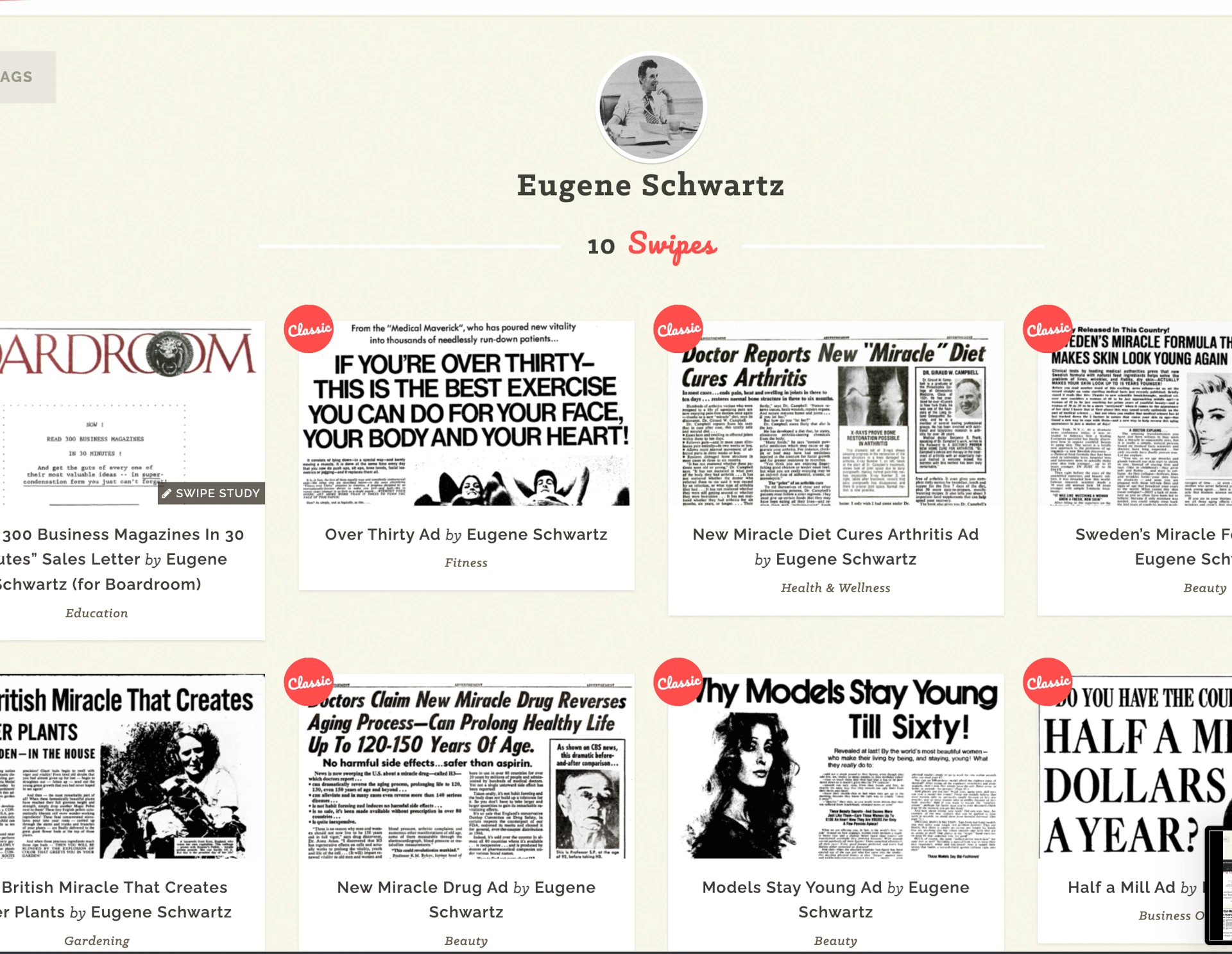
Eugene Schwartz swipe file
Free, online, search-engine-findable. Read every letter. Even the ones for products that no longer exist. The structure and copy craft are still the gold standard.
Swipe.co
82+ direct response swipe files curated from the OG operators. Type "dental" or "joint pain" or whatever niche you're in and you'll find real direct response from operators who actually moved units. Way more useful than modern templated advertorial swipe files.
David Ogilvy — How to Make Successful Television Commercials
Even though it's TV-focused, the principles transfer entirely. The clearest framework for how a successful long-form ad is structured.
Adrecon.io (Dan de Silvio)
Software I've recently started using. Tracks direct response, affiliate, and lead-gen operators across niches. These operators have to do conversion through direct response, so they're forced to get good. Study them.
ClickBank offers
If you can get a vendor account or know someone who has access, study the top-converting offers. Pure direct response, hardcore conversion focus, no brand fluff.
Twitter (operator screenshot leaks)
Operators love posting screenshots of winning ads for engagement. Search Twitter/X for "advertorial" or "winning ad" and you'll find a steady stream of leaks. Build your own private swipe file from these.
What to AVOID studying
Big brand-focused operators (Gatorade, Celsius, etc.). They're not running direct response anymore. They're running brand. Their copy isn't the conversion-driven craft you need to learn.
Study the trenches. Not the established brands.
Brandon's honest take on swipe files
I'm not a big swipe-file guy.
Most swipe files are generic. Most operators are pulling from the same swipe files, which produces ads that all sound the same. The way to stand out is to be more creative than the swipe-file crowd.
That said, swipe files are useful for:
- Structural inspiration — seeing how headlines + sub-headlines + body arc together
- Avatar-language reference — pulling specific phrases your avatar would actually use
- Confidence building when you're stuck
What they're NOT useful for:
- Copying directly. Generic. Detectable. Will not stand out.
- Replacing your own creative thinking. The best advertorials I've written had no swipe file basis at all.
Use them as inputs to your own creativity, not replacements for it.
The fiction reading principle
This is the most underrated advertorial-improvement advice I can give you, and the most underused.
I've never finished Breakthrough Advertising. I've never finished David Ogilvy's books. Multiple operators reading this will be horrified by that admission.
But here's the truth: I've learned more about writing good copy from reading good fiction than from any direct response book.
Why fiction reading improves copy
Good fiction does three things that good advertorial copy must also do:
- Builds a world the reader is pulled into — they stop sitting on their couch and start inside the story
- Plays on emotion through specific sensory detail — body sensations, room temperature, the texture of fabric, the smell of a room
- Creates tension and release cycles — open loops, paid off later, reopened with new loops
These are the exact same craft skills you need for a 5-minute advertorial. Fiction trains them at a depth no direct response book can match.
Specific fiction references that have improved my copy
| Reference | What it teaches | Best for |
|---|---|---|
| Harry Potter | World-building, identity reflection, hope-against-the-odds arcs | Any avatar that wants transformation |
| Lord of the Rings | Epic-scale storytelling, mechanism mythology, character archetypes | Authority-figure / mechanism-revelation advertorials |
| Land of Stories (kids book) | Pure narrative momentum, no wasted words | Mom advertorials, family-focused niches |
| 50 Shades of Grey | First-person emotional intensity, body sensation language, female-perspective voice | Any advertorial written for a female avatar |
The 50 Shades technique
If you're writing to women, you must understand what gets women emotionally engaged when they choose to read for pleasure. 50 Shades is one of the highest-grossing fiction phenomena targeting that exact audience. Whatever you think of the content, the prose technique deserves study.
The workflow:
- Download 50 Shades (or another reference book targeting your avatar) — free PDFs exist
- Drop the PDF into your Claude project
- Reference it explicitly in your copy generation prompts: "Match the prose style, emotional intensity, and first-person voice of the attached reference."
- Your output copy instantly shifts toward what your avatar already chooses to consume
I tested this on a first-person women's advertorial. Never had better first-person copy than after this. The prose has texture, body, vulnerability, sensory detail — all the things AI-default copy lacks.
For male avatars: find equivalent reference texts. Sci-fi, action thrillers, GameStop forum threads, military memoirs — depending on the sub-avatar. Use what your specific avatar actually consumes for pleasure.
The principle:
You don't want to give people broccoli. Give them dessert. Then lead the dessert toward your product.
The world-building approach to advertorials
Putting it all together: I view an advertorial as a long-form piece of copy that builds a world.
The world has:
- A main character (your avatar, often "you" or a relatable narrator)
- A clear problem they're suffering from
- Failed solutions they've already tried (which build credibility — you know what they've been through)
- An authority figure or moment of revelation that introduces the mechanism (doctor, researcher, friend, accident, discovery)
- The mechanism explanation that makes the new solution feel inevitable
- The product reveal as the embodiment of the mechanism
- The offer / close at the bottom
The reader spends 5-10 minutes inside this world. When they leave, they've internalized the problem-mechanism-solution arc as if it were their own story. That's the conversion.
The 2-hour advertorial discipline
When I make my best advertorials, I don't run a single prompt. The 2-hour video I made (gatekept in masterclass) shows me writing live — and I'm constantly:
- Stepping away to grab a book
- Researching random tangents (when was Instagram founded? How do this avatar's friends actually talk? What does the inside of a doctor's office look like?)
- Re-reading paragraphs to feel the rhythm
- Pulling phrases from fiction I've been reading
- Asking myself "would my avatar actually say this? Would this hit her body?"
This is craft work. AI can support it. AI can't replace it. Not yet.
That said, for operators not ready to write at this level (and that's most operators starting out), the prompts I use for first-person, doctor-authority, and third-party-witness advertorial structures exist and are gatekept in the masterclass. Use them as scaffolding while you develop the underlying craft.
The format migration (the actual production flow)
Cross-reference Module 7 → Native Ads Breakdown for the full picture. The migration sequence:
- Native ads test which copy hooks convert (in-feed, cheap, high volume)
- Winning native → advertorial — take the validated copy, expand to a full advertorial with images, host on a bridge page
- Catalyst ads drive cheap clicks into the advertorial
- Once the advertorial is winning: drive MORE traffic to it before iterating to a new advertorial
- VSL (optional next stage): repackage the winning advertorial copy as a video script for VSL ads
Don't iterate to a new advertorial while your current one is still winning. Drive more traffic to the winner first. Squeeze every dollar out of validated copy before building new validated copy.
This is one of the most counterintuitive disciplines. Operators get bored. They want to build the next thing. Resist. A winning advertorial that's getting $500/day in spend can usually take $2-5k/day in spend if you just feed it more traffic via more Catalyst ad variations.
Microsoft Clarity for advertorial analytics
Once you have an advertorial live and getting traffic, Microsoft Clarity is the analytics layer for understanding what's actually happening.
- Heat maps — where on the page readers stop scrolling
- Scroll depth distribution — what % of readers make it past the first section, mid-page, the bottom CTA
- Drop-off points — exactly which paragraph causes readers to bounce
- Session recordings — watch individual reader sessions to see how they navigate
Use this to iterate the advertorial:
- High drop-off in the first 20% = headline + opening paragraph need work
- Drop-off in the middle = the mechanism section is too long / too boring / too technical
- Readers scrolling fast through the close = either offer is wrong or close is overdone
- Readers scrolling up and down = something earlier isn't clear and they're going back to re-read
Without Microsoft Clarity, you're optimizing blind. With it, you know exactly where to surgically improve.
Cross-references
This sub-page sits inside the deepest web of related material in the case study:
- Module 3 → Advertorials is the Claude automation / production layer (the prompts, the structures, the AI workflow)
- Module 7 → Native Ads Breakdown is the testing layer where you validate the copy before promoting it to an advertorial
- Module 7 → Catalyst Ads Breakdown is the traffic-driver that brings cheap clicks into the advertorial
- Module 7 → Product Research for Custom Brands is where you find the competitor advertorials you're competing against
- Module 7 → Sales Campaigns in Meta / How To Launch is the campaign architecture that runs the advertorial traffic
- Module 5 → Customer Research is the qualitative foundation — your survey data, your avatar definition, the emotional valence chart
- Module 5 → The Brief & Concept Tracking System is the framework foundation for Persona × Angle × Awareness applied to advertorials
- Module 4 → How to Properly Run Split Tests covers the 3-2-2 testing rhythm I run on advertorials
The natural production sequence:
- Customer Research (Module 5) defines who you're writing for
- Native testing (Module 7 → Native) validates the copy hooks
- Advertorial promotion (this sub-page) scales the winning copy to a bridge page
- Catalyst ads (Module 7 → Catalyst) drive cheap traffic to the advertorial
- The advertorial converts the cold click into a purchase
- Microsoft Clarity (this sub-page) tells you where to iterate
What's gatekept inside the masterclass
The principles are here. The artifacts and live walkthrough live in the masterclass:
- The full 2-hour advertorial creation video — me building a winning advertorial from scratch, no prompts, live thinking, pulling from references, building the world in real time
- The 25-minute strategic breakdown video of this entire framework
- The advertorial prompt library — first-person, doctor authority, third-party witness, comparison framework, mechanism-led — all gatekept for operators who need the scaffolding while they develop the craft
- The Eugene Schwartz swipe file curated and annotated — the letters I've studied most, with notes on what each one teaches
- The Microsoft Clarity setup + interpretation walkthrough — how I actually read heat maps, scroll depth, and session recordings on real advertorials
Want the full 2-hour live advertorial creation video, the 25-minute strategic breakdown, the advertorial prompt library, the curated Schwartz swipe file, and the Microsoft Clarity walkthrough? All inside the RunItUp Masterclass → Join here
Join now to lock in your rate, prices are increasing quickly.