How I launched my brand on native ads
I launched my custom brand fully using native ads. Then transitioned to Catalyst and advertorials. Now we run AI UGC, real UGC creators on retainer, the full custom creative stack.
Native ads are still the foundation. They're how I test volume angles and long-form copy faster and cheaper than any other format. You can launch 15 native ads for under $300 in spend and have real signal within 5 days. No other format gives you that test density at that price.
This sub-page is the full strategic breakdown of how native ads work, why they work, the 3-component framework, the worked examples, the image sourcing methodology, and the underground meme method I've been hitting winners with that I haven't shared anywhere else.
Cross-reference Module 3 → Native sub-page for the Claude automation / production layer. This sub-page is the strategy and craft. Module 3 was the "how to make them at scale with AI." Module 7 is the "why they work and how to make them land."
Eugene Schwartz refresher (with the native ads scaling marks)
Five levels of customer awareness, in order from coldest to hottest:
| # | Awareness level | What it means | Native ad fit |
|---|---|---|---|
| 1 | Unaware | Never heard of you, never heard of the problem | Hardest. If you crack it, biggest scale. Long copy required to build the entire frame. |
| 2 | Problem aware | They know they have the problem, looking for solutions | • Strong fit. High TAM. Natives convert well here. |
| 3 | Solution aware | They know solutions exist, comparing options | • Best fit for scaling. Compare/contrast solutions, position your product as superior. Largest convertible TAM. |
| 4 | Product aware | They know your specific product, considering | Works for retargeting. Doesn't scale cold. |
| 5 | Most aware | Knows you, ready to buy | Bottom funnel only. |
Think of these as 5 → 4 → 3 → 2 → 1 in ease. Easiest to hardest. Solution aware is the sweet spot — the audience is warm enough that compare/contrast converts, the TAM is still huge, the copy is straightforward to write.
Cracking unaware natives = biggest scale of all, but the hardest execution. Most operators reading this should start at solution aware, move to problem aware once that's validated, and graduate to unaware natives only after they've already won at the warmer awareness stages.
Cross-reference Module 5 → Customer Research for how to identify which awareness stage your real customer base sits at — it's not always where you think it is.
The 3 components of an ad concept
Module 5 → The Brief & Concept Tracking System introduced the Persona × Angle × Awareness framework as the foundation for all paid ad work. For natives specifically, this framework becomes everything.
Quick refresher, then the native-specific application:
| Component | What it is |
|---|---|
| Persona | Who you're targeting + what problem they're suffering from |
| Awareness | Where they sit on the Eugene Schwartz spectrum |
| Angle | How you connect your product to this persona at their awareness stage |
The more specific your Persona, the better the native. Native ads live or die on whether the reader feels like the copy is talking to them specifically. Generic personas produce generic ads that get scrolled past.
The Neurogum worked example
Throughout this sub-page I'll use Neurogum (the energy + focus caffeine gum brand) as the running example. Public brand, easy for anyone to study.
Defining one Persona:
A guilty mother in her early 30s who had to put her child on prescription pills for ADHD.
That's specific enough to start visualizing. Specific enough to identify the content she consumes, the language she uses, the pain points she actually feels. Vs. "mothers who want focus support for their kids" — too vague to write good copy against.
Defining her Awareness:
She's problem aware (knows her child has an ADHD issue, knows the prescription pills are the "solution" but feels guilty about them). Leaning into solution aware because she's heard about alternatives — vitamins, omegas, nootropics — but doesn't know which ones actually work.
Defining an Angle:
"It helps your child focus without the zombie personality that comes from prescription pills."
That's an angle. It's a specific reframe. It speaks directly to her real fear (the zombie personality side effect that's commonly discussed among parents).
Persona + Awareness + Angle = one ad concept. Build the native against this. Don't try to write a native for "all moms" or "all parents" — write one for her.
The car crash angle analogy
This is the cleanest explanation of "angle" I've ever heard, and it'll change how you think about ad concepting forever.
Imagine an accident in the middle of a four-way intersection. You're on the north side. I'm on the east side. There's someone on the south side, someone on the west side. We all saw the same accident. But each of us tells the story differently.
I might say: "This dude came over from the right, he was speeding, and out of nowhere this other car slammed into him."
You on the north might say: "I was just chilling here, I noticed the car off to my right ran the red light, and the other car couldn't tell if they had a green light or yellow."
Same accident. Four unique angles. Each one tells a different story about the exact same event.
That's what angle is in advertising. Same Persona, same Awareness, same product — but a completely different perspective on how you tell the story.
The killer application: you can have the same Persona and the same Awareness and generate a totally new ad concept just by switching the angle. The mother story angle vs the doctor authority angle vs the comparison-to-Adderall angle vs the school-performance angle — all aimed at the same Persona, all at the same Awareness stage, all selling the same product. Each one routes through a different psychological doorway and pulls in a different sub-segment of the same Persona.
This is the leverage point in native ad concepting. Don't try to find 15 different Personas. Find 3 Personas, then find 5 angles for each Persona. That's 15 distinct ad concepts off only 3 audience definitions.
The Force (how the funnel actually moves them)
Once you have the Persona × Awareness × Angle defined, you build the "force" — the funnel mechanism that moves the reader from where they are to purchase.
The structure:
- Native ad in feed — Persona-targeted inline copy that hooks them inside Facebook itself
- Bridge page (if used) — listicle, advertorial, or pre-lander that deepens engagement and warms them up
- Product page — closes the conversion
Many natives skip the bridge page and go straight to product page. This works when the native ad itself is doing the long-form work in the Facebook primary text. We'll cover this in the Rosabella example below.
The bridge page (if used) has 3 requirements
When you DO use a bridge page (listicle or advertorial — cross-reference Module 3 → Advertorials and Module 7 → Advertorials Breakdown), the page must hit three structural requirements:
1. Persona focus
The page is written for one specific person. Not "all women." Not "moms." Her. The guilty mother in her early 30s with the ADHD child. The 63-year-old grandmother with joint pain. The 35-year-old man with focus issues at work. One Persona. Total commitment.
2. Open loops
You leave unresolved curiosity throughout the page so the reader keeps reading. Mentioned in Module 3 → Advertorials but worth emphasizing for natives: the open loop is what keeps eyes on the screen. Dr. Linkstadt said two things had to happen — but I'll get to the second one in a minute. The mechanism is X — but you have to understand the back story first.
3. Correct framing
The frame of the page must match the frame of the native ad that drove the click. If the ad is from "Dr. Vines" (authority frame), the bridge page is written in Dr. Vines's voice. If the ad is from "Margaret, 63" (peer testimonial frame), the bridge page is written in Margaret's voice. Frame mismatch is a conversion killer.
The 3 × 5 launch architecture
When launching native ads from scratch (a new brand, a new product, a new niche), this is the architecture:
| Layer | Count | Total |
|---|---|---|
| Personas | 3 specific Personas | 3 |
| Angles per Persona | 5 angles each | 15 |
| Image variations per angle | 3 images per concept | 45 |
| Copy variations per angle | 3 copy variations per concept (confession, mechanism tease, witness moment) | 45 |
Total: 15 unique ad concepts × 3 image variations × 3 copy variations = 135 native ad combinations to test.
That sounds like a lot. With the right prompt stack and image generation pipeline, this is doable in a single weekend.
Why this density: native ads have cheap CPCs but variable CTR depending on whether the in-feed hook lands. You need volume of tested combinations to find the 3-4 that print. Out of 135 combinations, you'll typically end up with 5-10 winners that carry the entire ad account. The other 125 fail. That's the math.
If you're not willing to test 100+ combinations, native ads aren't the format for you. Run Catalysts or advertorials instead, where each test is more expensive but higher signal density per test.
Brandon-rule on the 3 × 5: test every angle like it's already a winner. "Every single one you test, you should be 'this is a winner.'" Anything less than that level of confidence going in, and you're not concepting hard enough. The reason most operators only hit 1 in 50 winners is that 49 of their concepts were lazy.
The production stack (high-level)
The actual production flow for each ad concept:
- Define Persona × Awareness × Angle
- Generate brief using the Concept Generator prompt (gatekept in masterclass — see below)
- Generate copy variations — first-person, doctor authority, third-party witness — using the Copy Generation prompts
- Generate image prompts using the JSON Image Converter prompt
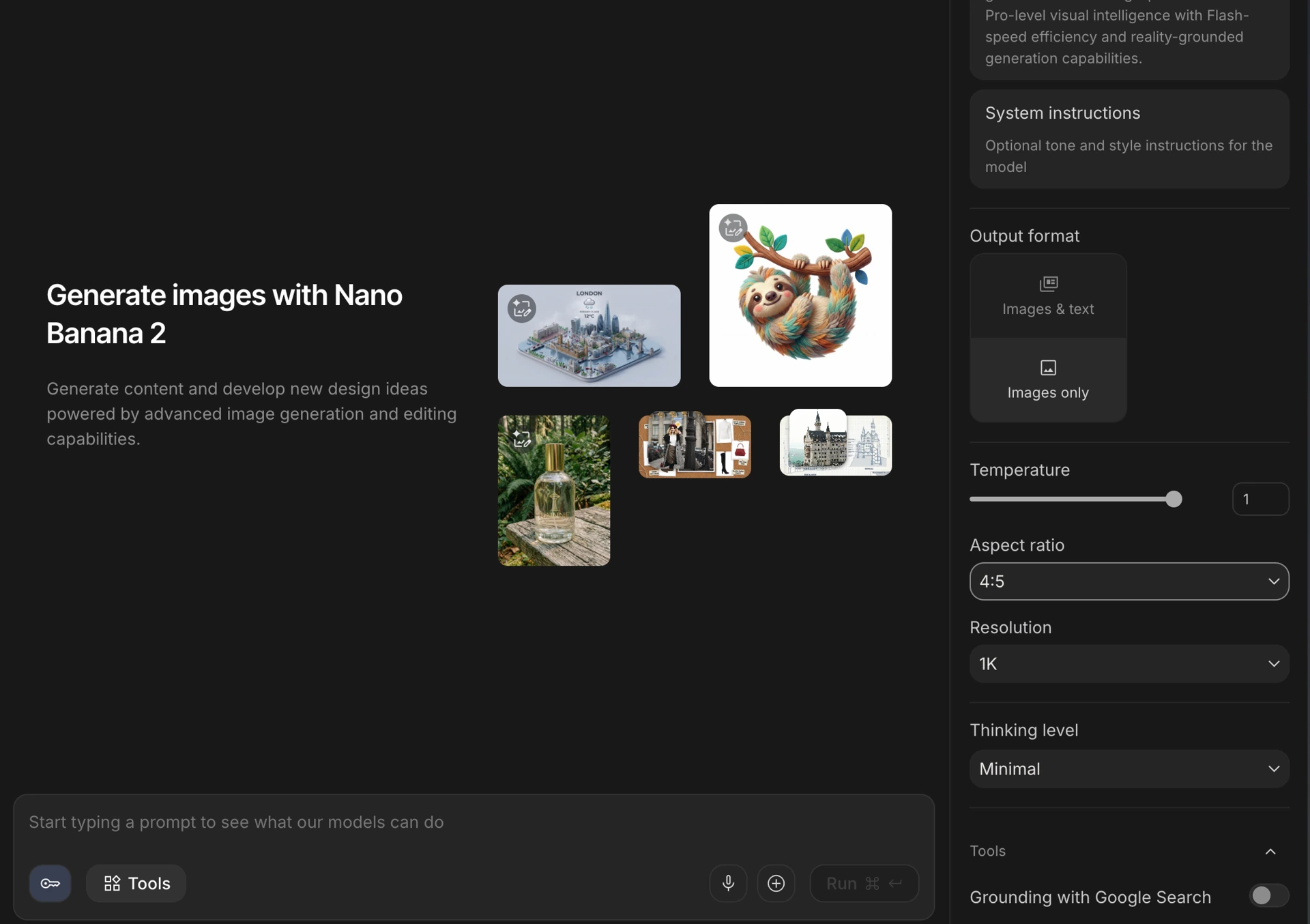
- Generate images by taking the JSON prompt into Google Studio (Nano Banana 2)
- Upload ad with native copy in primary text, image in feed slot, headline below
Cross-reference Module 3 → Native sub-page for the deeper Claude automation walkthrough.
Google Studio / Nano Banana 2 setup notes
For native ads specifically, the aspect ratio matters more than people realize.
Use 4 × 5 aspect ratio for native ads. Not 1 × 1, not 5 × 4 — 4 × 5. This is the native-feed portrait ratio that performs best in Meta's algorithm and feels most "real post-like" in feed.
- 1 × 1 looks too "ad-formatted"
- 16 × 9 / 9 × 16 are video ratios, wrong for static native unless its meant to be a selfie
- 5 × 4 is wider than 4 × 5 and crops badly on mobile
- 4 × 5 is the sweet spot for static natives in feed
Set Google Studio to 4 × 5, paste your JSON image prompt, generate.
What a native ad actually IS (the in-feed avatar)
This is the conceptual reframe that unlocks the whole format.
A native ad is an in-feed avatar. It's a real person, in your feed, telling a story.
Compare to other formats:
| Format | Where it lives | Length | Visual |
|---|---|---|---|
| Native ad | In-feed (Facebook primary text + 1 image) | Long-form copy in primary text | 1 native-feeling image |
| Advertorial | Off-feed (your own bridge page) | Long-form copy + headers + structure | Multiple images interspersed with copy |
| Catalyst | Off-feed bridge page (newsletter / editorial style) | Long-form with editorial framing | Image-heavy, magazine layout |
| Video ad | In-feed (video format) | 15-60 sec script | Video |
The key insight: a native ad is essentially an advertorial compressed into the Facebook feed. You're not asking the reader to click off to your site to read it. You're delivering the whole pitch inside the feed itself. Click only happens after they've already consumed the story.
This is why natives are the highest-volume testing format. Each native costs $30-100 to validate. Each advertorial requires building a page, hosting it, tracking it — way more setup cost. Natives let you test 15 angles for the price of 1 advertorial test.
Once you find a winning native (one that prints in feed), you can promote it to a full advertorial with images by adding the image breakouts on a bridge page — that becomes a Catalyst format (cross-reference Module 3 → Catalyst and Module 7 → Catalyst Ads Breakdown).
The natural progression: native (in-feed) → advertorial (off-feed bridge) → Catalyst (image-rich editorial bridge). Same story arc, three execution tiers. Native to test, advertorial to refine, Catalyst to scale.
Worked example — the Rosabella native ad deep dive
The single best native ad I've broken down in detail. Public brand, you can study this in their ad library.
The brand: Rosabella (women's joint pain + cardiovascular health, beetroot-based)
The hook:
"My daughter sat me down, told me she was putting me in a care home. And what happened next nearly killed me."
Why this hook is excellent:
- First person, peer testimonial frame — feels like a real Facebook post from a real grandmother
- Emotional stake immediate — daughter, care home, "killed me" all in the first sentence
- Open loop — "what happened next" forces you to keep reading to find out
- Native to feed — looks nothing like a typical product ad
The awareness arc inside the copy
The primary text walks through the full Schwartz awareness arc inside a single Facebook post.
Stage 1 — Problem aware setup
"My name is Margaret, I'm a 63-year-old grandmother... I wasn't always like this. In my 40s and early 50s I was active. I walked the dog every morning, I did the garden..."
The reader meets Margaret. Empathy established. The problem is introduced as it developed — joint pain creeping in, weight gain, mobility loss, the slide into where she is now.
Stage 2 — Solution-failure cycle
"I tried turmeric, I tried omega 3, I tried glucosamine — nothing made much difference. I tried diet... I cut carbs, I gained weight. I cut portions, I gained weight..."
Each failed solution is named specifically. This is the move from problem aware → solution aware. Margaret has tried what the reader has tried, and none of it worked. The reader is now nodding along, primed to hear what worked.
Stage 3 — Mechanism introduction (authority frame inside the testimonial)
"Dr. Linkstadt told me there were two things that need to happen simultaneously to break the cycle. First, you need to calm the chronic inflammation through the system that keeps attacking your joints. Second, you need to restore blood flow."
Authority figure (Dr. Linkstadt) is introduced inside Margaret's story. Mechanism explained — chronic inflammation + blood flow restoration. The reader now believes a real medical explanation has been given.
Stage 4 — Product reveal
"She said there's one natural compound that does both. I asked her what it was. She said: beetroot."
The product is revealed. Not as "go buy this product" but as a discovery inside Margaret's medical conversation. The reader doesn't feel pitched. They feel told a story.
Stage 5 — Offer close
"Right now Rosabella is offering a special introductory price... and if for any reason you don't feel a difference, they refund every penny."
Soft close. Price introduced, risk reversal stated. End of ad.
Why this ad is a masterclass
Five things to study:
- Persona is one specific woman — Margaret, 63, not "older women in general"
- The framing is consistent — Margaret tells the whole story; the doctor is a character inside her story, not a separate voice
- The awareness arc completes inside the feed — reader goes from problem aware → product aware in one read
- No bridge page needed — clicks go straight to product page because the native did all the work
- It's run as an image ad, not video — single static image, all long-form copy in primary text. Cheaper to test, faster to iterate.
The variant testing pattern
If you look at Rosabella's ad library, you'll find they run multiple variants of this same ad. Same copy, different image. Same image, different copy. This is how you know it's printing for them.
The variant strategy:
- Find a working combination (copy + image)
- Lock the copy, swap the image → test 3-5 new images with the winning copy → find which image performs best
- Lock the image, swap the copy → test 3-5 new copy variants with the winning image → find which copy variant performs best
- Stack winners → use the best image with the best copy
This is the Rosabella pattern. Steal it. Once you find a working native, run this variant pattern to maximize the winner's lifespan.
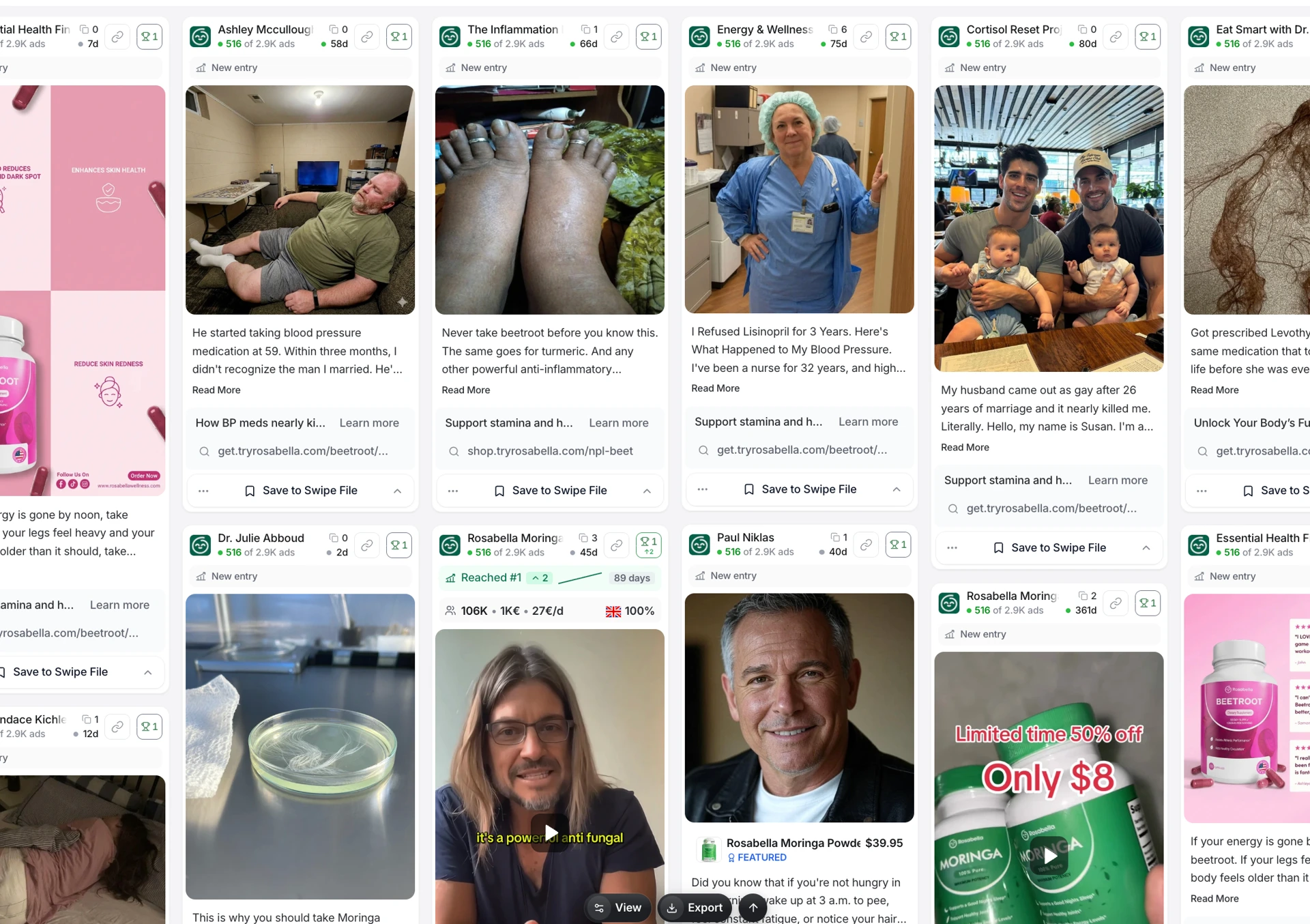
Image sourcing — where the real ones come from
Most operators generate every native image with AI. That works for some niches. For others, real images outperform AI. Especially when the niche has a strong "I've seen this in my feed before" pattern recognition.
Source 1 — Reddit
Everyone uses Reddit for research. Fewer use it for native images. When you find a strong post in a relevant subreddit, the post image is often more native-feeling than any AI image you could generate.
Workflow: type your Persona's concept into Reddit search, find posts with relevant images, screenshot, use as your native ad image.
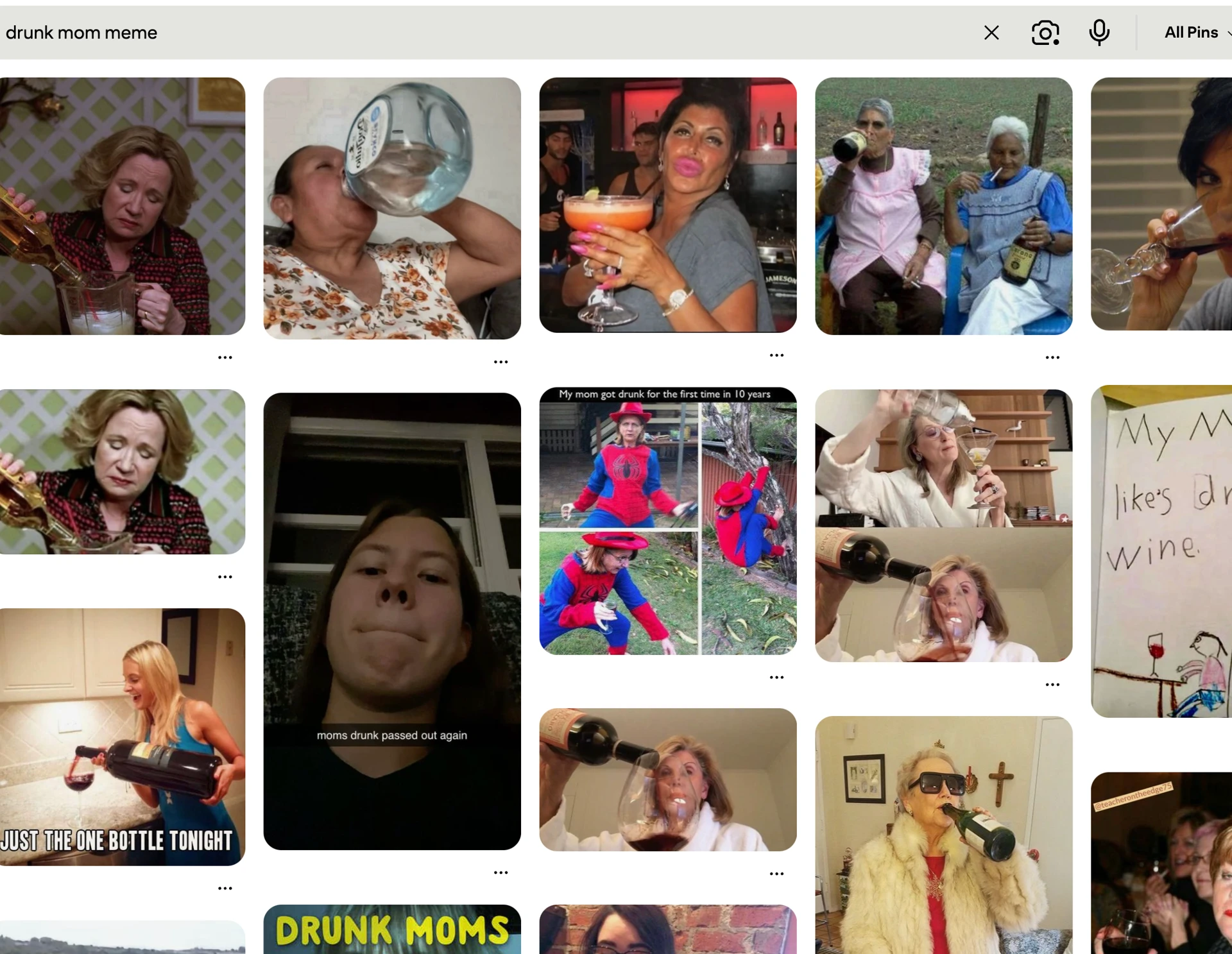
Source 2 — Pinterest memes (the underground sauce)
This is the method I've been hitting winners with that I haven't shared anywhere else.
Memes that people already see natively in their feed work as native ad images.
Example workflow: searching Ozempic mom memes on Pinterest produces a stream of weight-loss-related memes that look exactly like what your target avatar already sees in her feed.
When you took insulin for the meal and it's gross. When your weight loss week looks like X. Every week like clockwork D-day Ozempic shot.
These images:
- Feel native because they ARE native — they originated in feed
- Carry the avatar's existing emotional patterns
- Don't trigger "ad detection" instincts
- Pair beautifully with long-form personal-confession copy in primary text
The workflow: identify your Persona's existing meme culture → search Pinterest for those memes → pull 3-5 strong meme images → pair each with your long-form native copy → run as static native ads.
I've hit winners running real memes as native images while every competitor in the niche was running generated AI doctor portraits and lifestyle stock photos.
Compliance caveat: memes can drift into trademark / IP territory faster than AI images. Stay clear of memes that include public figures, branded characters, or copyrighted screenshots. Use generic format memes that don't tie back to specific IP.
Source 3 — Native-feeling stock or AI
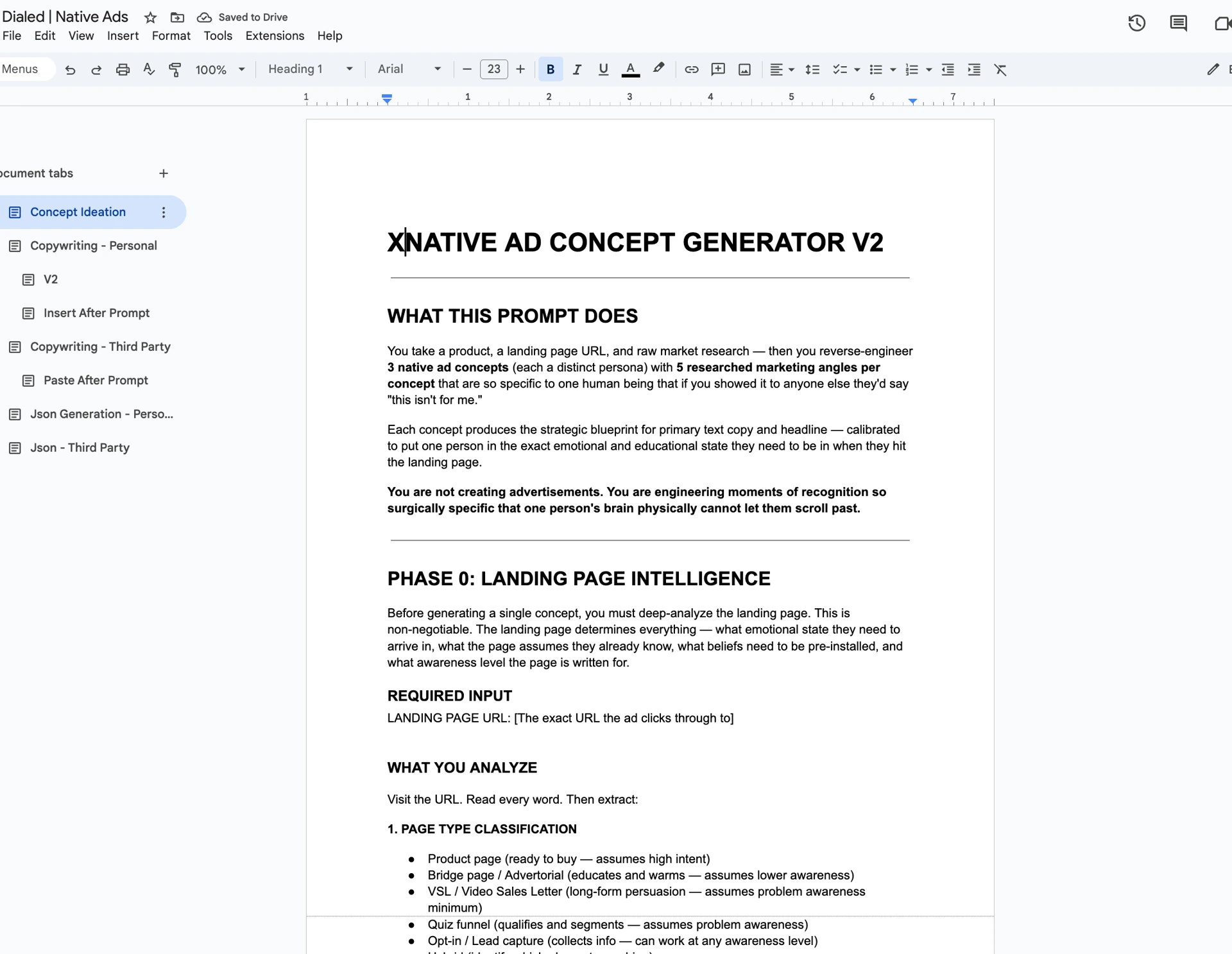
When real images aren't available or are too risky for compliance, generate native-feeling AI images via Nano Banana 2 with the JSON image converter prompt (Module 3 → Native sub-page). Bias toward "phone-shot," "iPhone realism," "candid" prompts — anything that fights the over-polished AI aesthetic.
Source 4 — Native-pattern brands to study
Brands worth bookmarking for native ad image inspiration:
- Rosabella (every native ad concept format that exists, beautifully executed)
- Over (apologies to the operator running this — public brand, excellent native ad library)
- Established weight loss / cardiovascular / supplement brands with mature native testing programs
Study their feeds. What does their image look like? What does the first 3 lines of copy look like? Mimic the structure, not the content.
The core copy principle — write what they want to consume
This is the most important copy principle in native ads, and the most underused.
Don't give people food they don't want to eat. Give them their favorite food. Give them dessert.
You can't make someone care about your product by talking about your product. You make them care by talking about what they already care about — their pain, their fear, their identity, their existing entertainment patterns — and then bridging that to your product at the end.
Application: match the reading style your avatar already consumes
Different avatars consume different content. Your native ad copy should feel like the content they already read for pleasure.
| Avatar | Content they consume | Reference style for your native |
|---|---|---|
| Women 35-55 | Romance novels, lifestyle Instagram, family dramas | First-person emotional confession, body-feeling language, relational stakes (50 Shades of Grey style emotional intensity) |
| Men 30-45 nerds | Gaming forums, sci-fi, tech blogs | Technical mechanism deep-dive, problem-solving framing, GameStop / tech reference style |
| Mothers 25-40 | Mommy Instagram, parenting blogs, school-pickup small talk | Day-in-the-life format, peer-mom voice, casual oversharing |
| Men 50+ | News editorial, sports talk, finance | Authority-frame, mechanism-driven, "Dr. X told me" structure |
Concrete tactic for the women avatar: download a reference book your avatar reads (50 Shades, Bridgerton, etc.). Drop the PDF into your Claude project. Reference it in your copy prompts: "Match the prose style and emotional intensity of the attached reference text." Your native copy will instantly feel more native to your avatar's consumption patterns.
I've had winning native ads that were 15 seconds long — just a day-in-the-life format — because they matched the content the avatar already wants to consume. Not because they were "selling harder." Because they were native to consumption.
Brandon-rule on native ad craft
The reason most natives fail isn't the product. It's that the copy doesn't read like what the avatar already chooses to read.
You'll see it everywhere. Operators writing generic "Are you tired of X? Try our Y" hooks for women avatars who consume 50 Shades-level emotional intensity. Operators writing "scientific breakthrough" copy for moms who consume mommy Instagram. The mismatch between avatar consumption pattern and ad copy is the silent killer of 80% of native ad attempts.
Get this right and your CTR doubles. Same product, same offer, same audience — different copy registry. That's all it takes.
Cross-references
This sub-page sits inside a deep web of related material:
- Module 5 → Customer Research is the qualitative input that defines who your Persona is and what they actually consume
- Module 5 → The Brief & Concept Tracking System is the framework foundation for Persona × Angle × Awareness (covered conceptually there, applied to natives here)
- Module 3 → Native is the Claude automation / production layer (where the prompts live and how to generate at scale)
- Module 3 → Advertorials is the off-feed long-form version of what natives are doing in-feed
- Module 3 → Catalyst is the visual editorial version (Catalyst Ads Breakdown in Module 7 deep-dives this further)
- Module 7 → Advertorials Breakdown is the strategic deep-dive on advertorials specifically
- Module 7 → Catalyst Ads Breakdown is the strategic deep-dive on Catalysts specifically
The natural production progression once you have a winning native:
- Native wins in feed (this sub-page)
- Promote to advertorial with images on a bridge page (Module 7 → Advertorials Breakdown)
- Promote to Catalyst with editorial framing and image-rich layout (Module 7 → Catalyst Ads Breakdown)
- All three formats running in parallel at scale once each version has been validated
What's gatekept inside the masterclass
The principles are here. The artifacts and prompts live in the masterclass:
- The full 31-minute video walkthrough of this entire native ad framework with live examples
- The Concept Generator prompt — the prompt the 1-on-1 guys are running to generate brief / Persona / Angle / Awareness combinations at scale
- The Copy Generation prompts — separate prompts for first-person, doctor authority, and third-party witness angle styles
- The JSON Image Converter prompt + the Nano Banana 2 workflow for generating native-feeling images at scale
- The Rosabella native ad deep dive walked through visually — me on screen pointing to specific copy beats, image variants, awareness transitions
- The meme-as-native-image workflow demonstrated live — Pinterest searches, image selection, copy pairing, compliance considerations
- The native ads swipe file — a curated set of winning native ads across niches, with annotations on why each one works
Want the full 31-minute walkthrough, the Concept Generator prompt, the Copy Generation prompts, the JSON Image Converter, the Rosabella deep dive, the meme workflow, and the native ads swipe file? All inside the RunItUp Masterclass → Join here
Join now to lock in your rate, prices are increasing quickly.