Honest preface
I'm putting this sub-page out before I'm fully expert on it. I'm still learning this layer of the game. It's the part of DTC where the top operators in the space pull away from everyone else, and I'm actively spending money on consultants, hiring a numbers person, and learning from guys at higher revenue tiers than me to get better at it.
What follows is the model I'm using right now and the principles I've internalized so far. I'll update this sub-page as I learn more from the operators I'm working with. If you're already running NCPA-driven subscription brands at scale, hit me up — I want to compare notes.
For everyone else: this is enough to get you out of the pump-and-dump direct response mindset and into the brand-building / LTV-driven mindset that the real wealth gets built on.
Why NCPA > ROAS
Most DTC operators live and die by ROAS (Return on Ad Spend). It's the number Meta surfaces in the dashboard. It's what the agencies report on. It's what every YouTube guru talks about.
ROAS is a lie at scale. Here's why:
ROAS counts every dollar of revenue, including from existing customers buying again. If you have a strong subscription base and your subs are rebilling every 30 days, your ROAS looks great — but you might not actually be acquiring any new customers. The number is masking the real performance.
NCPA (New Customer Acquisition Cost) is the metric that actually matters. NCPA = ad spend / NEW customers acquired. Strip out the rebills, strip out the repeat buyers, just look at how much it costs to bring net-new humans into your buyer pool.
Why this matters:
- NCPA tells you if you're actually growing. ROAS can stay stable while your customer pool is shrinking.
- NCPA scales predictably. ROAS doesn't — as you push more spend into the same audience, ROAS degrades non-linearly. NCPA degrades more linearly.
- NCPA lets you compare across channels. Meta NCPA, Google NCPA, TikTok NCPA — you can blend them and see your real cost to scale.
Once you start optimizing for NCPA instead of ROAS, you stop chasing the wrong number and start building toward the actual lever that matters: how much you can profitably spend to acquire a customer given their lifetime value.
The DTC subscription profitability model
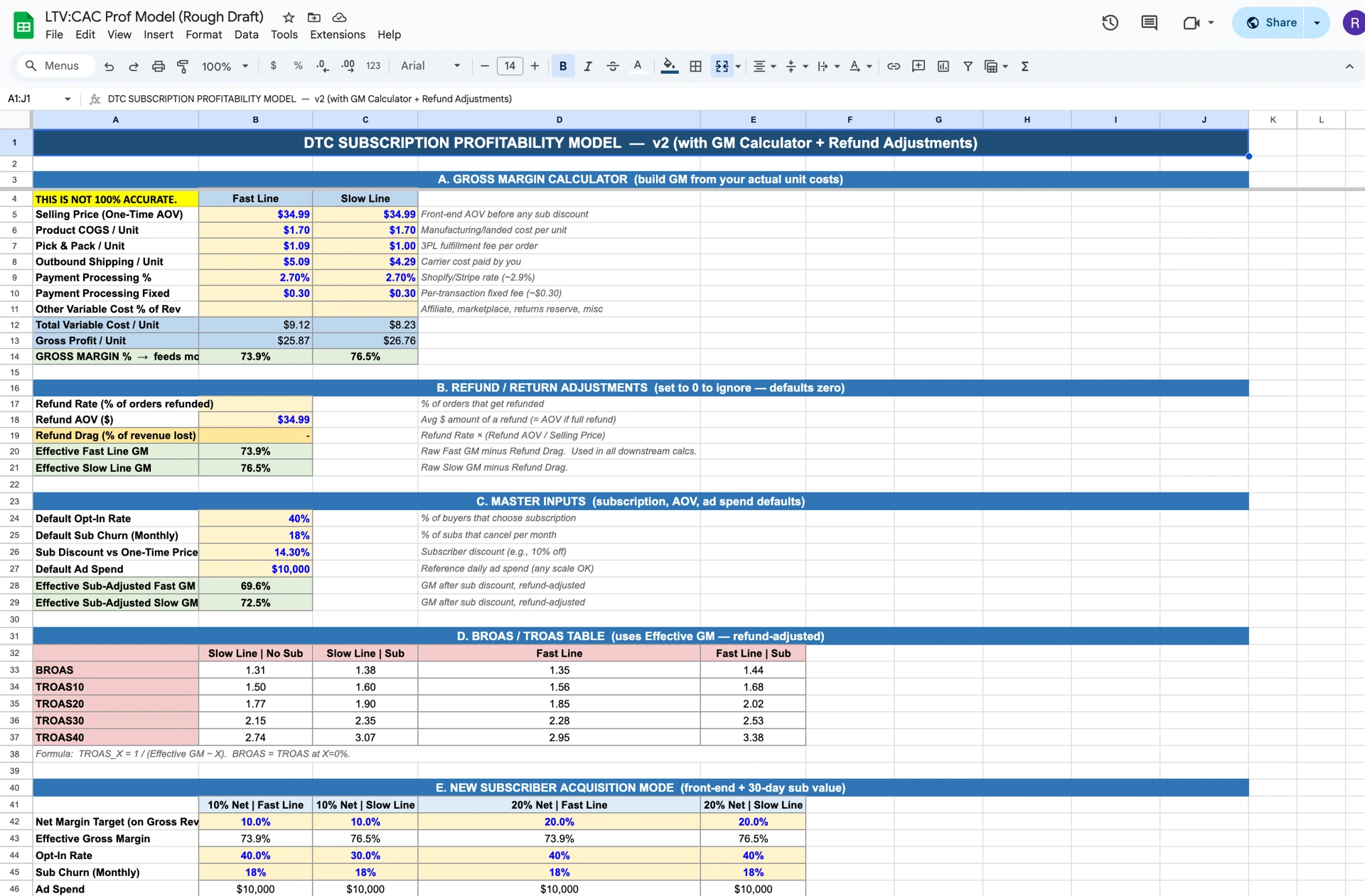
This is the model I built in Claude based on a simpler version one of my brands was using. Caveat: I made this in 15 minutes with Claude, the formulas may not be 100% accurate, hire a real numbers person to validate. Use this as a directional framework, not gospel.
Inputs:
| Input | Example value |
|---|---|
| One-time AOV | $48 |
| Subscription AOV | $34.99 (with 14.3% sub discount) |
| Product cost (pick & pack supplements) | ~$6-7 |
| Payment processing | 2.9% + $0.30 |
| Subscription opt-in rate | 30-40% (white hat, no pre-checks) |
| Monthly churn | 18% (mine, currently — was 40% before optimization) |
| Refund rate | varies (often skipped to avoid skewing the model) |
| Default ad spend | $10k/day (just for cleaner numbers) |
Outputs the model spits back:
- Gross margin per unit (one-time vs sub)
- Effective sub-adjusted gross margin — accounting for sub mix
- Refund-adjusted breakeven ROAS — what ROAS you need to break even, by margin tier
- New subscriber acquisition mode — forecasted +30 days of subscription value at given spend levels
- Front-end + 1 rebill cycle ROAS target — drops the ROAS you need significantly
The key insight: subs change the math. With 40% sub opt-in at 18% churn, your front-end breakeven ROAS drops from 1.31 (no sub) to 1.02. Your target ROAS goes from 1.85 (non-sub) to 1.28 (sub-adjusted with 1 rebill).
This is why brands like Grunz can run aggressive front-end CAC — the rebills make it work out.
The actual calculator with formulas + the explanation of how each output is derived is gatekept inside the masterclass. I'll keep iterating on it as I learn from the operators I'm hiring/consulting with.
The 3:1 LTV:CAC math
This is the rule top brands run on: spend up to 33% of customer LTV to acquire them. If a customer is worth $450 over their lifetime, you can profitably spend $150 to acquire them.
Grunz example: they're pushing toward a $1.2B exit. Inside their ad accounts you'd see 0.6 ROAS, 0.8 ROAS — numbers that look insane on paper. They make it work because:
- They know each customer is worth ~$450 LTV
- They can spend $150 CAC profitably
- They've got the funding to wait the months it takes for that LTV to realize
- They've got the data to forecast confidently
My current LTV:CAC ratio is closer to 1.5-1.6:1. I'm not running 3:1 yet because:
- I don't have the historical data to confidently forecast 6+ months of LTV
- I don't have the liquid capital to bleed cash for 6 months waiting on rebills
- My risk tolerance — if I lose all this money on a 3:1 forecast that doesn't pan out, I eat it personally
As you build:
- More data → tighter LTV forecasts → more confidence to extend
- More capital → ability to wait on the rebill cycles → 2:1, 2.5:1, 3:1
- Better systems → lower churn → bigger LTV → bigger CAC budget
This is also why I do info products. The funding from info lets me play a longer game on the brand side. If you're financing your DTC operation purely from DTC profit, you're stuck on tight first-order economics. Other revenue sources — info, consulting, agency work — let you push into the LTV-driven game faster.
Multi-channel blending math
The other lever for pushing CAC higher: add channels. Each new channel that comes in at a lower CPA than your max lets you push your primary channel higher.
Example math:
| Channel | CPA | Effect on Meta budget |
|---|---|---|
| Meta only | $44 | Maxed at target |
| • Google Ads (CPA $20) | Blended drops | Can push Meta to $49 |
| • Amazon (CPA $30) | Blended drops more | Can push Meta to $60 |
| • TikTok (CPA $35) | Blended drops further | Can push Meta even higher |
Each channel lets the others run hotter. Meta isn't the bottleneck once you have 3-4 channels feeding the same customer pool — your blended NCPA is the actual constraint.
This is why every scaled brand runs subs everywhere. It's not because they're fanatical about omnichannel — it's because the math forces it. You can't get to 8-figures on Meta alone competing against guys running Meta + Google + Amazon + TikTok + organic.
Order to add channels:
- Meta first — covered in Module 3. Highest-leverage starting point.
- Google Ads — branded search defense + non-branded scale. Covered in the next sub-page.
- Email / SMS — back-end retention. Covered in another sub-page in this module.
- Amazon — once you've got brand recognition from paid social
- TikTok ads — once you have creator output to feed it
- Organic distribution — covered in Mass Organic Distribution sub-page
Don't add channels in parallel from day one. Compound them. Get Meta dialed, then layer Google. Get Google + Meta dialed, then layer Amazon. Each one extends the budget on the previous.
The shift from direct response to LTV brand building
Real talk on what this all means.
The direct response game — pump-and-dump, optimize for first-order profit, don't worry about repeat — has a ceiling. The ceiling is rising every year because:
- Cost to advertise is increasing (every single year)
- Payment processing fees + chargeback fees keep getting harder
- Refund rates trend up as customer skepticism grows
- Privacy / iOS changes broke pixel-based attribution
- Two-ROAS days are hard at any meaningful scale
You can run direct response forever. People do. But the wealth in DTC is being built on longevity, not first-order profit.
The shift looks like:
| Direct Response Mode | Brand Building Mode |
|---|---|
| Optimize first-order ROAS | Optimize blended NCPA |
| Pump & dump | LTV / brand equity |
| Cash collection now | Forecasting 3-6 months out |
| Avoid refunds | Build customer love |
| Solo channel (Meta) | Multi-channel blended |
| 1.8x ROAS target | 0.6-0.8x front-end, 2x+ blended |
The brands at $1B+ exits are all in brand-building mode. None of them are running pump-and-dump direct response.
This isn't a moral judgment. Direct response is fine to start. You need cash collection. You need to learn ad ops. You need to validate angles. But know that there's a ceiling, and know when it's time to shift.
The 0.6 ROAS + map funding play (the advanced tier)
For the operators I see at the top of the game — guys spending six figures per day, running 0.6 ROAS on the front-end, six months out from breakeven — the game is funded growth.
Map funding = recurring revenue financing. Lenders look at your subscription base and lend against the predictable future revenue. If you have $500k MRR with predictable churn, you can get a credit line against that to spend on acquisition. You're betting future LTV against present cash, lender takes a cut.
This is how brands run 0.6 ROAS at six-figure daily spend without going broke. They're not profitable on cash basis day-to-day. They're profitable on a 90-180 day rolling basis as the rebills come in.
I'm not running this play yet. I'm not at the scale, not at the data confidence, not at the risk tolerance. But this is the layer that compounds into eight-figure exits and beyond.
If you're reading this and you're 7-figure plus on revenue, this is the part of the game to start exploring. Talk to guys running it. Talk to lenders. Build the LTV models. Get the data. Know your numbers cold before borrowing against them.
I'll update this sub-page when I'm closer to running this play myself.
The closing principle
Two takeaways:
1. Know when to shift games. Don't stay in the pump-and-dump direct response game too long. Don't stay in the "callous ripping, not caring about customers" mode too long. Both have value when starting — both have a ceiling. The wealth is in longevity. Customers who come back. Brands people remember. Subs that compound.
2. Hire nerds. Numbers people are 10x more valuable than they look. The math in this sub-page is the surface — the actual model, the rolling cohort analysis, the channel attribution, the LTV forecasting, the rebill cycle modeling — that's a full-time job for someone. Hire that person. Pay them well. They'll do numbers good and you'll do strategy.
I'm hiring mine right now. When I have the updated, accurate, validated version of all this — I'll update this sub-page and let the masterclass community know.
What's gatekept inside the masterclass
The principles are here. The actual artifacts live in the masterclass:
- The Claude-built subscription profitability calculator with all formulas + how to plug your own numbers in
- The NCPA tracking dashboard template I'm currently using (Google Sheets)
- Multi-channel attribution setup — UTMs, GA4 + Meta + Google blended view
- My actual brand numbers — what I'm running across my brands, what's working, what isn't, churn breakdowns
- Updates as I learn from the operators I'm consulting with — biweekly updates as I get smarter on this layer
- Map funding intro / the LTV-financing layer — when I start running it, full breakdown drops in masterclass
Want the actual calculator, the NCPA dashboard template, and the live updates as I learn from the top operators in this game? All inside the RunItUp Masterclass → Join here
Join now to lock in your rate, prices are increasing quickly.