I sat with this SOP for a while because it's the document that's saved my brands the most money — by orders of magnitude. Not the ad accounts. Not the email flows. The customer support system.
Customer support is the most under-rated lever in DTC. It costs almost nothing to run. Most operators ignore it. The ones who DO build a real CS system out-earn the ones who don't, every time.
I neglected this myself for a long time. I was the guy answering emails late at night, sending one-line responses, telling myself I'd build a real system later. Later came when chargebacks started piling up and refund requests started bleeding the brand. That's when I built the SOP my team uses today.
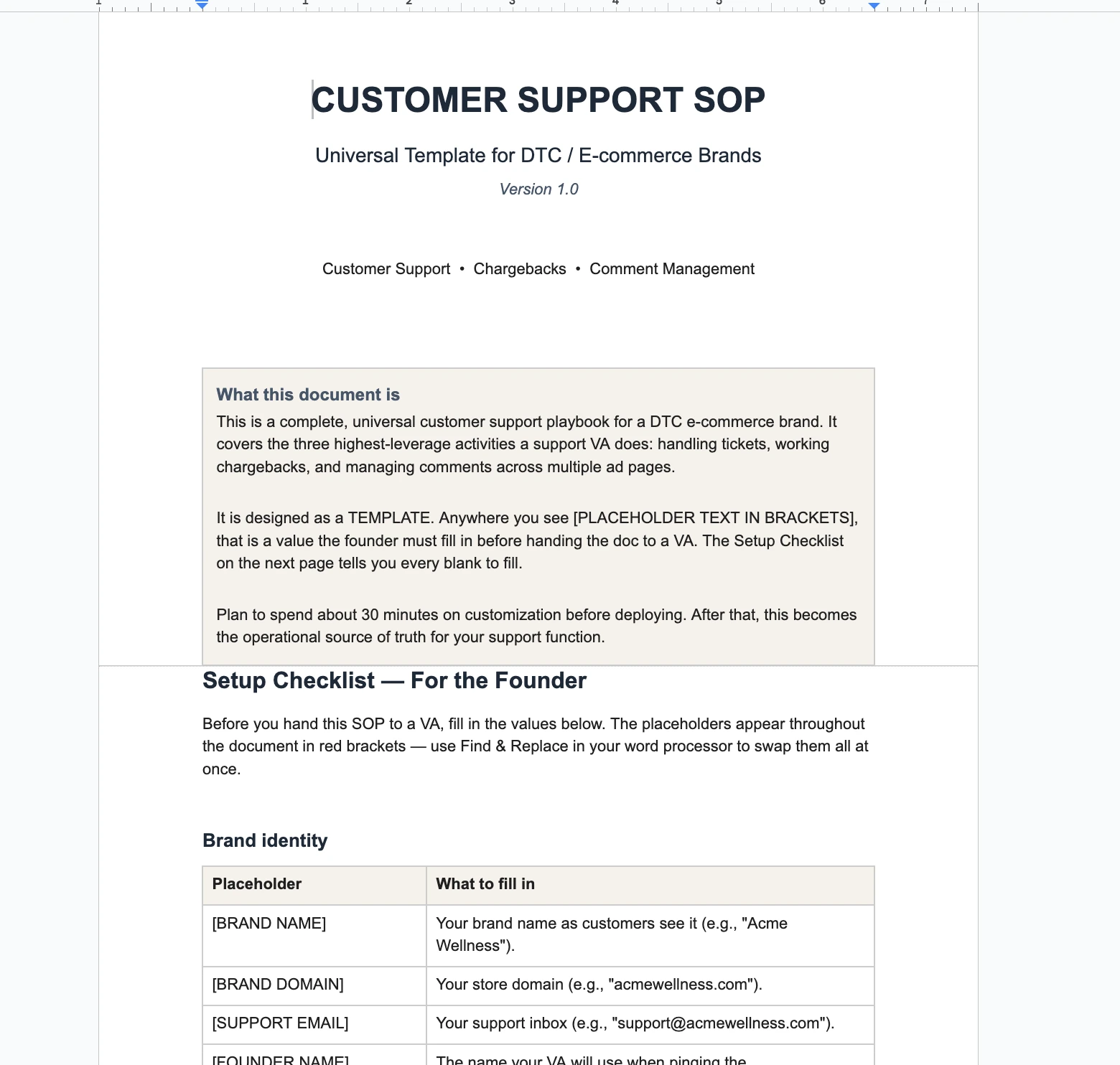
This page is a preview of what's in it. The actual SOP — every script, every decision tree, every template, every tool integration — is gatekept inside the masterclass. I'm sharing the structure and the highest-impact frameworks here so you understand why this SOP matters. The tactical execution lives in the masterclass.
Why customer support matters more than operators think
If a customer reaches out and you don't respond, you've started a clock. That clock ends in one of three ways:
- They forget about it (rare)
- They request a refund (common)
- They file a chargeback (worst case)
The chargeback is the worst. Chargebacks cost more than the refund itself — you lose the sale, you pay processor fees, AND your chargeback rate increases. Cross 0.3% and you're in trouble. Cross 1% and your payment processor cuts you off — which means no business. Game over.
The whole CS SOP is built around one principle: respond fast, respond honestly, prevent chargebacks at all costs.
Even if the response isn't positive — "yeah, I'm sorry your order is delayed, it'll be there in 3-4 business days" — it's a response. Customers need to feel spoken to.
Here's the analogy I use to drill this into my team. Think about your girl. Would you rather her ghost you or argue with you? Neither is great. But if she's arguing with you, communicating with you, there's still some thread — respect, reciprocity, hope. You know she's not out doing something else with somebody else. If she's ghosting you, you have no idea what she's doing.
Customer support is the same. Treat them like a relationship because that's what it is. They're the bloodline.
Hiring customer support — quick version
Before the SOP matters, you need the person. Quick playbook on hiring:
Where to find them:
- Upwork (my default — fast turnaround, lots of options)
- Onlinejobs.ph (cheaper rates, more vetting needed)
- Your network — even hiring a friend or sister works for this role. It's not that hard.
What to look for:
- Responds quickly (test this in the application phase — if they take 2 days to reply to your message, they'll take 2 days to reply to your customers)
- Kind energy in their writing
- Good English (this is non-negotiable)
- Experience with other DTC brands is a plus — they've seen similar SOPs and won't need every micro-detail explained
When to hire:
The moment you start dreading checking your support inbox. If you're spending 30+ minutes a day on emails, hire. The compression on your brain is costing you more revenue than the $100–$200/week the hire costs.
When to scale to multiple CS people:
Once you're past roughly 50 tickets/day. The structure: promote your most experienced one to a managerial role handling past tickets and training, then bring on new inbound handlers underneath them. Customer support is a department, not a single hire.
What's in the SOP
The full SOP is a long document. I'll just call out the structure here so you understand the surface area:
Section 1 — Mission and Loyalty Rules
The most important section. Sets the philosophical framing for every decision the CS team makes.
Section 2 — Tools and Workflow
Help desk, tag taxonomy, snooze rules, store admin permissions, subscription management, comment management, supplier fulfillment channel.
Section 3 — Daily Routine
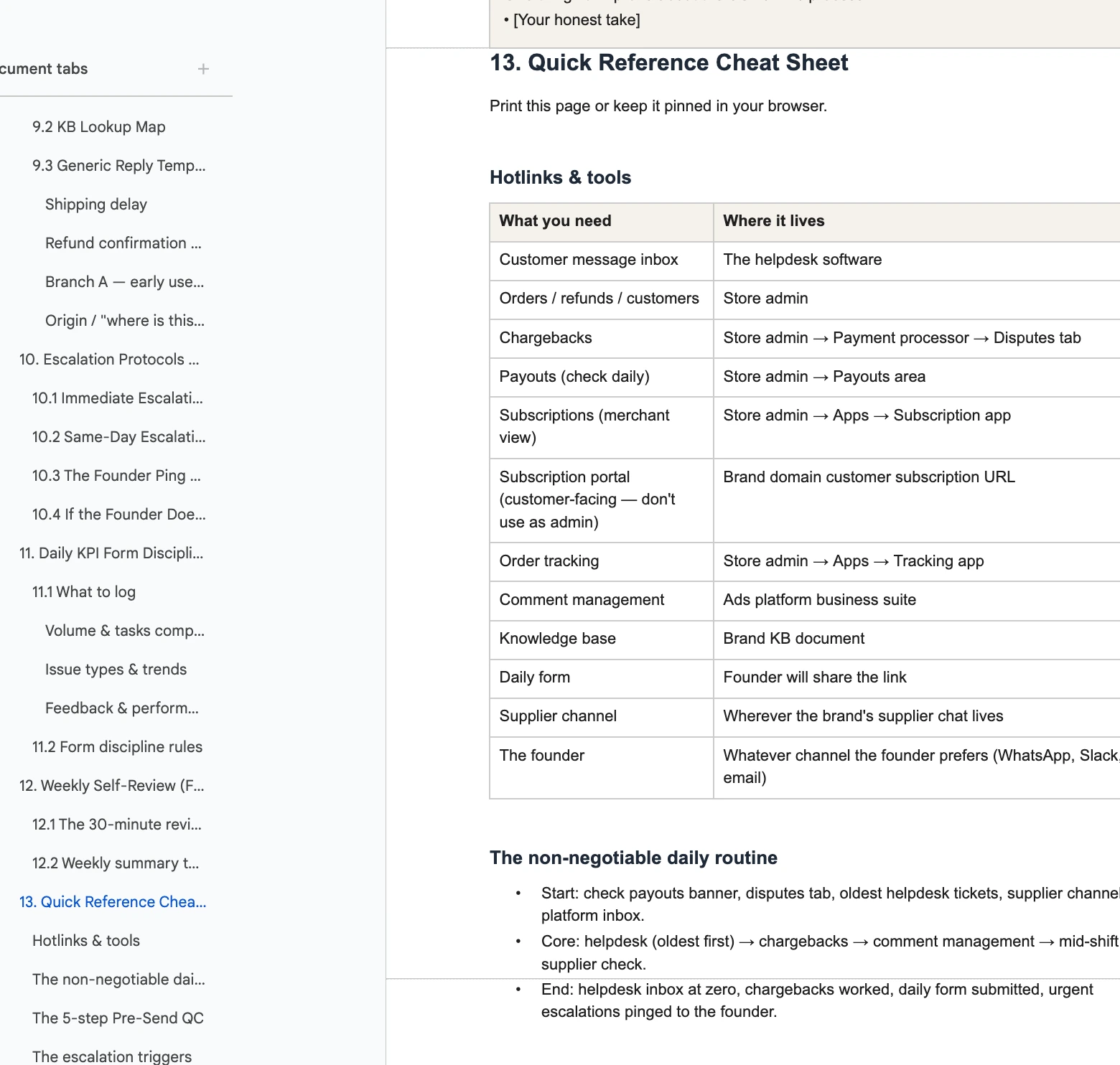
The exact morning sequence: check payouts → disputes → help desk → supplier channel → ads platform → business suite → comments. Plus pre-QC checklist for new hires.
Section 4 — Refund Saver Decision Tree
How to refund customers without bleeding money. Soft-door framework for potential buyback.
Section 5 — Chargeback Response
The most valuable section. How to win every chargeback. Threat response. Withdraw pursuit script. Follow-up cadence (day 2, day 6, daily after). Evidence packet structure.
Section 6 — Comment Management by Page Type
Different page types (brand, editorial, personal, doctor) get different response styles. Templates for each.
Section 7 — Common Scenarios
Pre-built replies for the questions every CS team gets: where the product is made, ingredient questions, shipping delays, returns, etc.
Section 8 — Escalation Protocols
What gets escalated to founder immediately, what can wait, and how to ping the founder so the message actually gets read.
What gets escalated immediately (no exception):
- Customer mentions self-harm, suicide, or mental health concerns — this is the most important one. The CS team has a specific protocol for these conversations and the founder is looped in immediately so we can handle it as humans, not as a brand.
- Customer reports a serious physical reaction
- BBB, FTC, or viral social media threats
- Multiple customers reporting issues with the same batch (potential product issue)
- Negative comments that could expose brand-level issues
- Any new chargeback that appears (volume tracking)
Same-day escalations get batched and reviewed by the founder once a day. Real-time escalations get a direct ping. The SOP includes the specific message format for both — most of the founder ping templates are gatekept inside the masterclass since the wording determines whether the message actually gets read in a flood of small notifications.
The self-harm protocol specifically is the section I take most seriously. It's not just an escalation — it's a defined response sequence designed to make sure the customer is heard, the right resources are referenced, and the brand handles the situation as a human first and a business second.
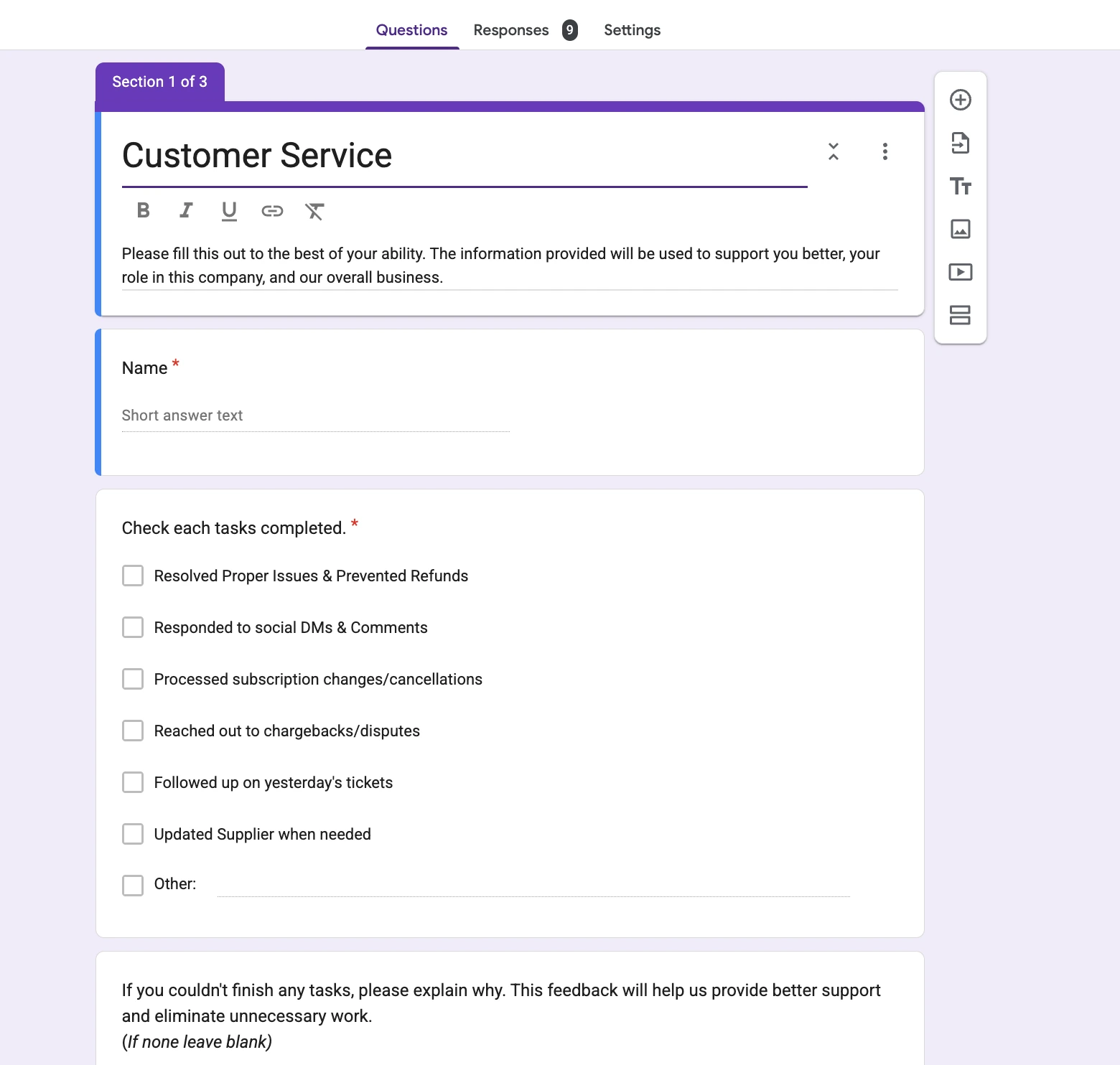
Section 9 — Daily KPI Form
Google Form the CS team fills out at end of shift. Auto-logs into a Google Sheet I can review without going into the help desk.
The exact fields:
- Name
- Tasks completed today (checkbox list against the daily routine)
- Anything you couldn't finish + why
- Issue types encountered today (so I can track trends across the week)
- Were there any new or unusual issues today?
- Does anything need my attention today? (yes/no — if yes, what + why)
- What slowed you down today?
- Anything you think needs improvement?
The form is intentionally simple. I value getting it filled out daily way more than I value detailed metrics. Long-term I'll automate a deeper KPI dashboard using AI to summarize the week's tickets and surface the trends, but for now this is what I get every day at end of shift. Consistent simple beats inconsistent comprehensive every time.
The 6 most valuable frameworks in the SOP
These are the highest-leverage parts. I'm giving you the framework. The tactical scripts and exact templates are in the masterclass.
1. The customer-first loyalty rule (with 3 exceptions)
The CS SOP literally says: "Your loyalty is to the customer, above the business."
I put this in writing because of myself. When money's coming in, it's hard to keep the focus on the customer. The natural pull is toward "what's good for the business." But your customer support team is in the trenches with customers all day — they need a clear north star.
There are exactly three exceptions where you protect the business over the customer:
- Suspected fraud
- Repeat refund requests on the same profile
- Anything requiring founder approval
Other than those three: customer first, always.
This rule has saved me more money than any other policy. CS teams that operate from "customer first" prevent way more chargebacks than CS teams that operate from "protect the business."
2. The chargeback math (and the win-rate bonus structure)
Chargebacks cost roughly $25–$30 per dispute filed (varies by platform). They also raise your chargeback rate, which is a critical metric you cannot afford to let slip past 0.3%.
Your CS team's job is to win every chargeback.
To incentivize this, my SOP includes a bonus structure: $25 per won chargeback. The math:
- If they win the chargeback, I'm out $25 (the bonus)
- If they lose, I'm out the original transaction + processor fees + chargeback rate damage
Net: paying $25 for a win is a steal. The bonus is the cost of the win, plus it incentivizes the CS team to hustle to win them. Set the bonus higher or lower based on your platform's rates.
If you're using a cheaper platform like Disputely, your bonus could be $13–$15 instead of $25. Same logic — pay for wins.
3. The threat response philosophy
When a customer threatens to dispute with their bank — DON'T fight them. Give them the money.
The SOP literally says: "If they threaten to dispute with their bank, refund immediately."
The math: a chargeback costs more than a refund. The refund is just the original transaction. The chargeback is transaction + fees + rate damage. So the threat is the moment you cut your losses.
This is counterintuitive to most operators who feel "they shouldn't get away with this." Doesn't matter. The money's already gone — the only question is whether you take additional damage on top. Take the L, prevent the worse L.
4. The withdraw pursuit script structure
When a chargeback IS already filed, your CS team needs to convince the customer to withdraw it.
The SOP includes a specific script structure — the exact wording is in the masterclass — but the framework:
- Acknowledge the dispute (no defensiveness)
- Confirm a full refund has been issued
- Explain why withdrawing helps both parties
- Add an incentive — gift card to their account once withdrawn
The gift card incentive is the multiplier. Most customers won't take the time to withdraw without a reason. The gift card gives them one. We're testing this script right now — out of three pursuits last week, one customer withdrew. The other two are still in follow-up.
If gift cards don't work consistently, I'll test sending physical gifts — flowers, branded merch, whatever drives the withdraw rate up. The cost of the gift is always less than the cost of the chargeback.
5. Page-type comment response templates
If you run advertorials or third-party-style ad pages, the comment management is critical. Comments visible on your ads either reinforce the angle or break it.
The SOP has different response templates for:
- Brand pages (direct product, brand voice)
- Editorial pages (third-party feel, more neutral)
- Personal pages (founder-style, intimate)
- Doctor / expert pages (authority voice)
If your CS team responds to a comment on an editorial page using brand-page voice, the page's authenticity gets blown. Click-through rate drops. Conversion rate drops.
This single framework — different response styles by page type — has measurable impact on advertorial performance. The exact templates are in the masterclass.
6. Marketing-savvy responses to brand-vulnerable questions
Some questions hit you harder than others. The classic example for supplement brands: "Where is your product made?"
If components come from a region that customers react to negatively — China, for instance — the SOP doesn't tell the CS team to dodge or lie. It pivots the response.
Instead of leading with country-of-origin, the script highlights:
- Facility certifications (FDA cGMP, ISO, etc.)
- Batch testing protocols
- Ingredient-level sourcing ("the creatine is sourced from X, the magnesium from Y, the L-theanine from Z")
The customer gets a real, specific answer that builds trust without pointing at a single country that triggers a knee-jerk negative reaction. Be smart. You're still a marketer.
The SOP handles dozens of these brand-vulnerable common questions — quality concerns, manufacturing details, ingredient sourcing, pricing pushback. The exact templates for each are in the masterclass.
Tools the SOP integrates with
The SOP is built around a specific stack. Most of these are interchangeable, but here's what we use:
- Help desk: Reamaze (recommended — flexible, paid). Alternatives: Brandify, Brandwise, Gmail + a Google Sheet (what I used for the longest time).
- Comment management: Comment Guard or Meta Business Suite directly.
- Subscription management: Loop (what we use). Alternative: Kaching Subs.
- Tracking app: Parcel Panel.
- Chargeback automation: Chargeflow (premium, automated). Alternative: Disputely (cheaper, manual).
- Knowledge base: Custom GPT trained on the SOP + brand-specific info, so the CS team can ask the bot before pinging me.
Why this SOP is gatekept
Five of these frameworks could each move a brand from 6-fig to 7-fig if implemented correctly. The full SOP — every script, every decision tree, every template, every step-by-step walkthrough of the daily routine — is hundreds of hours of operating experience compressed into a single document.
It's also currently being iterated on. My customer support SOP isn't what I was using a month ago — it gets updated every time my team encounters a new edge case or my brand structure changes. The masterclass version stays current.
Want the full SOP? Every script, decision tree, template, and the live updated version — inside the RunItUp Masterclass → Join here
Join now to lock in your rate, prices are increasing quickly.