There's a specific moment when hiring a UGC creator on retainer makes sense — and it's not always day one. Let me lay out when it does and when it doesn't.
It doesn't make sense when:
- You're ripping products and have a constant supply of competitor B-roll you can use
- You can use AI workflows to insert your packaging into existing creator content (Nano Banana 2 for image swaps, then Seedance for video) and scale on borrowed creative
- Your custom packaging doesn't matter yet — you're just testing if the offer/angle works at all
It does make sense when:
- You have custom packaging or a custom brand identity that needs to be in the content
- You need scriptable, briefable creative — content tied to specific marketing angles you're testing
- You're past the "does this product work?" stage and into the "how do we win at scale?" stage
- You want the organic feel of someone actually using your product, in their own voice, with their own audience
AI UGC isn't there yet — though it's getting closer. I've been testing AI-generated UGC in Claude with Seedance, and we're going to keep pushing on it. But for now, real UGC creators on retainer give you outsized return that AI can't fully match.
This sub-page covers how I hire and structure UGC creators. The approach is direct: $500/month/creator, 5 videos/week, 2 creators = $1,000/mo for 50 videos and 250+ B-roll clips. 10–50x cheaper than paying per-video rates from agency UGC platforms.
The math — why this hire is non-negotiable
The standard market rate for UGC content from agency platforms (JoinBrands, Insense, Billio) is $300–$1,500 per single video. That's per video. One.
The retainer model:
- $500/month per creator
- 5 videos/week minimum
- 25 videos/month
- Effective rate: $20/video
Two creators on retainer: $1,000/month → 50 videos → effective rate $20/video.
Compare to $300–$1,500/video rates: the retainer is 15–75x cheaper per piece of content.
But here's the multiplier most operators miss. Each UGC video isn't one piece of content. Each video has roughly 5 distinct shot types — a hook, a product intro, a use-case shot, a testimonial moment, a CTA. Your video editor can pull each of those segments and use them in different ad combinations.
50 videos/month × 5 distinct shots per video = 250 distinct B-roll clips per month for $1,000.
That's an effective rate of $4 per usable shot. No platform comes close.
This is why UGC retainers print money for ecom brands at scale. The cost per piece of content is so low that even mediocre creators give you outsized return.
Hiring the role
Where to find them:
- Upwork — my default. Throw up a job post titled "UGC Creator — [Avatar Description]," set the budget. Use the $25 URMA / shortlist boost — it accelerates how fast applications come in. You'll get a flood of applicants in 24–48 hours. If you don't have strong reviews on Upwork yet, expect slower fill — but it'll still happen.
- Twitter (X) — make a regular post (not an ad), use hashtags #UGC #UGCcreator. Creators will hit your comments, repost, and slide into your DMs. The Twitter creators tend to be more expensive than Upwork creators — most won't take the $500/mo retainer rate. But occasionally you'll find a banger.
- Move them up from affiliates — if you're running the affiliate community method from Module 1, your top performers in the community are natural retainer candidates. They've already shown they can produce. You're just upgrading their relationship from commission-based to retainer-based.
- Agency platforms — JoinBrands, Insense, Billio. Expensive but pre-vetted. Worth using if you're scaling fast and need volume immediately.
- Cold outreach — go on Instagram, find creators in your niche, DM them directly. This works if you're patient — most won't reply but the ones who do are usually higher quality and looking for direct brand work.
UGC creators are easy to hire. Don't make this complicated. If anyone tells you they "can't find UGC creators" they haven't actually tried.
What to look for — avatar embodiment, not "hot"
The single most important hiring criterion: does this creator look like, live like, and talk like your actual avatar?
This is where most operators fuck up. They hire the most attractive creator they can find, regardless of whether they match the avatar.
Wrong instinct: "She's beautiful, she'll get attention."
Right instinct: "She's a 33-year-old mom of two who works part-time as a nurse and lives in a suburban house with a husband who's also working. That's exactly my avatar. Hire her."
The reason: ads convert better when the viewer sees themselves in the creator. A 35-year-old struggling-to-sleep mom doesn't see herself in a 22-year-old fitness model. She sees herself in a 33-year-old mom who looks tired and is talking about how she struggled to sleep before she found this product.
What "avatar embodiment" looks like in practice:
- Lifestyle match — the creator's daily life reflects the avatar's daily life (kids, work, home environment, routines)
- Demographic match — age range, gender, ethnicity, region all align with the avatar
- Tone match — the way they talk on camera matches how the avatar talks (casual mom-voice vs Gen Z internet-speak vs professional vs whatever)
- Visual environment match — the spaces they film in look like spaces your avatar lives in (kitchen with kids' drawings on the fridge vs bare-walls aesthetic apartment vs whatever)
If the creator looks great but doesn't match the avatar, don't hire them. They'll produce beautiful content that doesn't convert.
The contract — usage rights upfront (V2 update)
V1 of this system: gentleman's agreement, "we'll use your content however we need." Worked most of the time. Failed catastrophically the few times it did fail — a creator's video would go viral, they'd come back demanding $2,000, claiming "you don't have usage rights on this one."
V2: signed contract for usage rights, every time.
Before any creator gets paid their first dollar, they sign a contract spelling out:
- What we can do with the content — paid ads, organic posts, Spark ads in partnership, repurposing into longer videos, B-roll for other content, whatever
- Where it can run — Meta, TikTok, YouTube, our website, our email, anywhere
- How long the rights last — typically perpetual (no time limit)
- What we won't do — we don't require them to post on their own channels (they can if they want), we don't require them to delete their content if they leave, etc.
- Spark ads / paid partnership setup — if we want to run their content as Spark ads through their account in partnership, the contract specifies how
The contract eliminates 95% of the headaches. The 5% that's left: creators who try to renegotiate after the fact regardless of contract. Those get paid the contract rate and we don't work with them again.
I use SignWell for the contracts — same e-signature platform as the affiliate community recruitment in Module 1.
The retainer structure
The base structure I'm running:
$500/month per creator. 5 videos/week minimum.
Of those 5 videos:
- 3 briefed — I (or my creative strategist) writes the brief, sends them a storyboard shot list, they execute against it
- 2 free-form — they make whatever they want based on their understanding of the brand and avatar
The 60/40 split (briefed vs free-form) matters. Pure briefed kills creator initiative. Pure free-form means you can't direct strategy. The balance gives you control on the angles you want tested AND lets the creator surface ideas you wouldn't have thought of.
The free-form videos are how you find your next briefer. If a creator's free-form videos consistently outperform your briefed ones, that's a signal — they understand the brand voice better than you do at the briefing layer. Promote them. Have them brief other creators. This is the path from UGC creator → creative strategist (without them realizing they're being trained for it).
Cadence rules:
- 5 videos/week is the floor, not the ceiling. Over-delivery counts toward bonuses, not toward next week's quota.
- Public holidays / sick days — give them notice. Makes them feel respected.
- Friday is the weekly check-in deadline (whatever cadence works for you — pick one and stick to it).
The affiliate commission (V2 update)
V1 of the retainer model: just $500/mo + bonus per winning ad.
V2 adds a layer: per-sale affiliate commission on top.
Every UGC creator on retainer gets an affiliate link. Every order driven from their content (organic posts they make on their own pages, our paid ads using their content, anywhere their content traces back to a sale) → they get a commission.
This changes the incentive structure. In V1, the creator's pay was capped at $500/mo + occasional bonuses. They didn't have skin in the upside. In V2, the creator's pay scales with the brand's success. The better their content performs, the more they make.
The compound effect: creators who see their content driving real sales push harder on quality, push harder on ideas, push harder on volume. They become invested in the brand because their income is now tied to the brand's growth.
This is the same mechanic that makes the affiliate community in Module 1 work, applied to retainer creators. Ownership creates output.
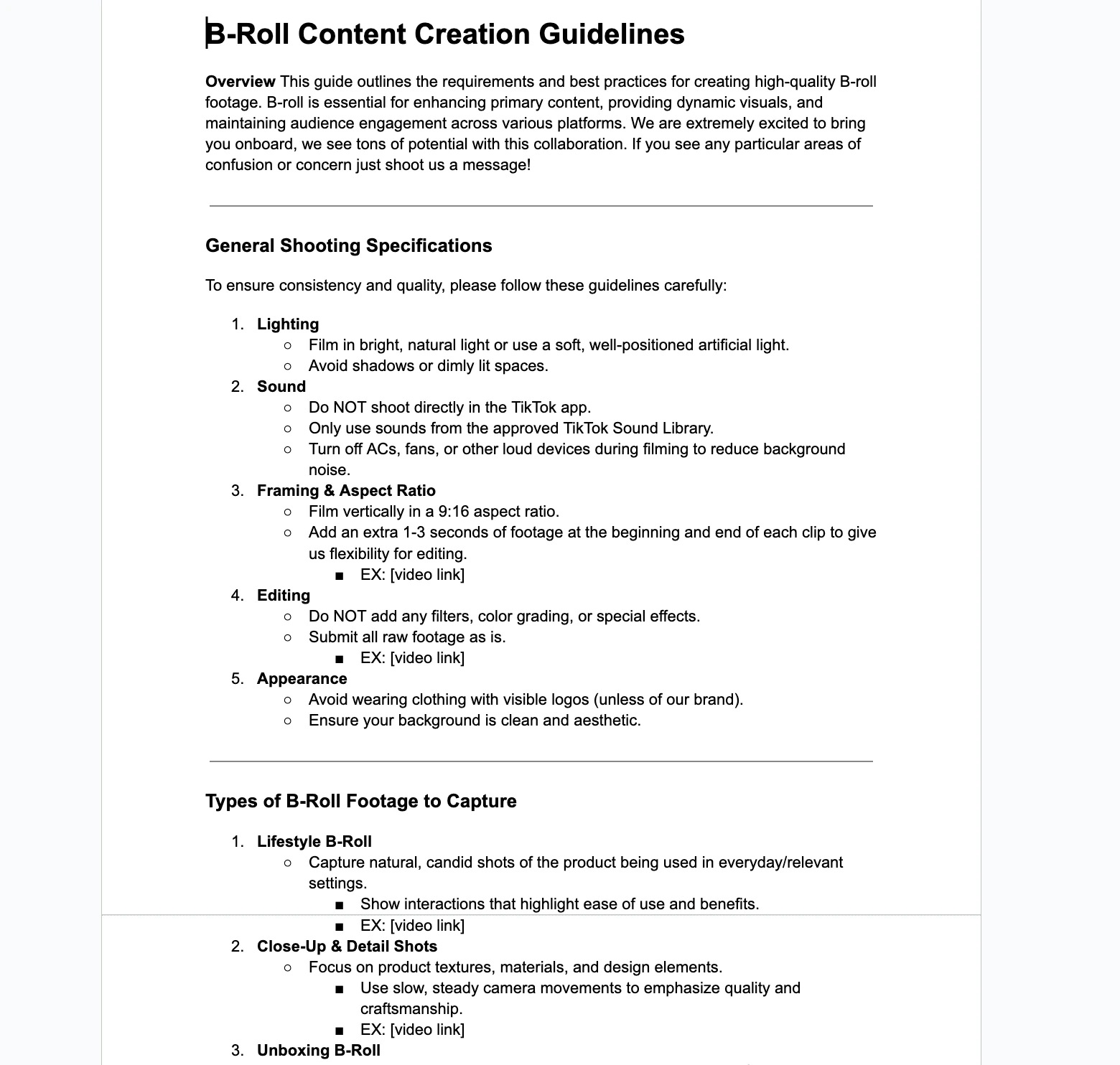
Filming specifications
The SOP includes specific filming specs every creator follows. The full list is in the masterclass — quick preview:
- Natural lighting preferred over studio. Real spaces, real lighting, real life.
- Phone's native camera, not the TikTok app. Higher resolution. Avoids the TikTok compression artifacts when we re-upload to other platforms.
- 9:16 vertical framing. Most ad placements are vertical now.
- Add 1–3 extra seconds at the beginning and end of every clip. Gives the video editor room for clean transitions.
- Keep the upper 20% of the frame clear. Captions and ad overlays land here on Meta and TikTok.
- No editing on the creator side. Raw or lightly assembled (a TikTok with simple cuts is fine). The video editor handles the actual edit.
- Use TikTok's official sound library for music. Avoids copyright takedowns when we re-upload.
- Brand name in every video. This is the only hard rule. It makes the content much harder to rip and use for competitor brands. (Yes, people rip ads. I've ripped ads. Saying the brand name doesn't fully prevent it but raises the friction significantly.)
Things you DON'T want on the creator side: kids in the background (privacy + algo issues), pets in the shot (distracting unless the brand is pet-related), copyrighted music, fast cuts they did themselves, polished "professional" look. Keep it raw.
The brief / storyboard shot list
When we brief a video, we don't just send "make a video about our supplement helping with sleep." That gets random output.
We send a structured brief that includes:
- Concept name + product
- Deadline
- Overview — quick context on the angle
- Storyboard shot list — every shot we want, in order, with notes on how to shoot it
- Script (when needed) — sometimes we write the script, sometimes we let them riff. Most of the time the brief is enough.
The storyboard shot list is the highest-leverage part. It tells the creator exactly what shots we need and lets us pull each shot independently for B-roll later. Every shot in the list becomes a discrete piece of footage we can splice into other ads.
To make storyboards faster, I generate visual references with Nano Banana 2 (Google AI Studio's image gen) and drop them into the brief. The creator sees a visual mockup of each shot they need to recreate. They don't have to imagine my vision — they execute it.
You can also use existing winning UGC ads as reference. Find a ripped video that's performing for a similar brand, drop it into the brief, and say "make me this with our product." Creators are MUCH faster at executing against a reference than against a written description.
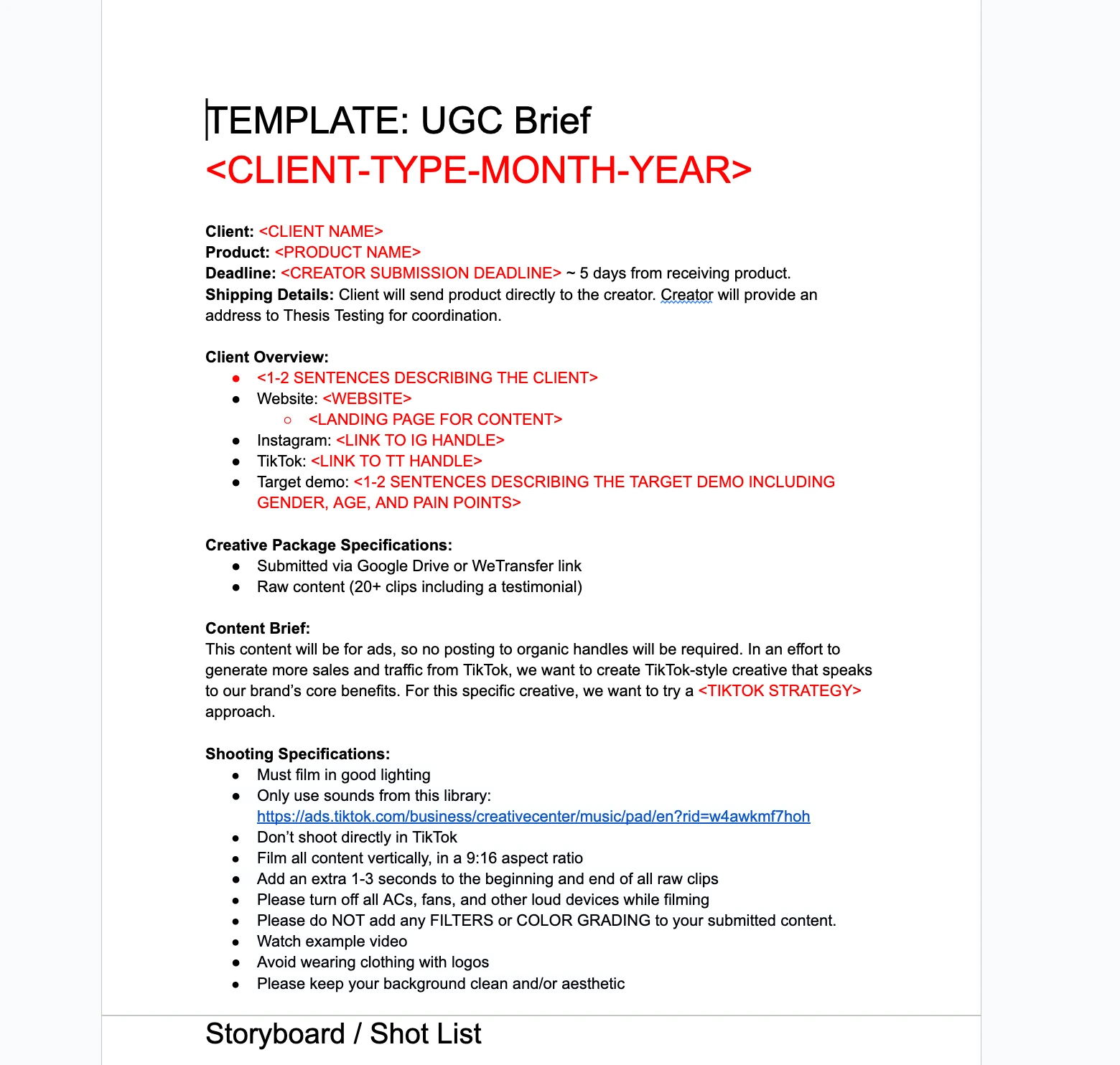
The actual brief template
Here's the structure I use, anonymized. Drop into Notion or Google Docs, replace the placeholders with your specific brand info, and send to the creator.
TEMPLATE: UGC Brief — <CLIENT-TYPE-MONTH-YEAR>

Client: <CLIENT NAME>
Product: <PRODUCT NAME>
Deadline: <CREATOR SUBMISSION DEADLINE>  (~5 days from receiving product)
Shipping Details: Client sends product directly to creator.
Creator provides address to your influencer manager for coordination.

CLIENT OVERVIEW:
<1-2 sentences describing the client>
- Website: <URL>
- Landing page for content: <URL>
- Instagram: <link>
- TikTok: <link>

TARGET DEMO:
<1-2 sentences describing the target — gender, age, pain points>

CREATIVE PACKAGE SPECIFICATIONS:
- Submitted via Google Drive or WeTransfer link
- Raw content (20+ clips including a testimonial)

CONTENT BRIEF:
This content is for ads — no posting to organic handles required.
For this specific creative, we want to try a <TIKTOK STRATEGY> approach.

SHOOTING SPECIFICATIONS:
- Film in good lighting
- Use sounds only from TikTok's official sound library
- Don't shoot directly in TikTok app
- Vertical 9:16 aspect ratio
- Add 1-3 extra seconds at beginning and end of each clip
- Turn off ACs, fans, and loud devices while filming
- Do NOT add filters or color grading
- Avoid wearing clothing with logos
- Keep background clean and/or aesthetic
The shot list (per brief)
Each brief specs a full deliverable — not just one finished ad, but the raw content needed to cut multiple finished ads:
| Shot | Quantity | Note |
|---|---|---|
| Testimonial | 1 | Selfie or tripod. Voiceovers without video also OK. Adapt script in next section to your own voice. |
| Testimonial Hooks | 3-6 | Multiple hook variations of the testimonial intro |
| Unboxing | 1 | No VO needed. No editing. |
| Product Shots | 5 | No VO needed |
| Product Usage clips | 3 | No VO needed |
That's 13-16+ raw clips per brief. Your video editor cuts those into 5+ finished ads, each with different hooks paired against the same body content.
A real example script
Here's an example script I ran for Obvi (collagen supplement brand). The structure shows what a high-converting hook + body + CTA looks like for the supplement category.
Hooks (rotate these to test):
- "I used this instead of getting botox and hair extensions…"
- "I've spent $1000s on hair and skincare products. Can ya relate?"
- "And despite using the 'best shampoo' and oils… and having a nearly religious skincare routine"
Body:
I still felt like my hair was thinning at a rapid pace and my fine lines were showing more and more each day. I was this close to getting hair extensions and starting a botox regimen… until I found this.
I use a scoop of Obvi's super collagen protein in my morning matcha every day… and that's it. It is packed with collagen peptides and biotin yet it contains no whey or added sugars, which was a huge concern of mine since I've suffered with acne.
I've been taking Obvi for two weeks and since then my wrinkles are starting to fade, my face is less dry, and I just have that glowww. I'm losing less hair and my boyfriend even said that it looked "skinnier or something."
Closing line:
You can spend all you want on the best products, but the real glow starts from inside and what we put in our bodies. I know, it looks like kids cereal, but it's actually good for you. Give it a try.
What makes this script work:
- Pattern interrupt hook — "instead of getting botox" reframes the category from "supplement" to "alternative to invasive procedures"
- Specific dollar amount — "$1000s on hair and skincare" creates relatable cost-fatigue
- Skeptic-on-camera framing — "I was this close to getting hair extensions" — the creator was a previous skeptic, which builds trust
- Specific mechanism — "collagen peptides and biotin, no whey or added sugars" — the creator names ingredients the avatar cares about
- Specific timeframe — "two weeks" — concrete, believable
- Casual close that disarms the sell — "I know, it looks like kids cereal" acknowledges the visual while pivoting to the product benefit
The full template + a script library tuned for multiple marketing angles (problem-solution, before-after, doctor-recommendation, skeptic-converted, testimonial-stack) is gatekept inside the masterclass. Each variant is engineered around a specific awareness stage and angle type.
The B-roll multiplier
This is where the math actually compounds. I touched on it earlier but it's worth slowing down on.
Each UGC video isn't one piece of content. Done right, each video is 5 distinct shot types that can be sliced and reused independently:
- Hook — the first 3 seconds, the attention grab
- Product intro — unboxing, first look, the moment the product appears
- Use case — the actual using of the product
- Testimonial moment — the creator looking at camera, talking about the result
- CTA / closing shot — the reach for product, the visual punctuation
Your video editor extracts each of these, tags them by type and creator, and they become assets in your B-roll library. New ads can be assembled from existing footage.
The math at scale:
- 2 creators × 5 videos/week = 10 videos/week
- 10 videos × 5 shot types = 50 distinct B-roll clips/week
- Over a month: 200+ B-roll clips for $1,000
This is the real value of the retainer model vs paying per-video rates. You're not buying videos — you're building a content library.
If you're using Recharm (covered in Module 1's main page), the entire library auto-tags itself. Your video editor searches by avatar + shot type + brand, gets the clips they need, stitches a new ad in 30 minutes. The system compounds.
The comm structure (V2 update)
V1 of the comms model: separate channels for each creator (one in WhatsApp, one in Slack, one in Telegram, one in Discord). Total mess.
V2: internal chat teams. All UGC creators sit in a single Slack workspace I run, with channels for:
- General announcements
- Brief drops (where new briefs get posted)
- Asset uploads (where finished content gets dropped)
- Help / questions
- DMs to the team for individual conversations
My executive VA + influencer manager are the day-to-day points of contact for the creators. They handle scheduling, brief delivery, asset review, payment confirmations, the social/relational side of the role.
I stay out of daily comms. If there's a specific creative direction I want to give, I drop it in the brief. If there's a relationship moment (creator going through something, milestone, etc.), my influencer manager handles it. I'm the brand voice, not the creator manager.
This is the difference between operators who burn out trying to manage 5 creators directly vs operators who run 5 creators through a managed comm structure. The first version doesn't scale. The second version scales as far as you can hire.
Selling them on staying — the emotional layer
The biggest mistake operators make with UGC creators on retainer: treating them as transactions.
You're not just buying videos. You're buying loyalty, longevity, and creative output that gets better over time. The creator who's been on retainer for 6 months produces 5x better content than the creator who's in their first month — IF they stick around. Most creators leave at 60–90 days because they don't feel connected.
The fix: sell them on the brand emotionally and logically.
Emotional layer:
- Make them feel like part of the team, not a vendor
- Loop them in on brand updates, new launches, behind-the-scenes
- Recognize their wins publicly in the team chat
- Send them merch / product samples regularly
- Make their input matter — when they suggest a creative direction, take it seriously
Logical layer:
- Pay on time, every time
- Be clear about bonuses and pay them out promptly when earned
- Show them the affiliate revenue they're driving (transparency builds trust)
- Promote performers — give them more retainer slots, more brief authority, eventually creative strategist roles
The Comfort playbook: Hunter Legrand is on every call with their creators. He's leading them, fostering the community, building relationships. They're not a vendor pool — they're invested partners. That's why Comfort can scale on community-driven content the way they do.
I had a UGC creator who got so bought into one of my brands that she went on a cruise specifically to film content for the product. A literal cruise. With her own money. Because she wanted to make content for us. That doesn't happen with a transactional vendor. It happens when you treat creators as part of the brand.
Why this SOP is gatekept
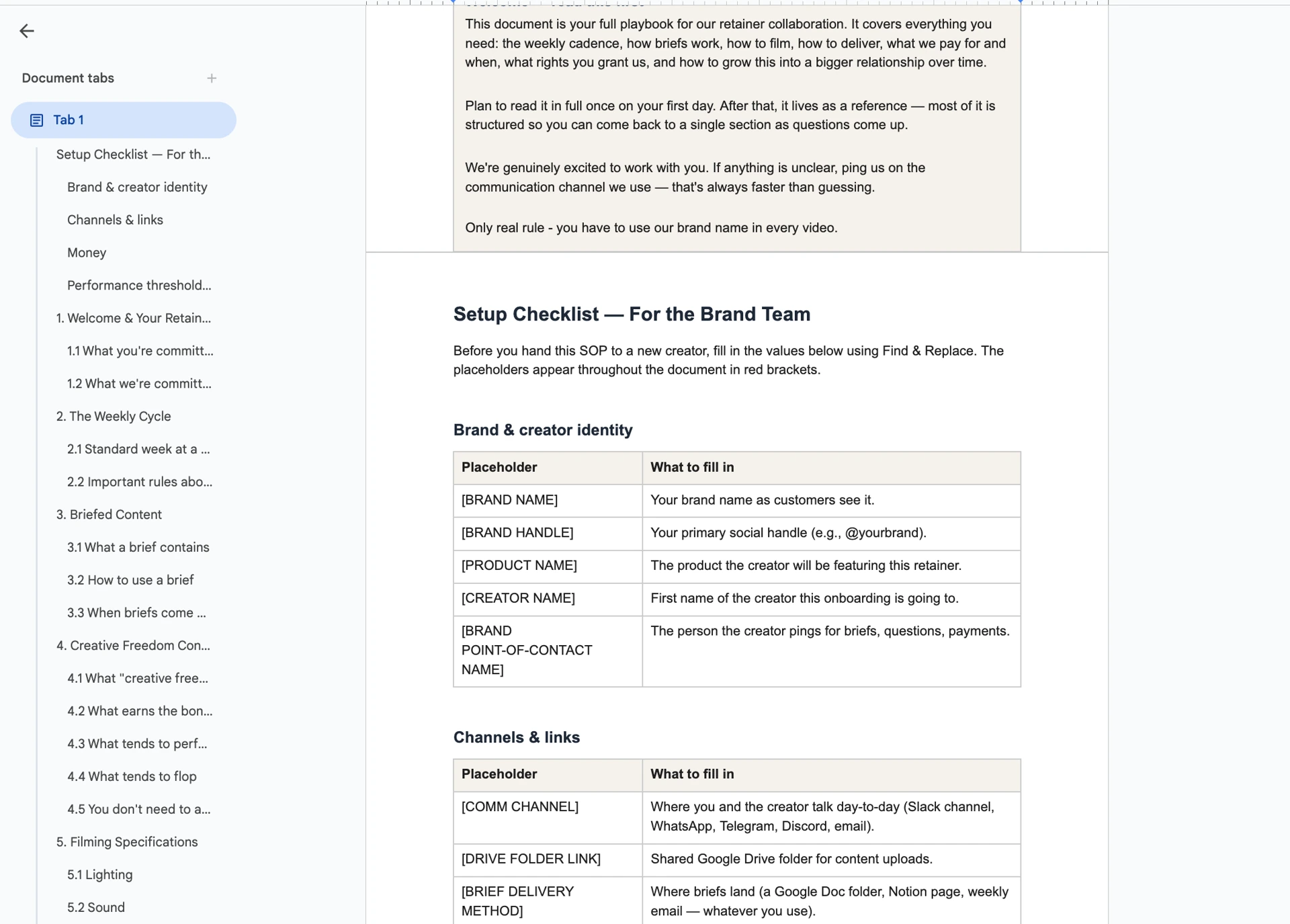
The full UGC creator SOP — the contract template, the brief template, the storyboard shot list format, the filming specifications cheat sheet, the comm structure setup, the bonus structure templates, the affiliate commission rates I use, the onboarding flow — lives inside the RunItUp Masterclass.
This SOP is the result of dozens of creators hired across multiple brands, plus the contract revisions that came from learning what creators try to renegotiate, plus the comm structure refinements from running it across multiple brand teams. The masterclass version stays current as I iterate.
Want the full SOP, the contract template, the brief format, and the comm structure setup? All inside the RunItUp Masterclass → Join here
Join now to lock in your rate, prices are increasing quickly.