No one's running organic at scale
The biggest underpriced channel in DTC right now is organic content distribution. Tabs Chocolate did roughly $12 million in a year almost entirely from organic. Hunter Legrand at COMFRT, the founders at Neurogum, and a handful of others have built nine-figure brands on the same model.
The model: one piece of content posted across an army of social accounts running through proxies, distributed automatically. Most operators run 1 account per platform. The play is running 25.
This sub-page is the full setup. Tools, account architecture, posting cadence, the comment moderation layer, and the ecosystem effect that makes this stack with paid (instead of replacing it).
If you're scaling on Meta and ignoring organic, you're missing the highest-leverage zero-cost channel in the entire DTC stack. Set this up once, your VA runs it, traffic compounds for years.
The core principle
One content source → automated distribution to N child accounts → compounding views.
You post one piece of content on your main Instagram. Software automatically reformats and pushes it to 24+ accounts across Instagram, TikTok, YouTube Shorts, Snapchat, Pinterest, X. Each account has its own proxy, its own browser fingerprint, its own slowly-built follower base.
If each child account gets just 100 views per post, that's 2,500 views organically per piece of content. Run the same piece across 5 posts per day, you're at 12,500 views per day of organic distribution from a single content production run.
Now stack that for a month. 30 days × 12,500 views = 375,000 organic views per month off content you would have produced anyway.
What the views actually do
Most operators dismiss organic because it doesn't directly convert at the same rate as a Meta ad. They're missing the ecosystem effect.
Of every 1,000 organic views:
- A small percentage convert directly — link in bio, swipe up, organic store visits
- A larger percentage sign up for SMS or email if your popup catches them on the website
- A meaningful percentage end up retargeted by your Meta ads later — they're now warm audience, not cold
- A bigger percentage build pixel data — Meta gets more signal on your real customer profile
- Some show up months later because they remembered the brand
Organic doesn't replace paid. Organic AMPLIFIES paid. The brands running both at scale (Tabs, COMFRT, Neurogum) are pulling lower CAC across all channels because their organic engine is creating warm audiences faster than they could buy them.
Brandon's actual result
I ran this on a brand over a year ago. The full account army — main account plus all the child accounts we'd set up plus additional ones we layered on top — was collectively driving around $1,000/day in organic-attributed revenue. Sessions, conversions, all coming through organic without paid driving them.
What happened to my Meta spend during that period: it went down. Not because we ran less, but because the organic was carrying a chunk of the conversion load. Meta's ROAS improved because the organic-trained audience was easier to close.
Individual accounts varied wildly — some hit 10k+ views per video, others stayed at 100-500. The compounding effect of the network is what matters, not any single account. This is why volume of accounts is the lever, not optimization of a single account.
The software stack
| Tool | What it does | Cost |
|---|---|---|
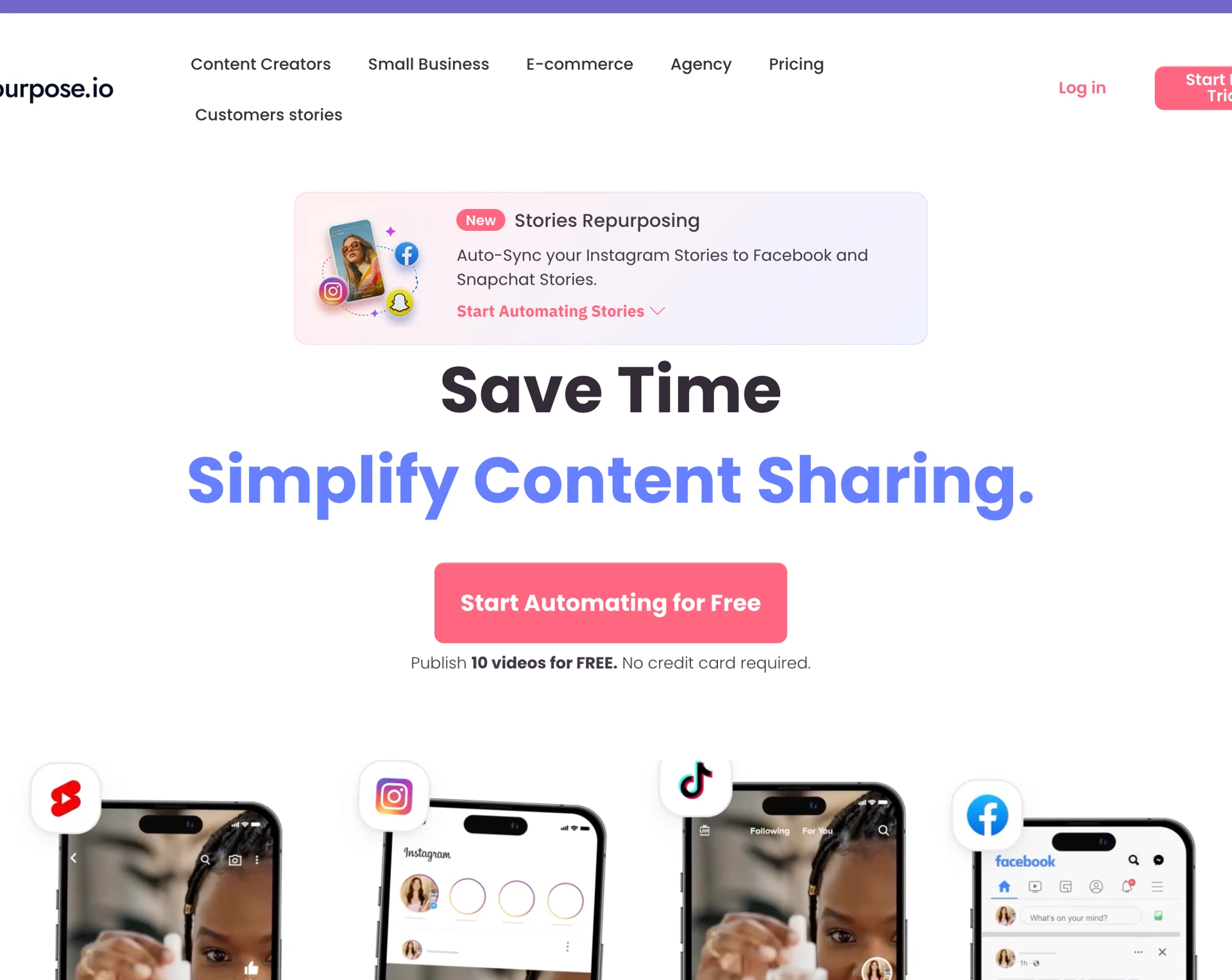
| Repurpose.io | Content distribution engine — auto-posts from main account to all child accounts across platforms | ~$30/mo |
| Octobrowser | Browser/account management with proxy routing per account | varies (per-profile pricing) |
| AlphaVault | Proxy provider | varies |
| Comment Guard | AI moderation + auto-reply on Instagram/Facebook | varies |
Links:
- Repurpose.io → https://my.repurpose.io
- Octobrowser → https://www.adrevival.io/octo
- AlphaVault → https://discord.gg/A9VqBdEsrh
- Comment Guard → search it, set it up
(Octobrowser and AlphaVault aren't affiliate plugs — I just use them daily and they're the GOATs in their categories.)
Account architecture
Main account: your real, primary brand account. The one you'd build organically anyway. This is the source. Every piece of content goes here first, then distributes outward.
Child accounts: 5-25 accounts per platform, each running on its own proxy and browser fingerprint. Start with 5 per platform (or even 3) until the workflow is dialed. I've run 25 at a time via VA — you can scale way bigger once it works.
Platforms to cover:
- TikTok
- YouTube (Shorts)
- Snapchat (specific setup — covered below)
- X (Twitter)
Account naming convention: thematic variations of your main brand name. @brandname.daily, @brandname.lifestyle, @brandname.fans, @brandname.community — variations that make sense as adjacent fan accounts or community pages without being obvious clones.
The tracking sheet
Get a VA to build this in Google Sheets. The columns:
| Username | Platform | Proxy ID | Octobrowser Profile | Repurpose Connection | Status |
|---|---|---|---|---|---|
| @brandname.daily | proxy_001 | Profile_001 | Connected | Active | |
| @brandname.lifestyle | proxy_002 | Profile_002 | Connected | Active | |
| @brandname.daily | TikTok | proxy_001 | Profile_001 | Connected | Active |
| ... | ... | ... | ... | ... | ... |
Each account → unique proxy → unique Octobrowser profile → connected to Repurpose. The sheet is the source of truth for which account belongs to which proxy, who's the VA managing it, and when it last posted.
The Snapchat caveat
Snapchat is different from the other platforms. To set it up correctly:
- Public profile (not a private snap account)
- Link in bio to your store / lead capture
- UTM-tagged URLs for tracking attribution
Snapchat traffic is hard to track natively. The UTM is what tells you which Snap account drove the click. It's working — even when the dashboard looks empty. Direct response operators dismiss Snapchat too quickly because the metrics look weak. The traffic is there.
Posting cadence
Tabs did 1x/day per account in their original playbook. I run 5-10x/day per account.
Why higher cadence:
- Algorithm exposure compounds faster
- Followers see your name more often = brand recognition
- More content = more chances at hitting an unexpected viral moment
- Distribution cost is zero once Repurpose is configured — additional posts cost nothing
The constraint isn't account safety (Repurpose handles spacing automatically). The constraint is content production capacity. If your team can produce 5-10 pieces of content per day, run 5-10x posting. If you can only produce 2-3, run 2-3x. Don't repost identical content within the same day across accounts — small variations help.
The Repurpose flow:
- Post to your main Instagram (or main account on whichever platform is your hub)
- Repurpose detects the post via API/browser hook
- Repurpose automatically reformats for each destination platform (Reels → TikTok, IG → YouTube Shorts, etc.)
- Repurpose pushes to every connected child account across all platforms
- Within ~2 hours, the same content is live on 24+ accounts across 6 platforms
Comment moderation — Comment Guard
Once volume scales, your DM and comment volume gets unmanageable. Comment Guard is the AI layer that handles it.
What it does:
- Auto-moderates negative comments — filters spam, hate, off-topic
- Auto-replies to common questions — pulls from a FAQ knowledge base you configure
- Routes complex questions to a VA for human review
- Trains over time — you mark replies, the AI improves
Setup: load your FAQ into the knowledge base — common product questions, shipping, returns, ingredient questions, anything you'd handle 100 times a week. Comment Guard now answers them automatically across every comment thread on every account.
Mainly Instagram and Facebook. TikTok and YouTube don't have the same comment-moderation API access yet, so you handle those manually or via your VA.
Especially critical for TikTok Shop and custom-content brands where comment quality directly impacts the algorithm and conversion. A well-moderated comment section tells the algorithm to push the content harder.
Steal from the brands doing it
Three places to study the playbook in deeper detail:
- Hunter Legrand's podcast appearances — COMFRT founder, has talked publicly about their organic distribution model on multiple podcasts
- Neurogum founder's podcast appearances — similar model, slightly different vertical, transparent about the strategy
- Oliver Ricardo's podcast — covers organic distribution at depth across multiple operator interviews
Steal their strategies, implement into this system, outscale everyone. Most DTC operators aren't even thinking about organic. The ones who are — Tabs, COMFRT, Neurogum — are building eight and nine-figure brands on it.
What's gatekept inside the masterclass
The principles are here. The artifacts live in the masterclass:
- The full Google Sheet tracking template (username + proxy + Octobrowser + Repurpose mapping)
- Repurpose.io setup walkthrough with screenshots — every connection, every reformatting setting, every cadence rule
- Octobrowser proxy configuration walkthrough — how to set up clean account fingerprints at scale
- Comment Guard FAQ knowledge base templates — drop-in answer banks for supplements, skincare, apparel verticals
- Live brand example breakdowns — what's running across my accounts, view counts, attribution numbers
- Hunter Legrand / Neurogum / Tabs deep-dive notes — strategy summaries from the podcasts + my application notes
Want the full setup walkthroughs, the tracking sheet template, the FAQ knowledge bases, and the live brand breakdowns? All inside the RunItUp Masterclass → Join here
Join now to lock in your rate, prices are increasing quickly.