Of all the roles in this module, the video editor is the hardest to hire well. Most operators struggle here. Most operators try to hire a video editor like they'd hire any other contractor — post a job, pick someone with a portfolio, hope for the best. Then they end up with someone who can edit but can't think strategically, can't iterate fast, and can't grow into something more.
The right framing for this role: you're not hiring a video editor. You're hiring a future creative strategist who happens to start as a video editor.
Every video editor I've hired, I've hired with the long-term goal of turning them into a killer strategist. The video editing is the entry point. The growth path is what makes the hire worthwhile. If you hire someone who only wants to edit and never wants to think, you're capping the value of the role at "decent ad output." If you hire someone hungry to grow into the strategy side, you're building a creative engine that compounds for years.
This sub-page covers: how to find video editors that can grow, the growth ladder I use, the performance-tied compensation structure, and how the role plugs into the broader creative pipeline.
Why this hire is hard
A few reasons most operators get stuck on this one:
- The talent pool is small. Compared to image editors, there are way fewer truly skilled video editors who understand DTC ads. Video editing requires more skills (storytelling, pacing, audio, captions, hooks) than image editing.
- Quality is harder to evaluate at the application stage. A portfolio shows what someone has done, not how they think. You need a paid trial to see how they actually execute against a brief.
- The role evolves rapidly. AI tools, hook formats, ad style trends, platform algorithms — all change month-to-month. Your video editor needs to be the kind of person who's actively learning, not someone who relies on a fixed skill set.
- The growth path requires investment. You don't just hire and forget — you train, you pay for courses, you give creative freedom, you bonus performance. Operators who treat this like any other contractor role get mediocre output.
If you want better-than-mediocre, you have to hire and structure this role differently than the others.
Hiring the role — get creative on sourcing
Standard hiring paths work for video editors, but the best video editors are usually already employed somewhere. You have to be more creative on sourcing than for any other role.
Where I hire:
- Twitter (X) — my default if you have a personal brand. Throw up a "hiring [video editor / strategist]" post and your DMs will flood with applicants. You also get good people in the comments and from referrals. If you have a network on Twitter, this is the fastest channel.
- Instagram — when I had it active, I'd post the same hiring announcement and pull good applications + referrals from people in DTC ecom circles.
- Network referrals — ask other DTC operators in your network. Their second-string editors are often great fits for your brand.
- EcomTalent direct — Karlo's community/course at EcomTalent is built specifically for turning video editors into creative strategists. He's a fucking killer — this is the place to go if you want pre-trained, hungry talent. You can either join EcomTalent and hire directly through it (if it's open / not waitlisted), or you can find editors in the wild who have EcomTalent in their bio, follow EcomTalent's account, comment on EcomTalent's posts. Reach out to those folks. Don't go into the EcomTalent community itself and DM-spam — that's against the spirit of how Karlo built it.
Where I haven't gone yet but the bigger operators do:
- LinkedIn ads for hiring. Bigger operators run paid LinkedIn ads specifically to recruit creative talent. I've used LinkedIn ads to hire customer support and gotten solid results. For video editors at scale, this is the channel.
- LinkedIn poaching. This is what the top operators do. They hire a "talent bounty hunter" or do it themselves — find video editors and creative strategists at top agencies or top DTC brands, slide into DMs, sell them on leaving and joining you. The same way you'd headhunt a C-suite executive. It works, and operators doing wild numbers use this constantly.
The mindset that wins:
Same way you think about acquiring customers, think about acquiring video editors. Get creative. Different channels, different angles, different comp structures. The operators with the best creative teams are the ones who hunt for talent the same way they hunt for offers.
The growth ladder — video editor → strategist
This is the single most important framing for the role. Every video editor I bring on, I bring on with the explicit goal of growing them into a strategist over time.
The ladder:
- Month 1-2: Pure execution. They edit ads against scripts and briefs I send them. 60-70% of their output is fully scripted by me. The remaining 30-40% gives them creative freedom — make whatever they want based on their understanding of the brand and avatar.
- Month 3-6: Pattern recognition. They start surfacing ideas that work. Their free-form ads start to outperform some of my scripted ones. I start giving them more creative freedom — 50/50 instead of 60/40.
- Month 6-12: Strategy contribution. They're proposing concepts, hooks, angles. I'm reviewing and approving instead of writing from scratch. Their compensation scales with their performance.
- Month 12+: Lead strategist. They're running their own creative pipeline, briefing other editors, mentoring new hires. They've effectively become a creative strategist — and they got there from inside the brand instead of being hired in cold.
Why this works better than hiring a creative strategist directly:
A creative strategist hired cold from another brand costs $3-4K/month minimum. They come in with their own ideas about how things should work, often clashing with the brand's existing systems. They take 3-6 months to ramp into your specific brand voice, customer, and offers.
A video editor you've grown over 12 months is already deep in your brand voice, customer, and systems. They know the avatar. They've watched what works and what doesn't on YOUR ads. They cost less than the cold strategist hire AND produce better-aligned creative because they grew up inside your brand.
I'm not a believer in hiring creative strategists at high cost cold. Until I find a unicorn, my approach is video editor → strategist, every time.
The performance-tied comp structure
This is the comp model I use. The base retainer scales with the editor's hit rate (% of ads they make that hit "winning" status):
| Hit Rate | Monthly Retainer | % of Ad Spend | Per-Ad Bonus (after 10%) |
|---|---|---|---|
| <5% | $500 | 7% | – |
| 5–9% | $500 | 10% | – |
| 10–14% | $600 | 10% | – |
| 15–19% | $750 | 10% | TBD |
| 20–24% | $1,000 | 15% | TBD |
| 25%+ | $1,200 + Lead Role | 15% | TBD |
Definitions:
- Winning ad = $1,000+ in ad spend AND above target ROAS
- Hit rate = % of ads they made that became winners over a 30–90 day rolling window
Starting tier: every new editor starts at $500/month + 10% of ad spend. They climb the ladder by hitting more winners.
Why this structure works:
- The editor has skin in the upside — when their ads scale, they make more
- The base retainer is low enough that bad hires don't sink your ledger
- The progression to higher tiers requires sustained performance, not one-off lucky hits
- The "Lead Role" at 25%+ hit rate is the path into strategist responsibility — they're proven, they get more authority, they get a seat at the strategy table
Payment cadence: weekly via PayPal, every Tuesday. Predictable. Don't fuck this up — late payments are how you lose good editors faster than anything.
The SOP at a glance
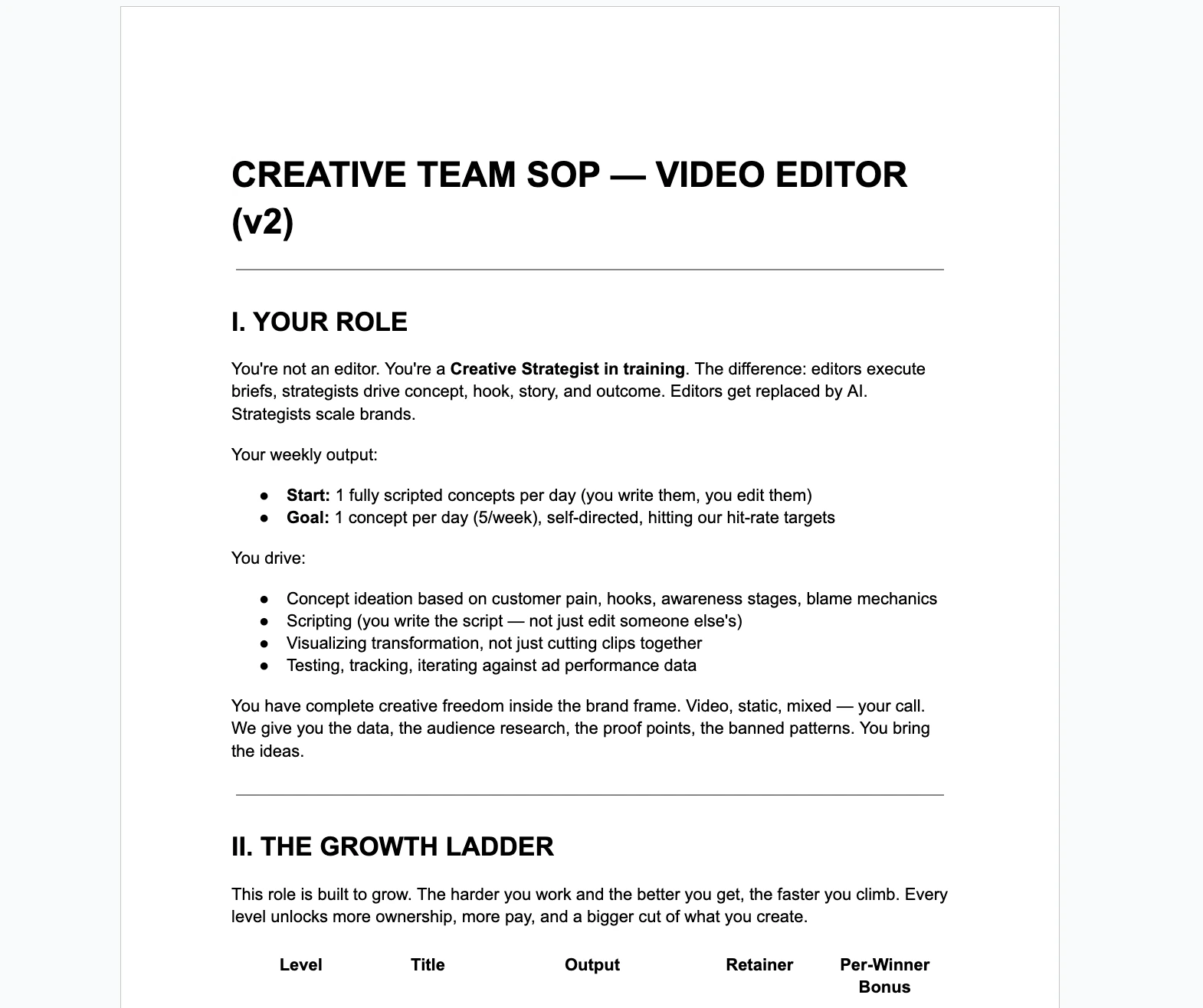
The video editor SOP I use is intentionally a starting framework, not a rigid playbook. Every editor has their own workflow. The SOP exists to set expectations and define the structure — actual execution evolves with the editor.
The structure of the SOP:
Section 1 — Your Role
- Create 2+ unique ad concepts per week (video/image — creative freedom)
- Use Claude AI to script and ideate angles
- Upload deliverables to Google Drive
- Document all work in the Growth Guide Sheet
- Review ads via AI Studio checklist before submitting
- Active in Slack + EcomTalent Discord
The framing in the SOP is explicit: "You are a Creative Strategist, not just an editor." That sets the expectation from day one. The path isn't "edit → repeat forever." The path is "edit → contribute strategy → become strategist."
Section 2 — Required Tools
- Google Drive (content archive)
- Current Ad Tracking Sheet (concept tracking)
- FB Ads Manager (view-only access — same approach as the image editor sub-page)
- Slack (team comms)
Note on access: I keep all brand-related content and resources private. I'll provide prompts, templates, ad examples, and any tools that help — but those don't get shared outside the team.
Section 3 — Weekly Workflow
- Create 2+ concepts using Claude + customer pain insights
- Upload final ads to Drive
- Complete Growth Sheet entries with hook, angle, awareness stage
- Run through AI Studio checklist before marking done
- Check in with team daily
- Learn from top ads via team learnings folder
Section 4 — Compensation
The pay table above is exactly in the SOP. Editors see the ladder upfront — they know what they're working toward.
Section 5 — Team Bonus System
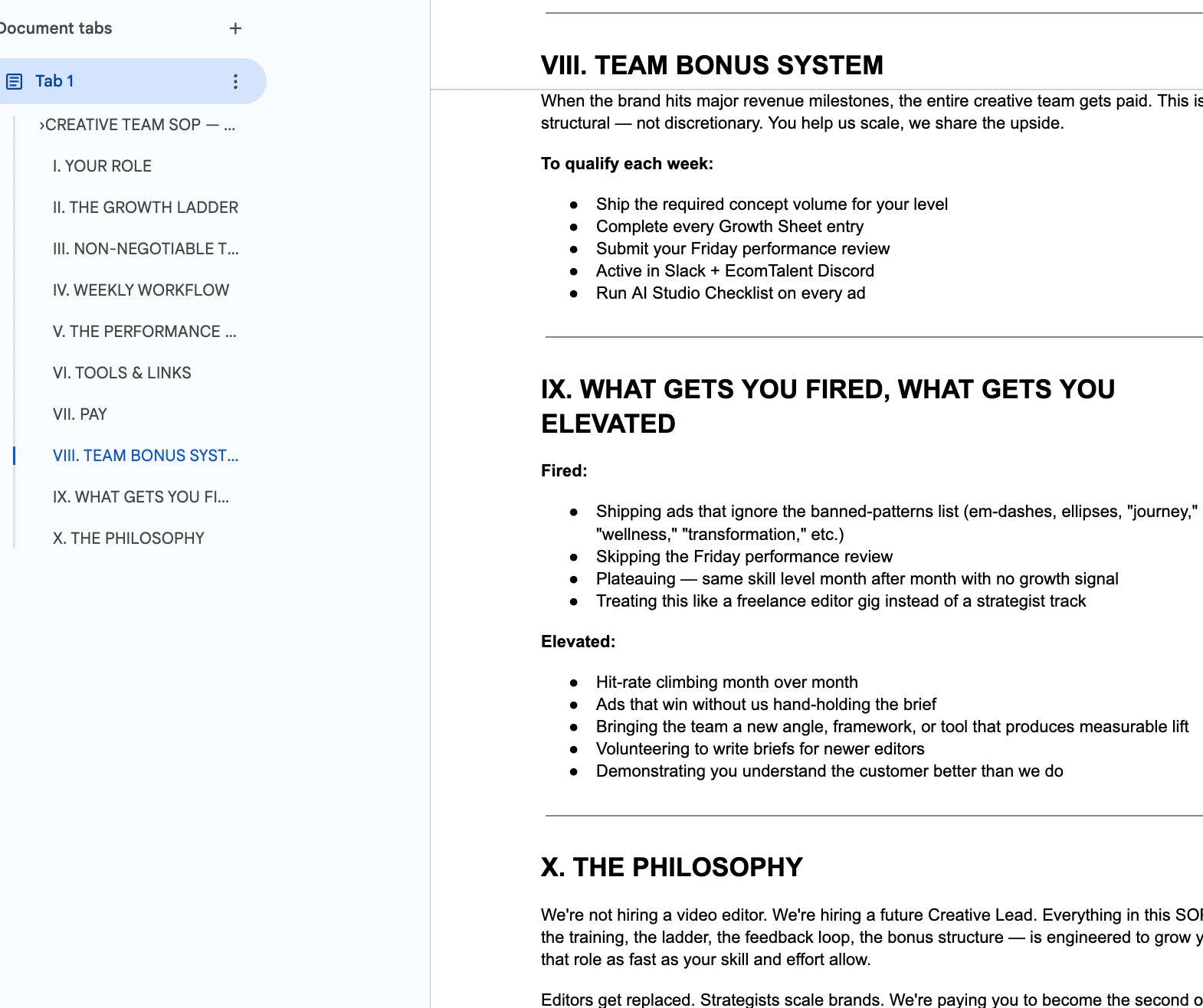
When weekly revenue hits major milestones, the entire team gets sizable bonuses. To qualify:
- Submit 2+ concepts that week
- Complete Growth Guide entries
- Use Claude + AI Studio properly
- Active in Slack + EcomTalent
This creates collective ownership of the brand's growth. Everyone wins together.
How this integrates with the broader pipeline (V2 note)
We've built the same Claude → Notion → Master Tracker pipeline for video editors that's described in the Media Buyer and Image Editor sub-pages.
Briefs go from Claude into Notion. Image editors and video editors both pull from the same Notion brief dashboard, produce against their respective specifications, and push files into the queue. The Google Apps Script auto-populates the media buyer's Master Tracker.
Current state: the video editor side of the pipeline isn't fully tightened up yet. Right now we're pushing heavily on image ads as the volume play (the machine-gun layer), with video ads coming behind it as the sniper layer. As we shift more weight onto video, we'll iterate the video pipeline integration the same way we've iterated the image side.
This is by design. You don't optimize every layer of the system at once. You push hard on one layer (image ads) until the math is dialed, then you shift focus to the next (video ads). The pipeline builds out as you go.
Training and growth — pay for courses, give creative freedom
The single biggest leverage you have on a video editor is what you invest in their growth.
Courses I pay for:
- EcomTalent — every editor gets in if they're not already. Karlo's community + course material is the highest-leverage training you can give an editor in this space. They should be active in the Discord, asking questions, contributing.
- Zacharias's course material — solid creative direction tactical content
- Direct response specific courses — once Module 9 (Direct Response) of this case study unlocks in masterclass, my own DR module becomes part of their training. Until then, there are external DR courses worth investing in.
The mindset to communicate to the editor: "My goal is to make you so good at this that in a year you'd be running this whole thing yourself." Treat them as an investment, not a contractor. The editors who feel that get hungry. The editors who feel like vendors stay vendors.
Bonus incentives:
On top of the comp table:
- Per-ad bonus when they hit a winner (set whatever amount feels right — $50, $100, $200 per win)
- Quarterly performance reviews with raises tied to sustained hit rate
- Once they're proven on the strategist path, expanded responsibility + the Lead Role at 25%+ hit rate
The review cadence — Loom over calls
Most creative teams default to weekly calls reviewing every ad together. Mine started that way too — Saturdays, group review, every ad.
I've moved away from this. I'm an entrepreneur, I shouldn't be doing things that don't directly drive the business. Weekly group calls are fun but they're a time tax.
The new format: Loom-based review. I record a Loom going through each ad, what's working, what's not, what to change. The editor watches it on their own time, records their own Loom in response with their workflow + thinking, and we compare.
This works better than calls because:
- Asynchronous — neither of us has to schedule around the other
- Editor sees my actual review process, not just the conclusions (compounds their learning)
- I see the editor's actual workflow, not their summary of it
- Reviews can happen daily instead of weekly — faster iteration
If you're scaling and you don't want to be on calls (you shouldn't), default to Loom for everything. The whole creative team can run async.
Why this SOP is gatekept
The full video editor SOP — including the Growth Guide Sheet template, the AI Studio checklist, the Claude scripting prompt library, the Loom review templates, the bonus structure tied to specific KPIs, the editor onboarding flow, the path-to-strategist promotion criteria — lives inside the RunItUp Masterclass.
This SOP is intentionally evolving. My video editor SOP isn't what it was 6 months ago — every time I hire a new editor, the AI tools change, the platform algorithms shift, or the brand voice evolves, the SOP gets updated. The masterclass version stays current.
The bigger reason this SOP is gatekept: the comp structure + the growth ladder is the playbook for turning a $500/month editor into a $4K/month strategist over 12 months. That's not a template — that's the entire creative engine of a 7-figure DTC brand. Worth gatekeeping.
Want the full SOP, the Growth Guide Sheet template, the AI Studio checklist, and the path-to-strategist promotion criteria? All inside the RunItUp Masterclass → Join here
Join now to lock in your rate, prices are increasing quickly.