This is my bread and butter. If you only learn one ad format from this case study, learn this one.
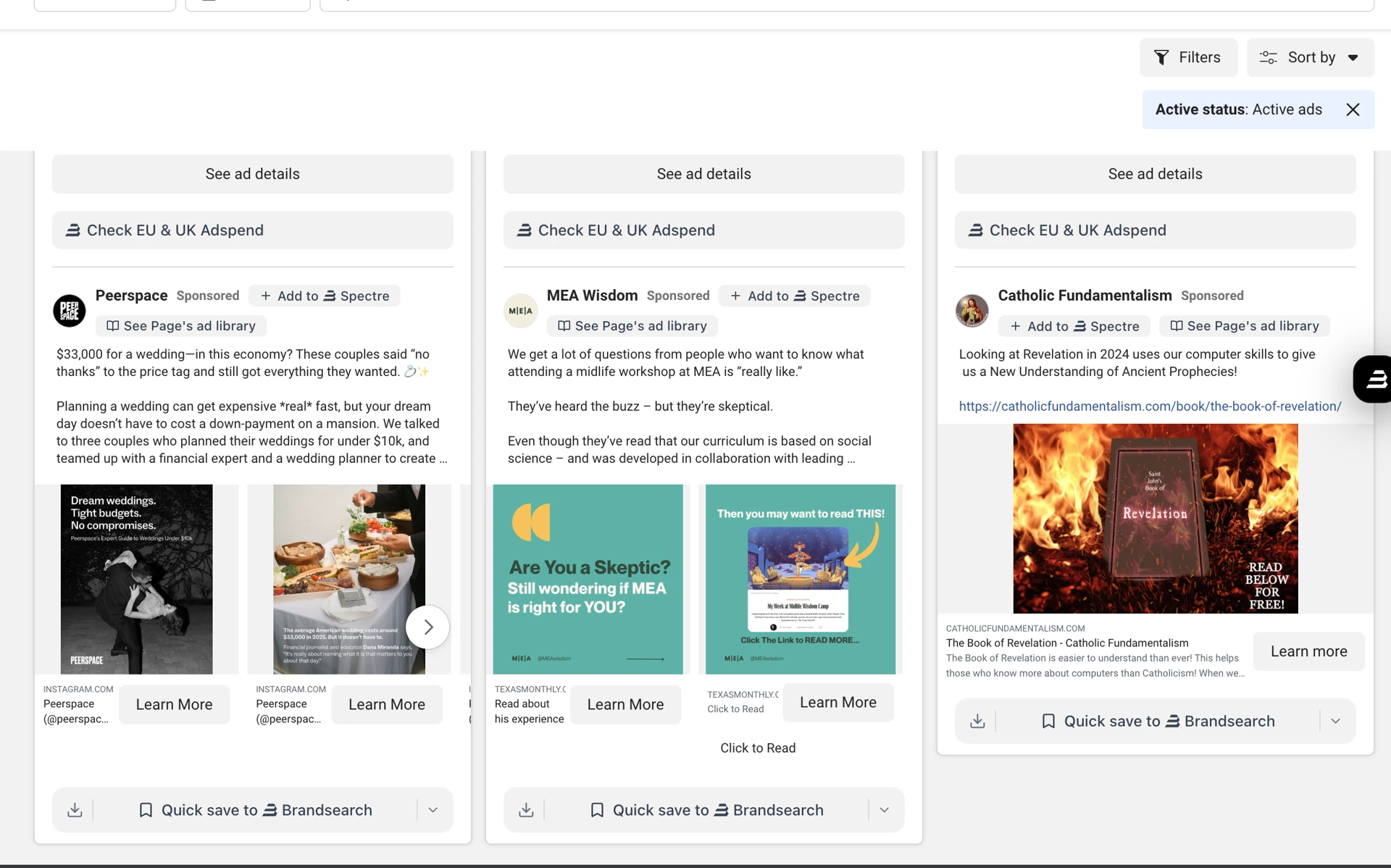
A Catalyst ad is the single most efficient way to get cold traffic from a Meta feed onto an advertorial. One image. One headline (12 words or less). One sub-headline (~25-30 words). Optional CTA. That's the entire ad.
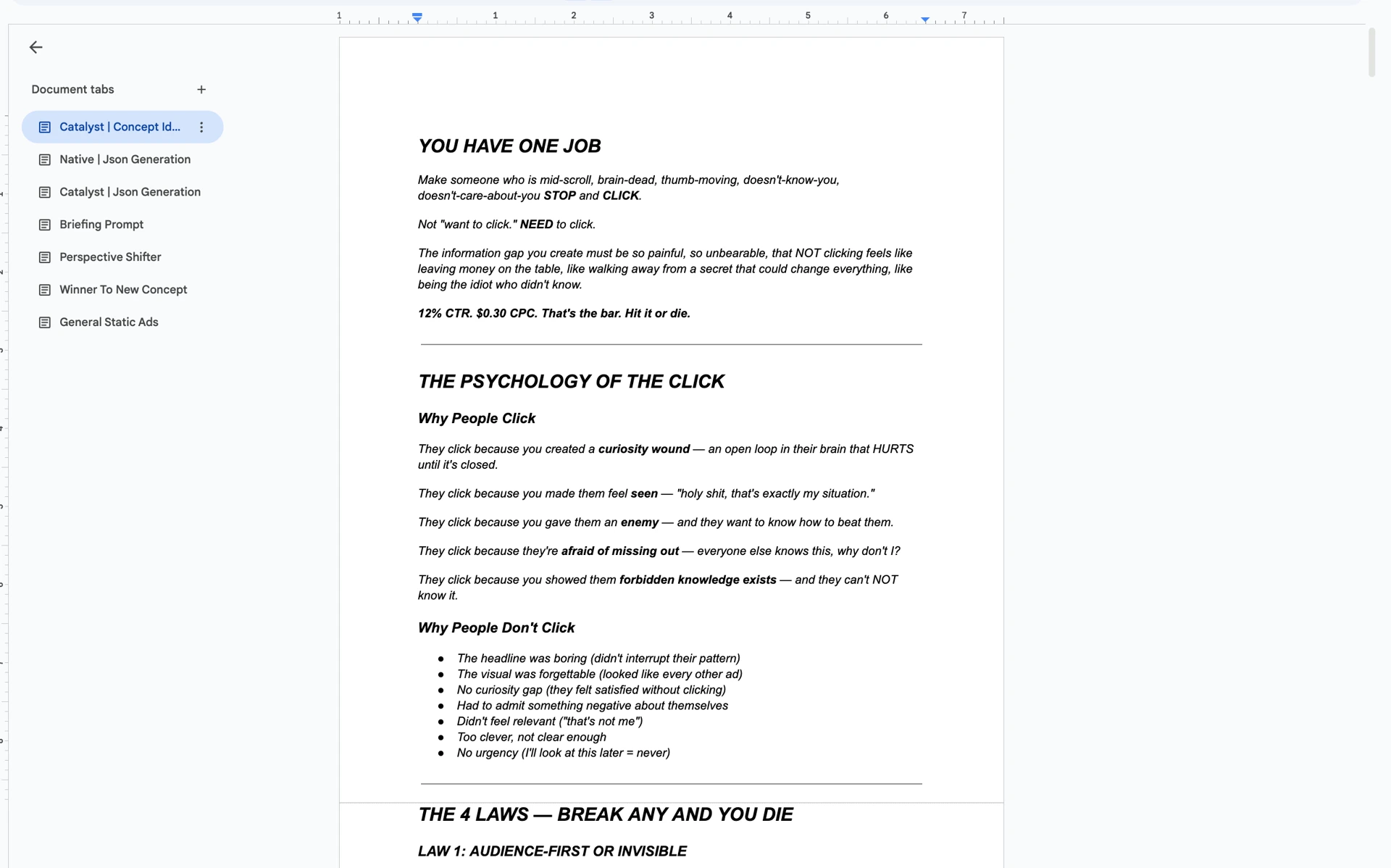
Most operators don't run Catalyst ads because they don't understand what they're for. They think the ad has to "sell" — pitch the offer, list the benefits, hit a CTA. That's not what Catalyst does. Catalyst's only job is to get THE click from THE right person. Not many clicks. Not the broadest audience. The ONE specific person whose internal monologue matches the advertorial that's about to do the converting.
This sub-page covers everything: what a Catalyst ad is, why it beats desire-based hooks, the blame-shift architecture that makes it work, the headline writing process (where 80% of the work lives), the image generation discipline, and three full worked examples I built for the Microingredients Astaxanthin example product (same one we used in the Native sub-page) to show you the workflow start to finish.
This sub-page assumes you've read the Native sub-page. If you haven't, go back — the project setup, imagen skill, and parallel chats workflow all carry over. The Advertorial sub-page is the companion piece on the other end of this funnel.
The single rule: congruency
This is the rule that overrides every other rule.
Every step of the funnel has to make sense to an 8th-grade-brain idiot.
Walk through your funnel as if you're that idiot:
- I see the ad. Does the next step make sense?
- I click the ad and land on the advertorial. Does the next step make sense?
- I read the advertorial and get to the product page. Does the next step make sense?
- I'm on the product page about to buy. Does the offer make sense?
If at any step the idiot goes "huh?" — congruency is broken. The funnel leaks.
For Catalyst specifically, congruency means: the ad's promise has to match what the advertorial delivers in the first 200 words. If your ad says "1982 psychology study reveals why Ozempic doesn't work" and your advertorial opens with anything other than that 1982 study, you've broken congruency. The reader feels bait-and-switched. Click cost paid, sale lost.
This is why Catalyst ads get built FROM the advertorial, not the other way around. You write the advertorial first, define the angle, define the avatar. Then the Catalyst ad is reverse-engineered to bring exactly that avatar into exactly that opening.
The avatar disqualification principle
This is the part most operators get wrong.
When you're running cold traffic, your instinct is to maximize clicks. Lower CPC = better, right? Wrong. A click from the wrong person costs you the same as a click from the right person, but only one of them buys.
Catalyst's job isn't to attract everyone. It's to disqualify everyone who isn't your avatar.
For our Microingredients example — internal-tanning supplement, target avatar: pale woman, married, 37-48, two kids, suburban, college educated, $200/month self-improvement budget, internal monologue "my husband doesn't look at me the way he used to" — every Catalyst ad has to:
- Show a pale woman in every image. Not tan, not olive-skinned, not ambiguous. Pale. If the woman in the image isn't pale, the right avatar doesn't see herself, the wrong avatar self-identifies and clicks. Wrong audience, wasted spend.
- Use specificity in the headline. "Your husband" disqualifies single women. "Lost 30 pounds for their husbands" disqualifies women who aren't trying to lose weight for someone. Every word of specificity narrows the click pool to the avatar.
- Avoid generic appeal. "Tired of feeling invisible?" attracts everyone. "Wives who lost 30 pounds for their husbands are realizing it was never about the weight" attracts only that specific identity.
The visual + headline together act as a filter. The right person self-identifies and clicks. The wrong person scrolls past. Both outcomes are wins.
The blame-shift architecture
This is the psychological mechanic that makes Catalyst work where desire-based hooks fail.
People don't want to blame themselves for their problems. They also don't want to be told they're broken. Desire-based hooks ("Want a natural tan?") force the reader to admit "I want something I don't have, which means something is wrong with me." The defensive instinct kicks in. Scroll past.
Catalyst hooks externalize the cause. They name an enemy that's not the reader, not even adjacent to the reader. The reader gets to be a victim of circumstance instead of an agent of failure. Defensive instinct is bypassed.
For our example, the avatar's unconscious default blame target is her husband. "He doesn't look at me anymore" — the silent thought is "what's wrong with him." That blame is wrong, painful, and not productive. It also keeps her from clicking ads that target HER feeling.
The blame-shift moves the cause off the husband entirely. Better targets:
- Instagram (external, abstract, undeniable, polarizing in the right way)
- Big tech generally (same logic, slightly broader)
- Industry villains ($72B lingerie industry, diet industry, couples therapy industry)
- Animal kingdom (flamingos, redfish, salmon — curiosity-gap externals, completely non-confrontational)
- Pseudo-science authority (1980 psychology study, behavioral biologist's six-year investigation, Nobel-prize-adjacent research)
The crazier the external blame source, the better the curiosity gap. A flamingo cannot be at fault for your marriage. Which is exactly why you'll click on the ad that says it is.
The Catalyst framework types
When you're picking the angle for a Catalyst ad, you're picking the type of catalyst. These are the framework patterns that work:
| Catalyst type | Pattern | Example |
|---|---|---|
| Timing | "By the time you read this, it's too late" | "Wives who started Ozempic in 2024 are already learning..." |
| Availability | "Supply was just cut" / "Last batch" | "Why Sephora pulled this serum from shelves last month" |
| Discovery | "Researchers just uncovered..." | "Behavioral biologist's six-year investigation traces..." |
| Regulatory | "FDA / EU just changed the rules" | "EU banned this ingredient — US is next" |
| Experiment | "1982 lab study predicted..." | "Arizona State psychologists ran the test in 1982..." |
| Exposure | "What [industry] doesn't want you to know" | "$72B lingerie industry doesn't want wives to know..." |
| Systemic | "A 2014 algorithm change rewired..." | "Instagram quietly rewrote its algorithm in 2014..." |
For our example, Systemic Catalyst was the right pick. Instagram's 2014 algorithm change is the system event that rewired husbands' brains. It's external, it's undeniable, it's abstract enough to feel like real research, and it places the avatar's problem squarely outside her control.
You pick the catalyst type by asking: what kind of villain creates the most curiosity gap for this avatar without making her defensive? That's it.
The full Catalyst frameworks doc — including 5+ variations per type with hook templates, sub-headline templates, and image direction guides — is gatekept inside the masterclass. Shoutout to Karlo for some of the foundational framework structures that originally shaped how I think about this.
The 5 questions framework
Before writing a single Catalyst ad, answer these for your avatar:
- Where is she before the ad? Mentally, emotionally, what's she doing in the next 30 seconds. (Doom-scrolling Instagram in bed at 11pm. Husband's on his PlayStation in the next room.)
- What's she asking herself? The internal monologue, raw. ("Why doesn't he look at me anymore? I've tried everything.")
- What does she believe is wrong? Default unconscious blame target. ("My husband. He's lost interest. Maybe it's me. Maybe I just got older.")
- What would she search if she searched at all? SEO question — what she'd type into Google in a moment of weakness. ("Why doesn't my husband look at me the way he used to?" / "Is it normal for couples to lose attraction after 40?")
- What would shift her belief without disqualifying her? The blame-shift. (External cause she didn't consider, can't argue with, that lets her off the hook for the failure.)
These five questions are what you feed into the Catalyst headline generation prompt. The output is dramatically better when these are answered with specificity vs vague targeting.
The prompt is gatekept in masterclass.
Reverse-engineering from SEO questions
A move I added to the Catalyst workflow recently: ask Claude what someone would type into Google to land on your advertorial.
Why this works: SEO traffic is the purest representation of buyer intent. People who type a question into Google are already problem-aware, already articulating their feeling, already in the mindset to consume long-form content explaining their situation. Your advertorial is exactly that long-form content.
Claude generates the question list. You harvest the questions as direct headline candidates. The ones that hit hardest:
- "Why doesn't my husband look at me the way he used to?"
- "Is it normal for married couples to lose attraction after 40?"
- "Why don't I feel attractive anymore in my 40s?"
- "What changed in my marriage and how do I fix it?"
Some of these become headlines verbatim. Others become starting points you remix into a sharper version. Either way, the SEO question is the highest-fidelity version of the avatar's actual internal voice that you can extract.
The headline writing process
This is where 80% of the work lives. Get this wrong, the ad fails. Get it right, the rest is execution.
Rules for Catalyst headlines:
- 12 words or less. Tighter is better. The brain registers short headlines in 200 milliseconds.
- Specificity over cleverness. "Wives who lost 30 pounds for their husbands" beats "Tired of trying to look good for him." The specific version disqualifies non-avatars and creates self-recognition for the right one.
- Polarizing reference embedded when it makes sense. Donald Trump, Ozempic, Instagram — all polarizing in the right way for the right avatar. Polarization drives engagement, engagement drives algo distribution. (Detailed in the Native sub-page.)
- Curiosity gap over clarity. The headline shouldn't answer the question. It should open it. Clarity comes in the sub-headline. The headline's job is to make the click impossible to resist.
- Idiot test passes. Read it as if your brain barely works. If you go "huh? what?" — fix it. I'm trademarking the idiot test. Most of us scrolling Meta at 11pm are operating on idiot-brain. Your headline has to land for that brain.
The iteration cadence:
You don't write one headline. You write 30. Per concept. Cut down to the top 5. Run them through Claude with the analyze-out-of-100 prompt. Cut to top 3. Stress-test against the avatar. Pick the one that survives.
Brandon-rule: time spent on headlines = the highest-leverage hour of the entire campaign. I'll spend an hour on three headlines for one Catalyst concept. That hour pays back 10x in lower CPC, higher CTR, and tighter audience.
Headline frameworks that work
After running thousands of Catalyst headlines across multiple brands, these are the patterns that show up in winners over and over:
| Framework | Example |
|---|---|
| Industry blame | "Diet industry doesn't want wives to know why losing 30 pounds didn't bring his attention back" |
| Authority discovery | "Researchers blame the 2014 algorithm change for husbands losing interest" |
| Future-state-named | "Wives who lost 30 pounds for their husbands are realizing it was never about the weight" |
| Pseudo-science fusion | "1980 psychology study predicted why Ozempic would never revive a husband's desire" |
| Animal kingdom weird | "Flamingos don't use lingerie to get a mate's attention. Here's why you shouldn't either" |
| Industry decline | "American date night is dying. Restaurant owners say it's because your husband won't put his phone down" |
| Curiosity-gap headline | "Pink feathers, redfish and a million filtered selfies. How Instagram quietly made a generation of wives feel invisible" |
Each one creates a curiosity gap by pointing at an external villain or unexpected mechanism. None of them ask the reader to admit anything wrong with herself.
The sub-headline's job
If the headline's job is to stop the scroll, the sub-headline's job is to frame the click.
Three things every sub-headline has to do:
- Confirm the curiosity gap is real — gives the reader proof that there's actual content behind the headline, not a clickbait dead end
- Connect to the first 200 words of the advertorial — when they land, the opening should feel like the natural continuation of what the sub-headline promised
- Add specificity that disqualifies non-avatars — same filter principle as the headline, applied at sub-headline level
Sub-headlines run ~25-30 words. Longer than headlines because they're doing more work. Shorter than body copy because their only job is to set up the click.
The brand page move — Female Longevity Review
Most operators run their Catalyst ads from the brand's main Facebook page. Mistake.
Catalyst ads work better when they run from a publication-style page that matches the advertorial's editorial voice.
For our Microingredients example, the advertorial is written in the voice of "Female Longevity Review" — third-party publication, behavioral biologist as the expert author, citing Mario Kessler PhD, opening with editorial-style headlines about flamingos and Instagram algorithms. If you ran the ad from a supplement brand's page, the editorial voice breaks. The reader sees brand → reads editorial → feels manipulated.
Solution: create a Facebook page named "Female Longevity Review" (or "FLR" for short). Run the Catalyst ads from that page. Now the entire funnel reads as editorial — page name, ad image, headline, sub-headline, advertorial, all consistent. The product mention only happens deep in the advertorial, by which point the reader is invested in the story.
This single move dramatically improves CTR and time-on-page. The editorial voice gives the ad authority that no brand page can match.
The image — disqualify, don't decorate
The Catalyst image isn't decoration. It's the second filter (after the headline) that disqualifies non-avatars.
What every Catalyst image must include:
- Avatar markers. For our example: pale skin, age 37-48, build/style consistent with the persona. Not tan. Not 22. Not a Photoshopped model. The right woman.
- Single still that scroll-stops in the top-right of the feed. Most users see ads in their peripheral vision while scrolling. The image has to register at thumbnail size in 200ms. If it doesn't, regenerate.
- Visual congruency with the headline. Flamingo headline → flamingo image. Date night headline → restaurant scene. Ozempic headline → 1980s lab. Don't be cute with mismatches.
What I avoid in Catalyst images:
- Before/after splits. Personal preference, but I find they convert worse for Catalyst specifically. Catalyst is curiosity-gap, not transformation-promise. Before/afters work better in direct response.
- Stock photography vibes. AI-generated images look better than stock when iterated. Stock signals "another supplement ad." Generated images feel new.
- Brand logos in the image. The ad runs from the publication page, not the brand. Logos break the editorial illusion.
The image generation rule: separate passes
Most operators try to generate the image AND the headline overlay in one pass. The result: the headline is unreadable, the image looks AI-generated, the whole thing reads off.
The rule: two separate passes.
Pass 1: Generate just the image. Clean, no text. Iterate until the visual itself works — composition, lighting, avatar markers correct, scroll-stop instinct confirmed. This usually takes 3-5 generation rounds via the imagen skill (covered in the Native sub-page).
Pass 2: Layer the headline + sub-headline on top. Either:
- Have Claude do it in a second pass with the now-finalized image as input
- Use the Canva connector (covered below) for full editorial control
Trying to do both at once is what gives you those terrible AI-generated ads where the text is 60% blurry and 40% wrong words.
The Canva Magic Layers move
Newest workflow addition. Canva has a connector that integrates with Claude — when set up correctly, you click a button and the generated image opens directly in Canva.
Once it's in Canva, use Tools → Magic Layers. This splits the image into editable layers — background, subject, text, props — each one independently movable, recolorable, replaceable. You can:
- Move the headline to a better position if the AI placed it badly
- Change the headline color for contrast against the busy background
- Add a transparent background behind the sub-headline so it's actually readable
- Replace fonts with brand-consistent ones
- Recolor specific elements without regenerating the whole image
- Remove unwanted elements the AI added (random props, weird hands)
This is the cleanup layer that takes a 70% AI-generated image to a 95% launch-ready ad. Without it, you're either accepting AI mistakes or regenerating endlessly. With it, the AI gives you the bones and you finish the polish in 5 minutes.
The Canva connector setup walkthrough is gatekept in masterclass.

The volume math — 3 concepts, 5 variations each
For a single advertorial launch, the Catalyst layer is structured as:
- 3 distinct concepts (3 different Catalyst angles → e.g., Ozempic, Flamingo, Date Night)
- 5 variations per concept (different headline phrasings, different sub-headline framings, different images)
- = 15 first-batch ads
You launch all 15. You watch the data over 3-5 days. The winner emerges — usually one or two concepts pulling 60-80% of the spend with the right CPC and downstream conversion. You kill the losers, double down on the winners, and start iterating within the winning concept (new images, new perspective shifts, new sub-headline framings).
You don't go broad until you have a winner. Premature broadening on Catalyst is the #1 reason operators burn cash on this format. The narrow targeting is the strength. Keep it narrow until the data justifies expansion.
Worked examples — three Catalyst ads end-to-end
Here are the three Catalyst ads I built for the Microingredients Astaxanthin example product, with full headline, sub-headline, and visual direction. The advertorial they're driving traffic to is "Pink Feathers, Redfish and a Million Filter Selfies — How Instagram Quietly Made a Generation of Wives Feel Invisible to Their Husbands" — Female Longevity Review byline, Mario Kessler PhD as the cited authority.
These are demonstrative — Microingredients is a public Amazon brand we used as the example product, not a brand I run.
Ad 1 — Ozempic Catalyst (Pseudo-science framework)
Headline:
1980 psychology study predicted why Ozempic would never revive a husband's desire. Instagram's algorithm proved it true.
Sub-headline:
In 1982, psychologists at Arizona State found that the male brain stops seeing his partner as attractive after he sees too many other attractive faces. Back then, there was no way to test it on a large scale. In 2014, every smartphone in America became that test. And wives are the ones paying for it.
Visual concept:
1980s university psychology lab, two researchers (one male, one female, both period-accurate dress) standing 8-10 feet from a single average-looking man at center frame. Behind the man, 50 women lined up shoulder-to-shoulder across the back of the auditorium — different ethnicities, different heights, all within a 20-30s attractiveness spectrum. The two researchers hold clipboards, gesturing at the participant. Wide shot, slightly elevated angle, captured in 1980s archival photography style.
Why it works: Pseudo-science authority (1982 study) + systemic catalyst (2014 algorithm change) + avatar disqualification (target is "wives," singular husband, specific age range). External blame (smartphone industry → Instagram → algorithm). No fault on the avatar.
Ad 2 — Flamingo Catalyst (Animal kingdom weird framework)
Headline:
Flamingos don't use lingerie to get a mate's attention. Here's why you shouldn't either.
Sub-headline:
Wives try lingerie, weight loss, makeovers and date nights to revive what was lost. A behavioral biologist's investigation into social media platforms found that these billion-dollar companies are conditioning husbands to not desire them anymore. And how flamingos are the solution.
Visual concept:
Upscale lingerie boutique dressing room. Pink walls, antique gold-framed mirror, soft pendant lighting. In the mirror's reflection: a single flamingo standing in front of the mirror, wearing a delicate black lace bralette and matching garter. Pink shopping bag with tissue paper on the floor. Flamingo's neck arched dramatically — almost a "is this how I look?" pose. Camera positioned at eye level with the mirror, where the human shopper would normally stand.
Why it works: Animal kingdom weirdness creates pure curiosity gap. No defensiveness possible — flamingos can't be at fault for anything. The visual is shocking enough to scroll-stop on its own. Sub-headline names the industry villains (lingerie, weight loss, makeovers) without blaming the avatar. "Flamingos are the solution" creates an absurd promise that demands the click to resolve.
Ad 3 — Date Night Catalyst (Industry decline framework)
Headline:
American date night is dying. Restaurant owners say it's because your husband won't put his phone down.
Sub-headline:
OpenTable reservations for long-term couples are down. Cheesecake Factory locations are closing. Mario Kessler PhD now believes the cause isn't the economy — it's that millions of husbands are being exposed to hundreds of professionally photographed filtered models every single day.
Visual concept:
Wide shot of an upscale Italian or steakhouse restaurant. Wife on the left side of the table — pale skin, late 30s, deep emerald or burgundy silk dress, hair done, fresh manicure on the wine glass stem. Direct eye contact with the camera, composed but devastated expression. Husband across the table — head down, slumped slightly, on his phone. Phone screen angled toward the camera with an Instagram model visible (workout-wear, tan, beautiful, the visual opposite of the wife). Camera elevated slightly to capture both subjects.
Why it works: Specificity of "your husband" disqualifies single women. Industry decline framework (date night dying, Cheesecake Factory closing) gives the avatar permission to feel that something larger is wrong. The visual juxtaposition of the dressed-up wife vs the phone-distracted husband is the entire ad in one image. "Millions of husbands are being exposed" externalizes the cause. Avatar feels seen, not accused.
Why this is gatekept
The full Catalyst playbook lives inside the masterclass. Specifically:
- The full Catalyst frameworks doc with all 7 catalyst types, 5+ headline templates per type, sub-headline frameworks
- The Catalyst ideation prompt (the one that generates the master brief from the avatar + advertorial inputs)
- The headline iteration prompt (the analyze-out-of-100 specifically tuned for Catalyst structure)
- The image direction prompt with the JSON spec format for Catalyst-specific visuals
- The Canva connector setup walkthrough
- Live campaign breakdowns of the Catalyst ads I'm currently running across my brands
These get updated biweekly inside the masterclass as I run new tests, find new winners, and iterate the frameworks. The case study you're reading covers the principles. The masterclass is where the live, iterating playbook lives.
Want the full Catalyst playbook, the prompts, the JSON image specs, and the live campaign breakdowns I update biweekly? All inside the RunItUp Masterclass → Join here
Join now to lock in your rate, prices are increasing quickly.