What "ripping" actually is
Before any of this lands, you need to understand what ripping a product actually means, because most people misunderstand it as theft or pure laziness.
Ripping is using a winning product's already-validated foundations — the product itself, the packaging shell, the creatives, the offer structure, the price point — as your starting input. You source the same product from a vetted drop shipping agent or supplement-grade factory. You run the same video creatives with a 5-10% iteration on packaging. You launch with a baseline that's already been market-tested by someone else.
Why this isn't lazy: every winning DTC product is built off proof of concept somewhere. The brands posting screenshots on Twitter doing "custom" $5M months? Many of them started as ripped products that got rebranded. The biggest names you know have ripped products in their portfolio history.
Why this isn't theft: the suppliers / agents / factories produce these products at scale for any operator. There's no IP on most supplement formulations. Marketing approaches aren't copyrightable. The actual brand identity (your logo, your packaging design, your customer relationship) is yours.
The risk you ARE taking: if you rip too close to an established brand (logo, packaging design, exact copy), you can get DMCA'd or sued. The 5-10% iteration rule below is what keeps you safe.
This sub-page is the full methodology for finding products to rip on Kalodata (the TikTok Shop data aggregator) specifically for building a real supplement brand — not pump-and-dump (covered separately in this module).
The MOQ signal — the most misunderstood positive signal in DTC
When you find a product on Kalodata and send it to your supplier, they'll come back with one of two responses:
- "In stock, ready to go" — they have it, you can drop ship now
- "MOQ required" — minimum order quantity, you need to commit to X units
Most operators read "MOQ" as a negative — "this isn't immediately drop-shippable, skip it." That's backwards.
MOQ means the agents don't have it in stock because nobody is selling it at volume yet. Saturated products (wallets, EarPods, posture correctors, the obvious dropship list) are always in stock because everyone's running them. MOQ products are the ones with low competition.
Translation: MOQ = market signal that you've found something with edge.
The MOQ funding cycle (how to flip MOQ from blocker to lever)
The MOQ feels like a blocker because you have to put money up front. Here's how the actual cycle works:
- Find a winning product on Kalodata. Validate it via the filters and creative analysis below.
- Order a small initial batch to drop ship the first orders. Some agents will do this even on MOQ products if you're a known customer.
- Launch ads, start generating sales with the small batch shipping out
- MOQ commitment = ~$2k (typical for a single SKU)
- Generate $2k in sales (about a week at $300/day in revenue) — your payouts cover the MOQ. No money out of your own pocket.
- Place the MOQ order, get the full stock, now you're ahead of new orders permanently
- Continue scaling, now with stock buffer
Critical setup for this to work:
- Chargeback prevention live before you launch. Disputeify is what I run (the one I keep coming back to). Chargeblast and Chargeflow also work. If MOQ products take longer to ship and chargebacks come in, these tools protect you. Setup walkthrough gatekept in masterclass.
- Pre-order emails explaining the timeline — set expectations, kill the inbound "where is my order" volume before it starts
- Customer support SOP ready for the inevitable 5-10% of customers who don't read the timeline (cross-reference Module 2 → Customer Support SOP)
Without those three pieces, MOQ becomes a chargeback bomb. With them, MOQ is a funding-cycle advantage.
The 5-10% rebrand rule
Once you hit consistent $800-1,200/day in revenue on a ripped product, start rebranding the packaging. Don't wait. The longer you scale under someone else's branding, the bigger the DMCA risk and the bigger the eventual rebrand pain.
The rule: 5-10% iteration on packaging only.
What changes:
- Your logo in place of theirs
- Maybe a slight color shift
- Maybe slightly cleaner typography
What stays:
- Overall packaging shape and dimensions
- Layout structure (where the product name sits, where the dose info is)
- Color palette (broadly)
- The "look at a glance" pattern recognition
Why only 5-10%: you need to keep running the ripped video ads. If the ad shows packaging that looks completely different from what arrives at the customer's door, they feel scammed. With a 5-10% iteration, the customer sees enough familiarity (rough shape + color + visual pattern) that the disconnect doesn't register. The actual brand identity is fully yours.
The image swap technique: add "new packaging" / "improved formula" overlay text on the product images in your funnel. This visually accounts for any small differences customers might notice. Cleanest version of this gatekept in masterclass with template.
This is also why some of the biggest "custom" brands on Twitter started as ripped products. They iterated the packaging 5-10% at a time, ran the original ripped creatives, scaled, then eventually evolved into fully custom. Ripping is the entry point, not the destination.
The real talk about ripping quality
Drop shipping agents are not the original manufacturer. Reality:
- Active ingredients: you might get 50% of the spec, not 100%. Real fact.
- Logo / branding: won't be there (you'll add your own — that's the point)
- Quality control: more variance than the original brand has
- Shipping time: longer than the original brand
What this means in practice:
- About 10% of your customers will be upset with quality on the first batches
- About 90% won't notice or won't complain enough to refund
- As you scale, you shift to better suppliers (higher tier factories), tighter QC, and your own custom packaging
Don't ship ripped product forever. It's an entry phase. You're using it to validate the offer and creative, generate cash, build a real brand foundation. Once you're at meaningful scale (~$1k/day+ consistent), the upgrade to custom manufacturing pays for itself fast.
You can also reach out to your agent and ask: "Can you send me a photo of what the product really looks like?" Get a sample shipped to you before launching. Verify quality is at the level you're willing to put your name on.
The Kalodata filters I run
For supplement brand product research specifically, these are the exact filter values I use:
| Filter | Value | Why |
|---|---|---|
| Category | Health | Supplements live here |
| Time period | Last 30-90 days (I prefer 60-90) | Long enough to see real signal, not too long to catch dying products |
| Variants | Cross-variants | More accurate revenue picture |
| Minimum revenue | $30,000 (over 30 days, ~$1k/day) | Below this is too small to validate the angle |
| Revenue source | Affiliate | TikTok creator-driven, not paid-amplified |
| Average unit price | ~$18 minimum | Below this, you can't get a profitable CPA on Meta |
| Creator number | Minimum 100 | Lots of creatives to rip |
The AOV filter is the trap. Operators see a $12 product printing on TikTok and assume they can rip it. A $12 TikTok product can't sell at $30+ on Meta — the perceived value gap is too large. CPC + CAC on Meta requires a higher AOV.
The 100+ creator filter is the lever. With 100 creators making videos for the product, you have hundreds of pre-made ad variations to study, rip, and iterate on. That's the actual asset you're building — not just the product, but the creative library underneath it.
What you're actually looking for
Not every product hitting $30k in revenue is rippable. The decision criteria:
1. Large TAM (Total Addressable Market)
A product targeting "women" or "men over 40" or "people with joint pain" has a large TAM. A product targeting "left-handed redheads who lift" doesn't. Scale requires audience size.
2. Emotional pain point
This is the biggest filter. A product that solves a deeply emotional pain (looking older than you feel, husband stopped looking at you, can't keep up with your kids) scales harder than a product that solves a logical optimization (slight strength gain, marginal cognitive boost). People buy on emotion, justify with logic.
3. Video revenue, not live revenue
On Kalodata you can see the breakdown — what % of revenue comes from video posts vs live streams. You want video-heavy. Live revenue means the product sells through TikTok Live influencer pitches — completely different game with different mechanics. Video-heavy means the creatives themselves do the selling, which is what you'll be running on Meta.
4. Good product images
The product page images on Kalodata are what you'll either rip directly or recreate. If the images are mid (3 photos, no benefit graphics, no reviews), the product page conversion will be mid. Strong existing images = strong starting point.
5. AOV at minimum $30 sellable on Meta
Even if Kalodata shows $18, can you bundle, upsell, or premium-price to land at $30+? If not, the Meta math doesn't work.
Evaluating the video creatives — awareness stage framework
This is where you spend the most time. The product is half the decision. The creatives are the other half.
Cross-reference Module 3 → Catalyst and Module 5 → Customer Research for the awareness/sophistication framework. Quick reminder of what you're looking for in ripped video ads:
| Awareness stage | What the video does | Why you want this |
|---|---|---|
| Unaware | Doesn't mention the problem directly; uses curiosity-gap hook | Best for cold traffic top of funnel, lowest CPC, biggest TAM |
| Problem aware | Calls out specific pain ("bloated, tired, foggy") | High top-of-funnel scale, taps existing pain |
| Solution aware | Compares to other known solutions ("better than Ozempic") | Mid-funnel, captures buyers already searching |
| Product aware | Names the product immediately | Bottom-funnel, retargeting only, doesn't scale cold |
What you want for scaling cold traffic: problem-aware to solution-aware video creatives. Heavy. Unaware works if the hook is strong, but harder to execute.
What you avoid: product-aware videos. They convert existing buyers who already know the category, but they don't scale to new cold audiences.
Top 3 videos rule: before deciding on a product, watch the top 3 ranked video creatives (by views or revenue). If 2 out of 3 are product-aware bottom-of-funnel ads, the product is mostly being scaled via retargeting and bottom-funnel — it won't scale the same way on Meta with cold traffic. Pass.
If 2 out of 3 are problem-aware or solution-aware with strong hooks, you have a ripping target. Now you have 100+ similar video angles in the creator pool to choose from.
Worked example — the glutathione winner
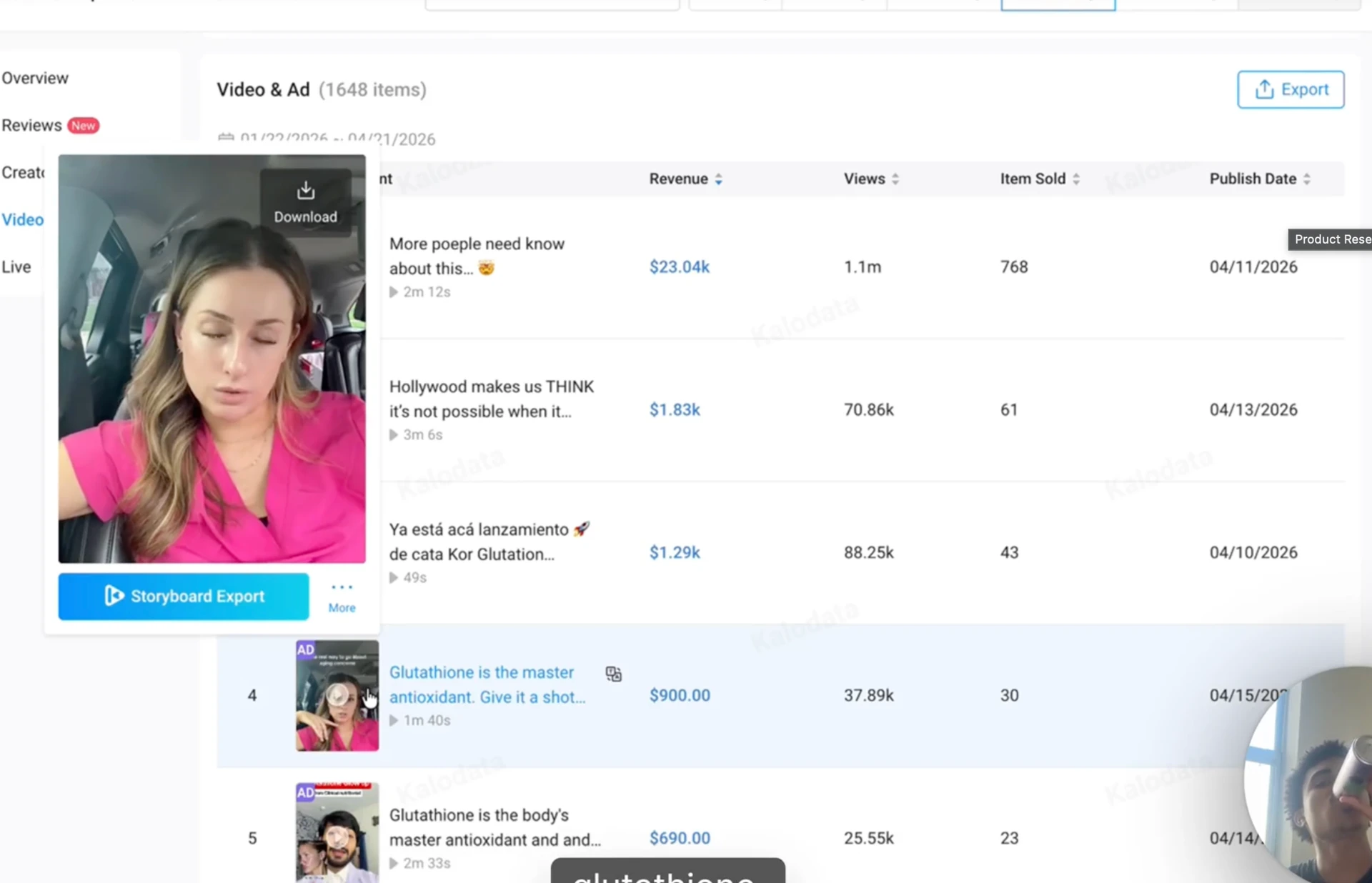
To make this concrete, here's the live decision I made on one product during a research session (Categor's Longevity AKG Biotin / Glutathione product, public).
The Kalodata stats:
- Last 30 days revenue: $186K
- Creator count: ~300
- Launched: ~1 week ago at the time
- Creator videos available: 1,600+
The creatives I evaluated:
- "Joe Rogan / Dr. Whoever" first-person podcast clip — authority-style, problem-aware (anti-aging, brain fog). Strong hook, clean format.
- "A lot of women don't know this, but your signs of aging could be significantly reduced..." — direct problem-aware hook, lists alternatives (NAD, NR, NMN, glutathione, NAC), positions glutathione as the missing master antioxidant.
- "Why is nobody talking about the hidden message they just uncovered in the biggest TV show of the entire year? I'll play the clip right here. I'm the world's greatest goddamn advertisement for the hottest new super..." — curiosity-gap pattern interrupt, attention-grabbing, unique.
- "Took glutathione for exhaustion and brain fog. Now your skin is glowing like you just got a facial." — first-person diary-style, multi-benefit hook
- "Your glutathione supplement might be a complete scam. As a pancreatic cancer researcher, let me explain..." — authority + adversarial hook, sets up category education
The verdict:
- 1,600 creatives to work with ✅
- All top-of-funnel problem-aware to solution-aware ✅
- Unique angles (Joe Rogan, anti-aging, scam-warning, pancreatic researcher) ✅
- High emotional pain (anti-aging is one of the biggest in DTC) ✅
- Authority figures present in creatives (instant trust transfer) ✅
- Recently launched = early entry advantage ✅
Decision: banger product, source it immediately, scale fast. Multiple creative angles to test in parallel. The category education in the creatives does the awareness-building for you.
This is the kind of product you want to find. Not every research session ends here — most don't. But when you find one, move fast.
What to avoid (the pass criteria)
Same framework, opposite direction. Skip products with these signals:
Avoid: dominant retail brands
Rosabella, Goli, established CPG brands with retail presence. They have legal teams. They have IP. They'll DMCA you. They'll sue. Not worth the headache for marginal upside.
Avoid: unique unreproducible mechanisms
Root Labs' micro-bead gummies are a good example. The mechanism itself is the selling point ("only micro-bead gummy in the world, designed to absorb"). Your supplier can't produce that. If you rip the marketing without the mechanism, chargebacks flood in because the product doesn't actually deliver what the ads promised.
Avoid: bundles
A product that's a 3-pack or 2-bottle bundle is harder to rip profitably. You have to source and sell multiple SKUs, and the margins compress. Stick to single-SKU offers when you're learning to rip. Bundles come later when you've validated a single-product winner.
Avoid: aggressive intimate-anatomy products
PH balance products, intimate health products, anything that drops your customer into a very sensitive trust window. High refund risk + high customer support load. These can work, but they're not the entry-level rip.
Avoid: protein powders and real foods
Protein powders are commodity. Margins are tight. Quality variance from rip-tier suppliers is brutal (taste, texture, mixability are all noticeable). Powdered nutrients fail more often than capsules at the rip-tier supplier level. Real foods (meal replacements, snacks) have the same problem amplified.
Avoid: high live-revenue products
If 80%+ of the product's revenue on Kalodata comes from TikTok Live streams, it's a different game. Live products often don't translate to Meta because the conversion mechanic (live sales pressure, urgency, host trust) doesn't exist on a Facebook feed. Stick to video-revenue-heavy products that prove the creatives carry conversion on their own.
The eyeball test (fast version)
The deep analysis above is what you do when you find a candidate. The eyeball test is how you scan for candidates fast.
The workflow:
- Set your Kalodata filters
- Just scroll. Look at product images. Use your eyeballs, not your brain.
- When something catches your attention, click in
- Check the metrics: high video revenue ✅, low live revenue ✅, last 90 days trending up ✅
- Look at the top 3 product images. If they're strong, continue. If they're mid, pass and keep scrolling.
- Watch the top 3 creatives. If they hit the awareness-stage criteria above, deep dive. If not, pass.
Most products fail the eyeball test in 30 seconds. That's fine. You're scanning hundreds, looking for 1-2 to deep dive into. The eyeball test is what gets you through volume fast.
The decision arc: hundreds eyeballed → 5-10 deep-dived → 1-2 sourced and tested → 1 winner if you're lucky on the cycle.
Creator-based research (the alternative method)
Kalodata's product search is one entry point. The creator-based search is the underrated alternative.
Switch the filter from "products" to "creators." Set:
- Language: English (or your target)
- Category: Health
- Filter: independent creators (not Kardashians, not celebrities — you can't compete with their audience reach)
- Sort by: small-to-mid creators who make a lot of content
Now you're seeing what products winning creators are currently pushing. This surfaces products that haven't trended yet on Kalodata's main product search because they're newer or because the algorithm hasn't bubbled them up.
Example workflow: find a creator like "Phyllis the Pharmacist" or any niche creator with high creative output. Look at the last 10 products they've made videos for. Cross-reference with Kalodata's product data. The products they're pushing right now are often what's about to trend on Kalodata's main search 2-4 weeks from now.
You're effectively front-running the trend by watching the supply side (creator output) instead of the demand side (revenue rankings).
Kalodata as a data aggregator, not just product search
The biggest unlock with Kalodata: it's a creative source as much as a product source.
What I actually use Kalodata for beyond product research:
- Specific brands worth tracking. Find a brand making bangers (Categor, Micro Ingredients, etc.). Click their profile. See every product they sell, every creative they run, every angle they're testing. You're not just researching one product — you're studying their entire portfolio strategy.
- Creator output libraries. A creator with 50 videos for the same product gives you 50 ad angle ideas. Even if you don't rip that exact product, you steal the angle and apply it to your own.
- Trend detection. Brands constantly popping up across multiple searches = something's brewing in that category. Worth deeper investigation.
- New product launches. Look at established brands' "Last 7 Days" or "Newly Added" filters to find their newest SKUs. Often the freshest angles.
Brandon-rule: Kalodata is a data layer. The creative analysis is yours. The filters get you to a shortlist of candidates. The actual judgment — which product to rip, which angles work, how to apply them to your brand — is the human work.
What's actually driving sales (the reframe)
The product itself is half the decision. The creatives are the other half — actually the more important half.
The trap most ripping operators fall into: they obsess over finding the "perfect product" and skip the creative analysis. The product is the cargo. The creatives are the engine. A mediocre product with bangers behind it scales harder than a great product with mid creatives.
What you're actually ripping when you rip a product:
- The supply chain (the agent makes the same product)
- The product page foundations (the images, the offer, the price)
- The proven creative angles ← the biggest lever
- The awareness stage entry points
- The market signal that there's demand
Once you have all 5, you layer your own work on top:
- Custom UGC creators (Module 1) making your version of the winning angles
- AI UGC video (Module 3 → Videos) for shot variations the original brand doesn't have
- Native ads (Module 3 → Native) for the longer-form storytelling layer
- Catalyst ads (Module 3 → Catalyst) for the editorial-feel top of funnel
- Advertorials (Module 3 → Advertorials) for the deep-funnel conversion layer
The ripped foundation gets you to launch faster. Your custom layer is what gets you to scale.
What's gatekept inside the masterclass
The principles are here. The artifacts live in the masterclass:
- Full drop shipping agent / supplier directory — WhatsApp contacts for the agents I personally use, plus the factory connections for when you scale beyond agents
- Chargeback prevention setup walkthrough — Disputeify, Chargeblast, Chargeflow with the exact configurations
- Packaging rebrand templates — the "new packaging / improved formula" image overlay template, the 5-10% iteration design framework, recommended designers for fast turnaround
- The Kalodata filter presets I run across different verticals (health, beauty, home)
- Sample request scripts — exactly what to message your agent to get a sample shipped before committing to MOQ
- Bundle / upsell architecture — how to structure the offer once you've validated the ripped product
Want the full supplier directory, the chargeback prevention setup, the rebrand templates, and the Kalodata filter presets? All inside the RunItUp Masterclass → Join here
Join now to lock in your rate, prices are increasing quickly.