The custom brand mindset shift
Module 6 was about ripping — finding products that already work and routing them through a 5-10% rebranded supply chain. Fast cash, decent LTV if you scale to brand mode, but always inherently bridged to someone else's creative work.
Module 7 is the opposite play. You're building a custom brand from scratch — your own creative, your own packaging from day one, your own positioning, your own LTV asset. The product research methodology is fundamentally different.
The mental model in one sentence:
Find a competitor with proof of concept but a skill issue. Build on top of what they've validated. Run laps around them with real execution.
You're not looking for products. You're looking for operators who are leaving money on the table because they don't have the direct response skill, creative volume, or execution discipline you do. Their work becomes your foundation. Your work becomes the upgrade.
This sub-page is the full methodology for finding those operators on BrandSearch specifically for building a custom brand around a validated product opportunity.
The target competitor profile
The window you're hunting in:
| Revenue band | What to do |
|---|---|
| Under $400/day | Skip — not enough proof of concept, could just be a bad product |
| $400-$1,200/day | The sweet spot. They've validated an angle but can't execute past their current ceiling. You target these. |
| $1,200-$2,500/day | Possible target if execution is clearly weak. Most have at least one real winning ad you'd have to beat |
| $2,500-$4,000/day | Probably has one genuinely good winner. Harder to compete unless their execution gap is huge |
| $4,000-$10,000/day | Maybe couple winner driving the whole thing. Worth analyzing but risky to compete head-on |
| Above $10,000/day | Starting to become real operators, real winners. Skip — go find someone less capable in the same niche |
The sweet spot is $400-$1,200/day. At this level, the brand has:
- Validated an offer that converts
- Identified an angle that works
- Tested at least one ad that's getting spend
- Set up a basic funnel architecture
- Hit the ceiling of their own skill
They can't break past their current revenue because their creative is mid, their copy is generic, their images are AI slop, or their direct response intent is weak. That ceiling is your entry point.
The critical filter — no rippers
This is the most important rule for Module 7 specifically:
Don't compete with brands that are ripping. Compete with brands building custom.
Why: when you're going custom, you have to make your own creative. That's the whole point. A competitor who's ripping has a structural advantage you can't easily match — they can pull 500 creatives off Kalodata, iterate on whichever one is performing, and outscale you on volume alone. It's a volume game they're already winning.
A competitor who's building custom is playing the same game you're playing. Their ceiling is their skill, not their content library size. That's a fair fight, and one where execution wins.
How to spot a custom-brand competitor (not a ripper)
The tells:
- Native ads in the ad library — clear sign they're producing original content, not ripping TikTok videos
- Pre-landers / advertorials / listicles — operators who use these are doubling down on a validated angle, which is the custom-brand mindset
- Custom-looking product pages (even if execution is mid) — signs they put their own thought into the funnel
- Branded packaging in their imagery, not generic Kalodata-style product photography
- Multiple ad angles that look similar in style — they're testing within their own creative process, not pulling from an external library
If a competitor's ad library is full of obvious TikTok B-roll downloads, raw UGC dumps, or 30+ variations of the same Kalodata creative — they're ripping. Skip. Find someone else.
The BrandSearch filter setup
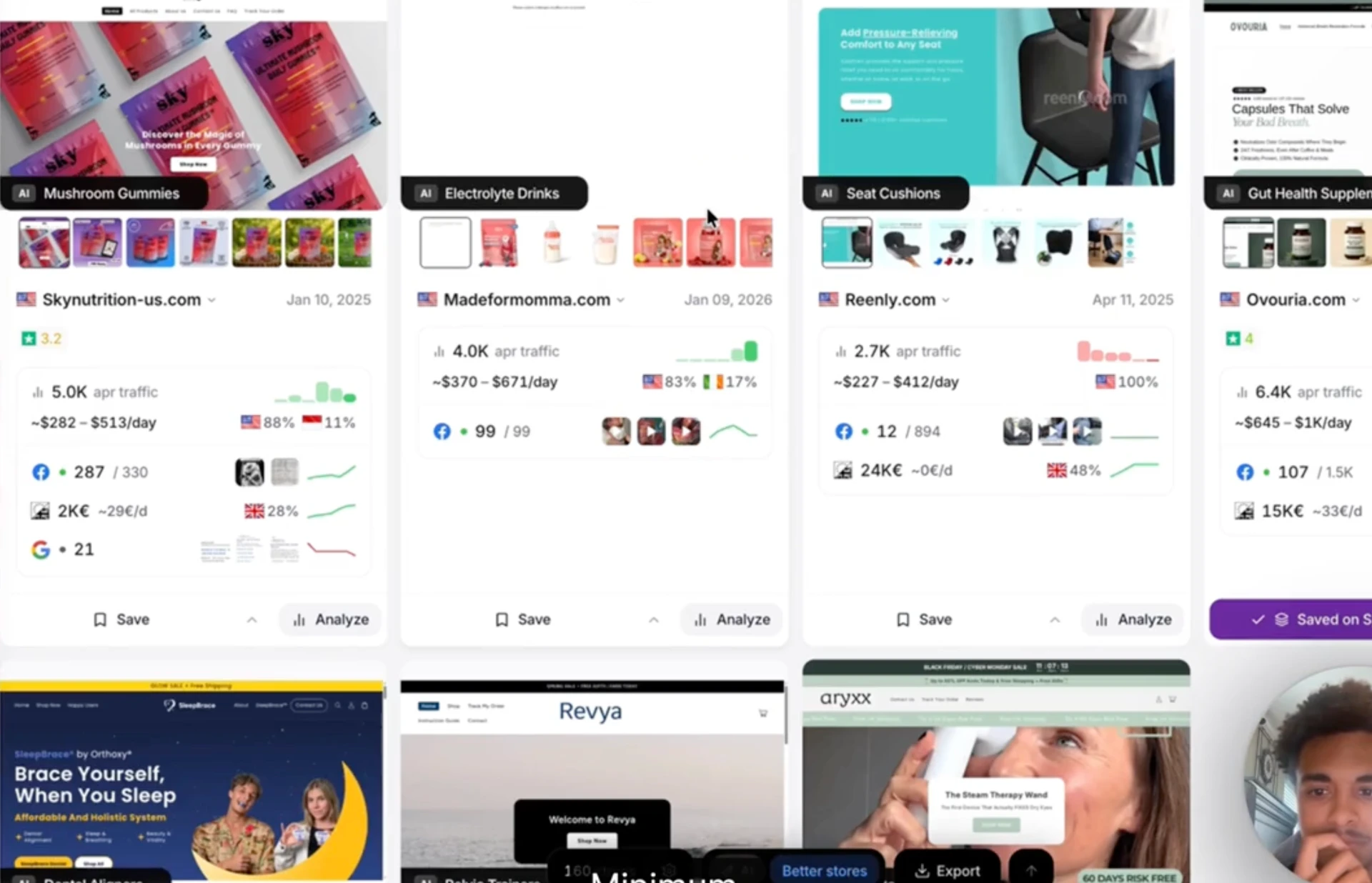
BrandSearch is the tool. ($20 off with code DIALED — https://brandsearch.co?ref=runitup-course — affiliate link.)
For custom brand competitor research specifically, these are the filters I run:
| Filter | Value | Why |
|---|---|---|
| Revenue range | $350-$1,200/day max | The sweet spot for skill-issue competitors |
| Theme filter | Shrine, Elixir, GemPages (or "Drop Shipping" themed Shopify stores) | These themes signal a custom-brand stack, not a generic Shopify-default ripper site |
| Store age | Ideally 3+ months | Long enough to have iterated, recent enough to still be missing skill upgrades |
| Sessions trending up | Trend signal | They're scaling, but not breaking through |
The theme filter is underrated. Shrine, Elixir, and GemPages themes are what custom-brand operators use when they're trying to build a real brand presence. Generic Shopify themes (Dawn, Refresh) usually signal either rippers or absolute beginners. Filter accordingly.
What you're actually looking for
Same three core criteria as Module 6 but applied differently:
1. Large TAM (Total Addressable Market)
A brand targeting "women over 40 with dry eye" has TAM. A brand targeting "left-handed kayakers with carpal tunnel" doesn't. Same rule, no shortcuts.
2. Emotional pain point
Anti-aging, blood pressure, sleep, gut health, chronic pain, autism support, fertility — these all have deep emotional pain. Brands targeting deep pain have built-in conversion potential that mediocre execution can't fully kill. That's why you can outscale them.
3. Proof-of-concept ad architecture
This is the new filter for Module 7. The competitor must already have:
- A specific angle they've doubled down on (e.g., "dry eye over 40" or "post-LASIK nightmare")
- A funnel structure live (pre-lander → product page, not just product page direct)
- Multiple ad variations tested (10+ active ads ideally)
- A specific avatar identified (their copy is targeting someone in particular)
If a competitor's hitting $1k/day with a clear angle + funnel structure + multiple tested ads, they've done the qualitative work for you. All that's left is execution.
The "skill issue" pattern — spotting your entry
This is the most valuable lens from this whole methodology. The visual + copy tells that scream "this operator is leaving money on the table":
Image tells
- Obvious ChatGPT-generated images — the over-saturated, slightly-warped, generic-stock-photo aesthetic
- AI-generated "doctor" portraits that look like every other AI doctor portrait (always smiling, always white coat, always slightly off)
- Inconsistent image quality in the same funnel — real photo here, AI image there, blurry stock photo somewhere else
- ChatGPT header artifacts still visible (you'd be amazed how often this happens — operators paste the ChatGPT output and don't strip the header)
- Watermarks left on stock images they didn't bother to license
- Poor cropping / formatting — images that look like they were resized once and never optimized
Copy tells
- Generic AI doctor names — "Dr. Sarah Mitchell," "Dr. James Morrison," "Dr. Emily Watson." All ChatGPT default outputs. Real direct response operators use actual names that feel authentic to a region or niche
- Vague benefit copy with no specific mechanism — "powerful blend of natural ingredients" instead of "12mg of clinically-studied curcumin"
- Listicle templates with the exact ChatGPT structure — "Reason 1, Reason 2, Reason 3..." with no real insight
- Generic "shocking discovery" hooks without follow-through specificity
- Copy that reads as if written by AI — no rhythm, no personality, no human voice
Funnel tells
- Buy-one-get-one-free as the only offer — operator doesn't understand offer architecture beyond discount stacking
- Generic Shopify checkout — no Slide Cart, no upsells configured, no smart cross-sells
- Single Facebook page running all ads — no whitelist pages, no demographic-matched profiles
- Identical primary text across all ad variations — no A/B testing on copy
- Pre-landers that look templated — clearly used the same Shrine/Elixir template without customization
When you find a competitor hitting 3+ of these tells while still doing $400-$1,200/day in revenue, you've found your target. Their numbers are despite the skill issue, not because of it. Execute properly on top of what they've validated and you can multiply the result.
Worked examples — the patterns in the wild
To make this concrete, here are competitor archetypes I've identified while doing real research sessions on BrandSearch.
Example 1 — Dry eye supplement brand
- Store age: 11 months
- Revenue: ~$500/day
- Niche: Dry eye supplements for adults 40+, sub-niche for post-LASIK
- The angle they've validated: "Your eyes are watering BECAUSE they're actually too dry" — strong reframe hook
- The funnel: Pre-lander → advertorial → product page
- The skill issues:
- Generic AI doctor portrait ("Dr. Sarah Mitchell, leading UK dry eye researcher")
- Obvious ChatGPT-generated images throughout the advertorial
- ChatGPT header still visible on the advertorial
- Generic AI-style copy throughout
- Buy-one-get-one-free as the only offer
The opportunity: the angle is real. The reframe hook is genuinely strong. The funnel architecture is correct. Everything underneath the skill execution is solid. A custom brand operator who replicates the angle, swaps the AI images for real assets (or higher-quality AI), rewrites the copy with actual direct response craft, and adds proper offer architecture could 3-5x this brand's daily revenue inside 90 days.
Example 2 — Cocoa flavanol / circulation brand
- Store age: 6 months
- Revenue: ~$360/day
- Niche: Anti-aging / cardiovascular health via cocoa flavanols
- The angle they've validated: "Cocoa flavanols stimulate stem cells, melts artery plaque, lowers blood pressure" — strong mechanism-based positioning
- The funnel: Catalyst-style top of funnel → pre-lander → product page
- The skill issues:
- "Shocking Discovery" Chat GPT-style headlines
- Generic "Harvard scientist" framing without specific research citations
- AI-generated product photography
- Inconsistent design quality across the advertorial
The opportunity: the mechanism positioning (stem cells + flavanols + circulation) is gold. Emotional pain points (artery health, blood pressure, aging) are deep. The competitor is testing 16+ ads against this angle — they've identified what's working. Cross-reference Module 3 → Catalyst for how to build a properly executed Catalyst funnel on top of this validated mechanism.
Example 3 — Liver detox brand
- Store age: ~8 months
- Revenue: ~$400-1,000/day estimated
- Niche: Liver support / detox
- The angle they've validated: "European pharmaceutical grade liver protection" + 7-day recovery story
- The funnel: Native + static → product page with buy-one-get-one-free
- The skill issues:
- AI-generated images (Elixir-style)
- Generic AI copy in the video ads ("powerful compounds go to work after your very first dose...")
- Same primary text across all ad variations
- Buy-one-get-one-free as the only offer architecture
The opportunity: "European pharmaceutical grade" is a genuinely strong positioning angle (it ties to the perceived-value framework — cross-reference Module 5 → Customer Research on the pricing/perceived value lesson). The 7-day recovery story is a workable narrative structure. A custom brand operator could take this same positioning, build proper UGC and AI UGC video content, layer in real authority signals (clinical studies, named formulators), and add upsell/subscription architecture to multiply this competitor's results.
The competing playbook
Once you've identified a target competitor, the playbook for outscaling them:
1. Steal their validated angle, improve the execution
The angle is the asset. They've validated that "dry eye over 40" or "European pharmaceutical grade" or "cocoa flavanols + stem cells" converts. Don't change the angle. Take it, build on it.
Where to add skill:
- Real images instead of generic AI slop (or higher-quality AI with consistent brand aesthetic)
- Real copy with direct response craft — proper hooks, mechanism specificity, emotional pacing, social proof integration (cross-reference Module 3 → Advertorials for the structure)
- Real authority signals — actual citations, real formulator credentials, real clinical study references (or properly-positioned claims you can defend)
- Proper headlines that aren't AI-default
2. Steal their funnel architecture, improve the offer
If they're running pre-lander → advertorial → product page, keep that structure. Improve the offer at the end:
- Bundle architecture beyond buy-one-get-one-free (3-pack with subscription, bundle + ebook, tiered offer)
- Slide cart with smart upsells (cross-reference Module 8 → Shopify Apps & Setup once it ships)
- Subscription opt-in with real LTV justification
- Email opt-in with welcome flow that captures and converts later
3. Reframe the format
A long-form static advertorial they're running can become:
- A native ad (cross-reference Module 3 → Native sub-page)
- A claymation-style AI video (cross-reference Module 3 → Videos sub-page for the Penrose claymation example)
- A Catalyst format (cross-reference Module 3 → Catalyst sub-page)
- A first-person diary advertorial (cross-reference Module 3 → Advertorials sub-page)
Same validated angle. Different creative format. This unlocks a whole new audience subset that the competitor hasn't reached yet because they were stuck in one creative mode.
4. Steal their B-roll
If the competitor has UGC creators making content for them, that B-roll is publicly visible on Meta's ad library or their Instagram. You can study the angles, the framing, the lighting they're using, and replicate the format with your own creators (cross-reference Module 1 → UGC Creators for your own creator pipeline).
You're not stealing their literal footage. You're stealing their creative direction. Their UGC creators did the framing work for them. Your creators can replicate the framing and apply it to your product.
The supplement bias — why custom brands work best here
Brandon-rule on which product types are worth building custom around:
Supplements > everything else. The reason: subscriptions and LTV.
A supplement customer who likes the product subscribes. A subscription customer has 3-12+ month LTV on autopilot. The LTV is what justifies the higher CAC required to compete with established brands. Without subscription LTV, custom brand math gets brutal.
Non-supplement custom brands can work (apparel, beauty, home goods) but the LTV math is harder. Most operators reading this should be building custom around supplements specifically unless they have a specific reason to be in another category.
For non-supplement custom plays:
- Apparel — need viral hit + retention community to make LTV math work
- Beauty — repeat-purchase mechanics if the product is consumable (skincare yes, makeup harder)
- Home goods — single-purchase products kill the math unless you have multi-product expansion path
Supplements are the cheat code. Everyone else has to engineer LTV. Supplements have it baked into the category.
Gray hat signals — pay attention, don't replicate
While doing this research you'll encounter operators using gray-to-black-hat tactics that explain why their revenue looks better than their execution justifies. Pay attention. Don't replicate. Understanding these tactics helps you correctly interpret what you're seeing.
The VIP Club rebill trick
Pattern: an operator selling a product that customers only buy once (like a single book, a single ear product, a single one-time-use item) somehow shows recurring subscription revenue.
The mechanism: they've added a "VIP Collection" upsell that auto-rebills monthly. The justification on the offer is "by joining you get access to more products on the store via subscription." In reality, most customers don't realize they're being rebilled, and the operator generates LTV that the product alone doesn't justify.
Why I flag it: if you see a brand doing better revenue than their product economics justify, look for this pattern. It's becoming more common. It's also a chargeback bomb at scale and a serious liability when consumer protection complaints stack up. Don't replicate it. Understand it exists so you correctly interpret competitor data.
The "ebook auto-add"
Pattern: when you add a product to cart, an ebook automatically gets added at $9.99 without explicit consent. Most customers don't notice and complete checkout.
Same mechanism, same legality issues. Same advice: understand it, don't do it.
The fake urgency stack
Pattern: countdown timers + "X people viewing this product right now" + "Y units left in stock" + spinning wheel discounts. Some of these are fine in moderation. All of them stacked together = customer trust destroyed at scale, refund rate spikes, and eventually payment processor problems.
Module 6 vs Module 7 — the differentiation
To be crystal clear on which methodology fits which goal:
| Module 6 (Ripping) | Module 7 (Custom Brand) |
|---|---|
| Fast cash, faster validation | Slower cash, bigger long-term asset |
| Find a winning product on Kalodata | Find a struggling competitor on BrandSearch |
| Source same product from agents | Source custom product with your own formulation |
| Rip the existing creatives | Build all custom creatives |
| 5-10% rebrand at $1k/day baseline | Custom packaging from day one |
| DMCA risk is real | DMCA risk is zero (it's your own brand) |
| LTV mostly comes after rebrand transition | LTV built into the structure from launch |
| Best for: cash flow, first wins, portfolio operators | Best for: long-term brand asset, MRR build, exit potential |
Both paths work. Most operators should run Module 6 first to generate the cash that funds Module 7. Cross-reference Module 6 → Winning Product Next Steps for the bridge from "ripped product I rebranded" to "custom brand I built from zero."
What's gatekept inside the masterclass
The principles are here. The walkthrough lives in the masterclass:
- The full 34-minute video walkthrough of me running custom-brand competitor research on BrandSearch live — exact filter setup, real competitor profiles, the skill-issue pattern called out in real time on actual stores
- The BrandSearch filter presets I run for custom brand research specifically (different from the PnD filter presets in Module 6 → Pump n Dumps)
- Real competitor breakdowns — me walking through 5+ live competitor stores, identifying their skill issues, mapping out the competing playbook for each
Want the full 34-minute video walkthrough, the BrandSearch filter presets, and the live competitor breakdowns? All inside the RunItUp Masterclass → Join here
Join now to lock in your rate, prices are increasing quickly.